Get Full Government Meeting Transcripts, Videos, & Alerts Forever!
Get email alerts on the Water Resources topic
No spam. Unsubscribe anytime.
Prairie Lands Groundwater District presents 2024 report; Ellis County used roughly three‑billion gallons, district urges conservation steps
Summary
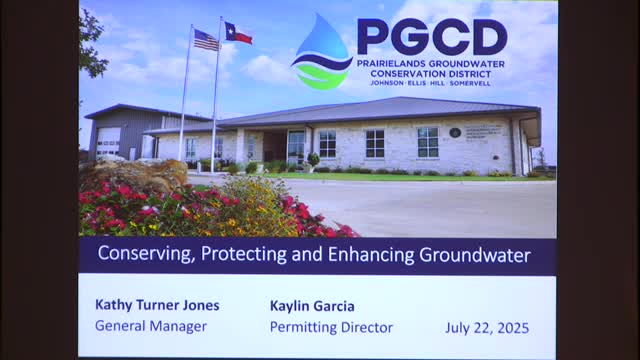
Prairie Lands Groundwater Conservation District delivered its 2024 annual report to the Ellis County Commissioners Court, highlighting registered wells, permitted allocations, a new five‑year management plan, water‑loss audits and a new rainwater harvesting rebate program.
The Prairie Lands Groundwater Conservation District presented its 2024 annual report to the Ellis County Commissioners Court, reporting registered wells, permitted allocations and emerging steps to reduce losses and encourage rainwater harvesting.
Kathy Turner Jones, general manager of Prairie Lands GCD, introduced the report and recognized a new board appointment. Kaylynn (Caitlin) Garcia, the district permitting director, delivered the presentation and outlined the district's 2024 findings and 2025 year‑to‑date trends.
Key figures presented: the district reported 318 registered wells across its four‑county area and said 193 new registrations came in during the most recent year. The district reported that roughly 10% of its registered wells are in Ellis County. Ellis County accounted for about 3.1 billion gallons of reported groundwater production in 2024, the presenters said, representing approximately 74% of the county's permitted allocation of about 4.2 billion gallons. Across the four‑county district the total permitted allocation sits at about 9.7 billion gallons.
Garcia said domestic and public water supply uses account for the largest portions of registered wells in Ellis County, with the county listing about 149 domestic well registrations and roughly 62 public water supply wells. She also noted industrial manufacturing users — including large permittees in the county — are among the largest permitted consumers and that a small number of high‑capacity wells account for a large share of withdrawals.
The district highlighted several programmatic developments: adoption of a new five‑year management plan (effective 2024–2029); completion of a regional groundwater availability model for planning scenarios; implementation of water‑loss audits for public water suppliers; and a new rainwater harvesting rebate program that provides a one‑time payment of $1 per gallon of storage up to 500 gallons. The district said it is exploring larger public or institutional demonstration projects as part of the rebate program.
Commissioners asked about deeper drilling, brackish resources and notice of proposed injection or other deep projects. Garcia said deeper drilling and brackish water projects are possible but more costly and that the district monitors filings at the Railroad Commission and the Texas Commission on Environmental Quality; the district also uses a paid monitoring service to check for relevant filings affecting the four counties. The court and district staff discussed the need for timely notice and the district said it will continue to refine monitoring and outreach to local realtors and property buyers to reduce surprises about groundwater eligibility for new owners.
The presentation was informational; there was no court action required or taken.