Get Full Government Meeting Transcripts, Videos, & Alerts Forever!
Get email alerts on the School Policy Hate Symbols And Clubs topic
No spam. Unsubscribe anytime.
Forest Lake board keeps ban on Confederate flag, KKK and swastika; allows student-led after‑school clubs for grades 8–12 after packed public comment
Summary
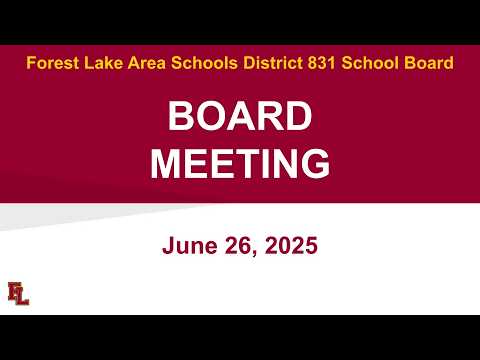
Forest Lake — The Forest Lake Area School Board spent much of its June 26 meeting responding to overflowing public comment and then voted to adopt a revised “limited open forum” policy allowing student‑led after‑school groups at the high school, at the community school and for eighth graders at the middle school, while referring a proposed change to the dress code to the policy committee for further review.
Forest Lake — The Forest Lake Area School Board spent much of its June 26 meeting responding to overflowing public comment and then voted to adopt a revised “limited open forum” policy allowing student‑led after‑school groups at the high school, at the community school and for eighth graders at the middle school, while also referring a separate proposed change to the district dress‑code policy to the policy committee for further review.
Why it matters: Hundreds of community members, teachers, students and elected officials packed the board room and used the meeting’s green‑card public‑comment process to press the board to retain clear, specific prohibitions on symbols associated with racial and religious terror. Speakers said they feared that removing explicit references to the Confederate battle flag, KKK insignia and Nazi swastika would signal permission for displays of hate and would make some students unsafe.
Public comment and themes
More than two dozen speakers addressed the board on policies 05‑15 (discipline/dress code) and 18‑01 (limited open forum). Many commenters urged the board to keep explicit language in the dress code banning specific symbols. Jenny R., who identified herself as a Forest Lake parent, told the board, “There is no room for hate in this community,” and asked board members to “leave your personal religious ideology or racist, transphobic, homophobic, etcetera views at the door.”
Longtime residents and educators recounted the district’s history. Lynn Dufresne, who said she worked for the district “for over 30 years,” told the board she remembered news coverage from the civil‑rights era and said the “Confederate battle flag…was a symbol of white supremacy.” Several former district employees and parents — including former superintendent Linda Madsen — urged keeping the wording that explicitly lists the Confederate flag, swastikas and KKK imagery as prohibited.
Students also spoke. Nicholas Fox, a 10th‑grade student, said removing protections made him feel less safe as a trans man: “Feeling not safe in my own community as a trans man hurts me… It makes suicide rates go up,” he said. Principal and supporters, clergy and business owners described community and economic risks if the district were perceived as tolerating hate symbols.
Board action and what changed
- Limited open forum (policy 18‑01): The board first voted and the measure failed on a roll call (3 in favor, 4 opposed). After further discussion and a motion to reconsider, the board approved an amended version of policy 18‑01 that requires groups to be student‑initiated and allows limited open‑forum groups at: the high school, the community school, and eighth grade at the middle school. Final recorded roll call on adoption (after reconsideration): Member Antonson — Aye; Member Corcoran — Aye; Member Christensen — Aye; Member Haglund — No; Member Tyson — Aye; Member Castle — Aye; Member Rebelein — Aye. Tally: 6 yes, 1 no. The policy change will permit student‑led, non‑curriculum groups to meet as limited open‑forum activities in those grades/buildings; administration will implement procedures and oversee compliance.
- Dress‑code discipline policy (05‑15): Board members debated replacing the district’s existing language with the Minnesota School Boards Association (MSBA) model wording. Several speakers, the superintendent and others argued the district’s history (an assault and subsequent displays in the late 1990s) justified keeping explicit bans in local policy. The board did not adopt an immediate large change; instead the board voted to commit (send) the draft back to the policy committee for additional work and to report back. The motion to commit passed.
- Multicultural/gender/disability policy (05‑29): After initial procedural confusion and a motion to rescind that failed, the board ultimately adopted the recommended revisions to policy 05‑29 in the meeting’s later votes (unanimous recorded approval on the final motion to adopt).
What the new limited open‑forum policy means, in practice
The adopted version of 18‑01 keeps the requirement that student groups be initiated by students rather than imposed by outside entities and removes mandatory annual re‑establishment of each group (the board amended that language during debate). Administration will write implementing procedures that define how students register groups, how meeting spaces are assigned and how school staff will monitor safety and compliance; the board asked administration to return with further guidance on logistics (for example, how eighth graders will be supported if they participate in groups).
Voices at the meeting
- Jenny R., resident and parent: “There is no room for hate in this community.” - Lynn Dufresne, former Forest Lake School District employee: “They carried the Confederate battle flag. They carried that flag because it was a symbol of white supremacy.” - Nicholas Fox, 10th‑grade student: “Feeling not safe in my own community as a trans man hurts me… it makes suicide rates go up.” - Linda Madsen, former Forest Lake superintendent: “What is best for our students and our community is to keep [the prohibitions] clearly stated in the policy.” - Pastor John Clowater, Faith Lutheran: warned of rising antisemitic incidents and urged continued explicit prohibitions.
Votes at a glance (formal actions recorded at the meeting)
- Policy 18‑01 (limited open forum): Adopted as amended to allow student‑initiated limited open‑forum groups at the high school, community school and for eighth graders at the middle school; final roll call 6–1 (yes: Antonson, Corcoran, Christensen, Tyson, Castle, Rebelein; no: Haglund). Legal threshold (simple majority) met: yes.
- Policy 05‑15 (discipline/dress code): Motion to commit to policy committee for further work and return with recommendations — motion passed (committee review requested; no immediate policy adoption). Notes: committee to consider whether to retain explicit list of forbidden symbols or adopt more general MSBA model language.
- Policy 05‑29 (multicultural/gender/disability sensitivity): Adopted as presented after procedural motions (final adoption recorded by roll call on the motion to approve).
- Other formal actions at the meeting included approving donations, approving general employment benefits terms for classified staff (07/01/2024–06/30/2026), and approving consent agenda items; those measures passed by roll call or voice votes recorded in the minutes.
Context and next steps
The debate followed months of public comment, petitions and media coverage. Board members and administration repeatedly invoked the Minnesota School Boards Association model policy, the federal Equal Access Act and the U.S. Supreme Court’s Tinker standard as legal context for limiting or permitting speech and symbols in schools. Superintendent Steve Massey and legal counsel emphasized that districts may restrict displays that can be reasonably forecast to cause a material and substantial disruption.
The board asked administration to return with implementation details for the limited‑open‑forum policy (registration steps, supervision/monitoring, and logistics for eighth‑grade participation) and the policy committee will take up the dress‑code language the board asked it to reexamine. The board’s next regular meeting is scheduled for July 17, 2025.
Ending
Board members said they hoped the meeting’s extended public comment and the policy discussions would lead to clearer procedures and better community communication. Several speakers left the meeting asking the board to prioritize student safety and inclusion as administrators write the implementing rules.