Get Full Government Meeting Transcripts, Videos, & Alerts Forever!
Get email alerts on the Building And Permitting topic
No spam. Unsubscribe anytime.
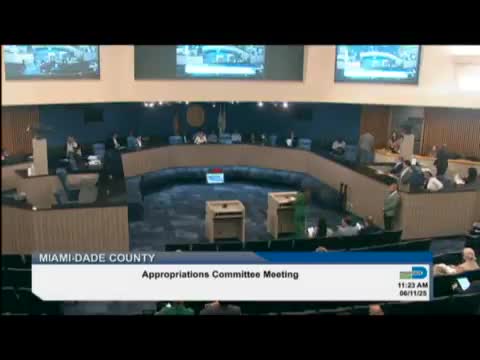
Appropriations Committee advances proposed permit fee increases for RER, sends item to BCC without recommendation
Summary
Miami-Dade’s Regulatory and Economic Resources (RER) department asked the committee to approve a schedule of higher permitting fees to align with state law changes and keep the department solvent; committee forwarded the item to the Board of County Commissioners (BCC) without a recommendation after debate on homeowner impact and fee structure.
Miami-Dade County’s Appropriations Committee on Thursday forwarded to the full Board of County Commissioners a proposal from the Regulatory and Economic Resources (RER) department to adjust permitting and trade fees, citing recent changes in state law and long-outdated local rates.
The county presented the proposal as necessary to keep RER — which the presenters said operates largely as an enterprise fund — competitive with municipal peers and able to sustain digitization, timely plan review and inspections. RER Director Lourdes Gomez said many RER fees have not been raised in “7 to 17 years” and that state law narrowed how permitting fees can be adjusted, prompting the request now.
Gomez told commissioners the department reviewed comparable rates across Miami-Dade municipalities and that, even with the proposed increases, the county would remain “at or below our peers.” She emphasized a “very generous list of permit exemptions” for homeowners on RER’s website and repeated that RER offers free, personalized assistance to homeowners navigating permitting. “Your permit fee includes not only plan review and resubmittal as needed, but inspection and reinspection,” Gomez said.
Deputy Building Official Sergio Asuncuense described the department’s 2023 code updates and exemptions for small repairs, giving examples: a kitchen-cabinet replacement needs no permit, and small roof repairs under $2,000 are exempt. He said the proposal also simplifies some trade fees — for instance, a window-replacement permit will be a single flat $147 fee under the new schedule rather than a fee that scaled by square footage.
Industry speakers and developers expressed support. Truly Burton, executive vice president of the Builders Association of South Florida, told the committee the building trades face sharp cost volatility — citing recent steel and concrete price jumps — and urged the county to ensure permitting timeliness and predictable fees to allow projects to proceed.
Several commissioners raised concern that even modest increases could trickle down to homeowners. Commissioner Steve Steinberg (first reference in the transcript) said he would not vote to raise fees on homeowners and urged staff to explore ways to place a greater share of any increase on commercial developers. Commissioners and staff discussed alternatives including a tiered approach (flat-fee option versus a percentage-based fee tied to job cost) or charging for the free homeowner assistance program rather than increasing permit fees for homeowners.
After extended discussion, a commissioner moved to forward the item to the full BCC “without a recommendation.” The committee approved that motion by voice vote.
The committee record shows RER committed to working with commissioners’ offices on potential adjustments before the BCC hearing, including providing a link and list of permit exemptions for homeowner outreach and meeting with commissioners who oppose homeowner fee increases to explore options.
The committee and RER repeatedly framed the proposal as aimed primarily at making the department self-sustaining and competitive with municipalities that have already raised fees and use fee revenue to staff plan review and inspections.
Next steps: the item will appear before the full Board of County Commissioners for final consideration; RER staff said they will meet with commissioners’ offices and stakeholders beforehand to refine fee structure and outreach materials.