Get Full Government Meeting Transcripts, Videos, & Alerts Forever!
Get email alerts on the Tax Increment Financing topic
No spam. Unsubscribe anytime.
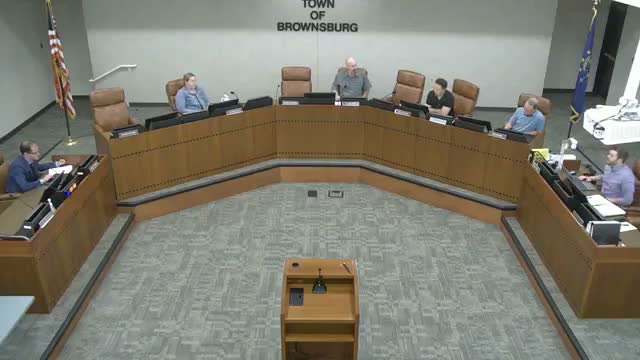
Brownsburg RDC hears annual presentation on tax increment financing, reviews projects and debt
Summary
At its June 5 meeting, the Brownsburg Redevelopment Commission heard the annual Indiana Code 36-7-25-8 presentation from LWG CPAs & Advisors explaining how TIF (tax increment financing) works, how the town uses TIF revenues, recent projects funded with TIF debt and how assessed value and bond structures affect revenues.
The Brownsburg Redevelopment Commission heard an annual presentation required by Indiana Code 36-7-25-8 on June 5 about tax increment financing, commonly called TIF, from staff and consultants at LWG CPAs & Advisors.
The presentation summarized TIF mechanics and how the Town of Brownsburg has used TIF to finance redevelopment, infrastructure and economic development incentives. Mister Pierce, a staff member, said TIF "is an economic development tool that helps municipalities fund infrastructure improvements, redevelopment projects, and other public investments within a specific TIF area." Bob Swins, of LWG CPAs & Advisors, described the statutory tests used when creating allocation areas and how bonds and assessed value interplay with allowable revenue.
Speakers emphasized the basic TIF structure: when an allocation area is established the current assessed value is set as the base assessed value. Property tax revenue on that base continues to be distributed to all taxing units, while increases in assessed value attributable to new development — the incremental assessed value — are captured for reinvestment in the allocation area. Presenters said newly created allocation areas now generally have a 25-year life after the first time debt is pledged, although legacy arrangements and previously issued debt can create longer timelines.
The presentation listed Brownsburg’s primary allocation areas and examples of recent projects financed with TIF: the North Beltway allocation area (created in 1994, expanded in 2006, 2010, 2012, 2014 and 2017) and the Wynne Farms allocation area (created February 2008, expanded in February 2015 and decreased in 2015 and February 2023). Mister Pierce said the town has also created smaller allocation areas within the North Beltway for discrete projects, such as the Arbuckle Commons expansions.
Examples of TIF-funded work cited by presenters included the town’s acquisition and site preparation of the former Archer and Raybould properties east of Town Hall; financing assistance for the Arbuckle Commons expansion (an addition the presentation described as roughly 100 apartments and about 3,600 square feet of retail); a pedestrian crossing installed on Green Street between Arbuckle and Union Green buildings; traffic-signal design work at South Green Street and Northfield Drive; and roadway, utilities and intersection projects tied to earlier bonds.
On revenue and debt, LWG and staff said the majority of Brownsburg’s TIF receipts are used for debt service on bonds issued for infrastructure and for economic development incentives. Bob Swins explained that bond purchasers vary: bonds may be sold on the public market through underwriters, privately placed with banks, or in some cases purchased by the developer or company benefitting from the project (a structure he described as effectively recycling TIF revenue back to the company).
Commissioners and attendees asked procedural questions. One commissioner asked how assessed value increases are tracked; staff and consultants confirmed the county assessor performs property assessments and the county auditor provides allocation-area accounting. Another question covered the intersection between tax abatements and TIF; presenters said the town will sometimes grant abatements in TIF areas for significant investments but generally will not give both a TIF incentive and a tax abatement for the same value stream ("we'll do one or the other"), because abatements reduce the tax base that would otherwise generate TIF revenue.
Presenters noted the town avoids capturing certain revenue (for example, the town does not capture personal property tax revenue in its TIF areas) and that the town has at times removed residential parcels from TIF areas to limit impacts to other taxing units; staff said 284 residential parcels were removed from Wynne Farms in February 2023 and that Wynne Farms collects only 50% of the increased tax revenue by design.
The presentation concluded with an overview of 2024 actual TIF collections and a projection methodology for 2025, emphasizing those projections assume standard collection and circuit-breaker limits. Staff said the commission budgets TIF revenues as part of the town budget process and uses the projections to evaluate projects for the coming year. The commission noted the presentation also serves to inform other taxing units and encouraged questions from county and taxing-unit representatives.
The commission did not take formal action on the presentation itself. Staff asked commissioners to remain briefly after the meeting to sign two resolutions and reminded members the next meeting is scheduled for July 1.