Get Full Government Meeting Transcripts, Videos, & Alerts Forever!
Get email alerts on the Land Use Trees topic
No spam. Unsubscribe anytime.
Council approves removal of three specimen trees at Trinity Park; denies removal of larger post oak
Summary
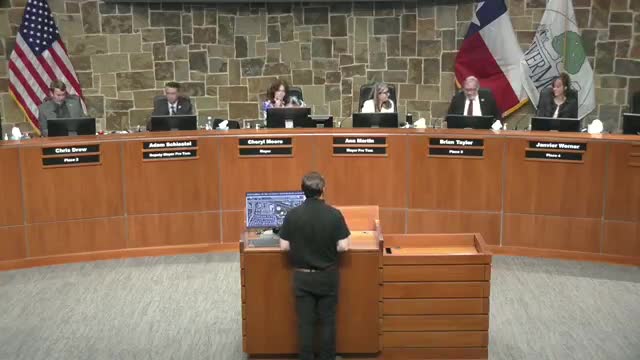
After public staff presentations and developer revisions to preserve additional trees, the council approved removal of three specified specimen trees but voted 4–1 to deny removing a large multi-trunk post oak that the original plan development had shown preserved.
The Town Council approved removal of three specimen trees on a 3.9-acre site proposed for campus-industrial redevelopment, and denied removal of a fourth, larger post oak.
Town planning staff said the developer revised the site plan after the April meeting to abandon a proposed cross-connection drive and to preserve additional trees in a designated preservation area; the changes saved roughly a dozen trees and preserved an additional 21.5-inch post oak that was close to specimen size. Staff reported three specimen trees remained requested for removal and recommended approval of those removals; council considered a separate request to remove a larger 39.5-inch multi-trunk post oak.
Cameron Dane, the applicant’s engineer with Claymore Engineering, described the efforts to revise grading and access and said the large post oak sits on higher ground relative to the planned building floor elevation. Dane said site topography, necessary truck-turn radii and fire-code access constrained options and that, after reworking the plan, the team could not find a feasible layout that preserved the larger tree without severely altering the development footprint.
One council member pushed back, noting that the property’s 2004 plan development had specifically shown environmental features and this group of trees had been marked and fenced. “They put a fence around it to say we’re not going to cut these trees down,” the council member said, urging the town to hold developers to commitments in their PD exhibits. The council discussion balanced the preservation of a canopy area and younger protected trees saved by the revised plan against the feasibility concerns for preserving the very large post oak.
The council voted 4–1 to approve removal of specimens 3827, 30930 (sic in record: 30930 interpreted as 309 or 305) and 3953? (note: see clarifying details for precise tree IDs) and to deny removal of the large 39.5-inch post oak (tree 3953). (Transcript roll call recorded Councilmember Taylor dissenting.) Staff and the applicant said the revised plan keeps a preservation zone with many smaller protected trees and that additional tree-protection measures will apply during construction.
Councilmembers asked staff to continue careful review of the preservation area and encouraged the developer to use the preservation zone and saved trees as a long-term canopy resource for the site.