Get Full Government Meeting Transcripts, Videos, & Alerts Forever!
Get email alerts on the Workforce Vacancies topic
No spam. Unsubscribe anytime.
City presents AB 2561 vacancy report; fire union warns of staffing shortfalls
Summary
Human Resources presented the city—s AB 2561-required vacancy report, showing a citywide 2024 vacancy rate of about 18%. Sacramento Area Firefighters Local 522 told council mandatory overtime and "brownouts" are widespread and urged steps including two academies and ambulance program expansion.
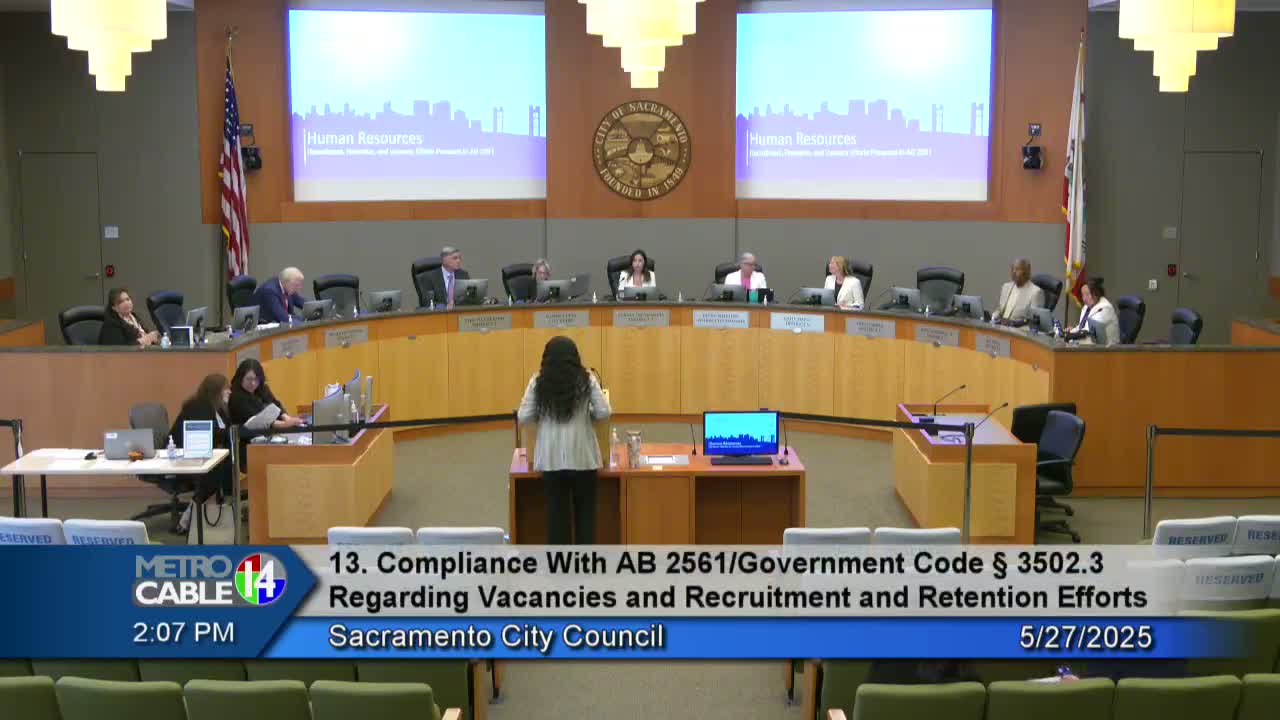
The Sacramento City Council received a public presentation on May 27, 2025, of the city—s 2024 staffing vacancy data under Assembly Bill 2561 and heard the Sacramento Area Firefighters Local 522 describe operational staffing shortfalls that have led to mandatory overtime and temporary company closures.
AB 2561 requires public agencies to report staffing vacancies, recruitment efforts and retention strategies before adopting their annual budget. Human Resources Manager Ebony Heaven presented citywide vacancy data and recruitment and retention efforts, and said the citywide vacancy rate for all positions in 2024 was 18%, with full-time represented positions at about 14% and much higher rates in part-time and noncareer roles. She described legal and operational reasons positions remain vacant, the city—s use of vacancy savings for one-time needs, and ongoing efforts to modernize hiring including a new NeoGov onboarding tool, blind-application screening, reduced barriers to qualification and expanded outreach to community partners.
Why it matters: Council members framed the report as a first step under AB 2561 to increase transparency before budget decisions. Council members asked for more granular analysis by department and cautioned against relying on single averages when staffing needs vary widely by function.
Details of the HR presentation
Ebony Heaven, human resources manager in the Employment Classification & Development Division, said the 2024 vacancy dataset used a Dec. 31, 2024 cutoff so the city could reconcile a full year of data. Among figures Heaven gave: the city processed 843 requisitions, posted 514 job announcements, received 41,895 applications and processed 2,587 hire/rehire/promotions/transfers for 2024. She said the city calculated a 2024 retention rate of 92% (using a Jan. 1, 2024 cohort of 3,873 full-time employees) and reported a retention rate of 98% for the period beginning Jan. 1, 2025 through the present.
Heaven described recruitment and retention measures including expanded outreach to local chambers and community organizations, vendor contracts for national recruitment, blind application screening, changes to when credentials must be provided (at appointment rather than application), an internship classification to develop pipelines, mandatory unconscious-bias training for interview panelists, expanded exit interviews and an onboarding tool in NeoGov.
Fire department testimony and operational impacts
Ryan Henry, a captain with the Sacramento Fire Department and vice president of Sacramento Area Firefighters Local 522, said fire staffing differs from other city functions because engine and truck companies must be staffed every day. "If a vacancy goes unfilled, the ability of the fire company to perform its job is reduced," Henry said. He told council that each engine or truck is staffed with four personnel, the city operates 34 fire companies out of 24 stations and staffs 18 ambulances with two firefighters. He said the department's daily staffing requirement for suppression and ambulance companies is 71 personnel.
Henry said the department averaged 23 vacancies per day in 2024, and that the city had to close companies ("brownouts") 152 times in 2024; on some days up to four companies were closed. He described three ways vacancies are filled: hiring (a process he said can take up to 13 months), use of a detail pool and overtime (voluntary and mandatory). Henry said the detail pool currently has 12 firefighters per shift (37 across three shifts) and that the department would need roughly 102 additional firefighters in the detail pool to significantly reduce or eliminate mandatory overtime. He urged restoring two fire academies per year, expanding single-role ambulance programs so firefighters can move back to engines, and exploring public-private ambulance transport partnerships.
Public comment and council discussion
One member of the public, Barbara Ram, supported blind applications and suggested blind interviews and operational experiments such as staffing trucks with three instead of four firefighters or triaging responses so a fire truck does not always respond to ambulance-only calls.
Councilmember Rick Dickinson (referred to in the transcript as Councilmember Dickinson) praised the presentation and emphasized the need for department-level analysis rather than citywide averages. Dickinson questioned retention math and asked HR to explain the retention calculation; Heaven described the cohort method (employees employed Jan. 1 who remained on Dec. 31). Multiple council members asked for next-step analyses to compare Sacramento to peer cities and to incorporate vacancy review into the budget process.
Formal action
Council opened and closed the public hearing on the report and moved the item by motion; council approved the action by unanimous voice vote. No council vote altered policy in the meeting; the item provided the required public report and began a council-level conversation about how vacancies will be addressed during upcoming budget deliberations.
Ending
Councilmembers and staff said they expect AB 2561 reports to become recurring annual inputs to the budget cycle and asked HR to return with more granular, department-level analyses and potential cost-neutral recruitment or process changes. Ryan Henry said the fire department sees mandatory overtime and brownouts as continuing operational risks unless staffing and academy scheduling change.