
SAWS: Exceptional drought prompts 2025 water-management plan and new supply projects
Get AI-powered insights, summaries, and transcripts
Subscribe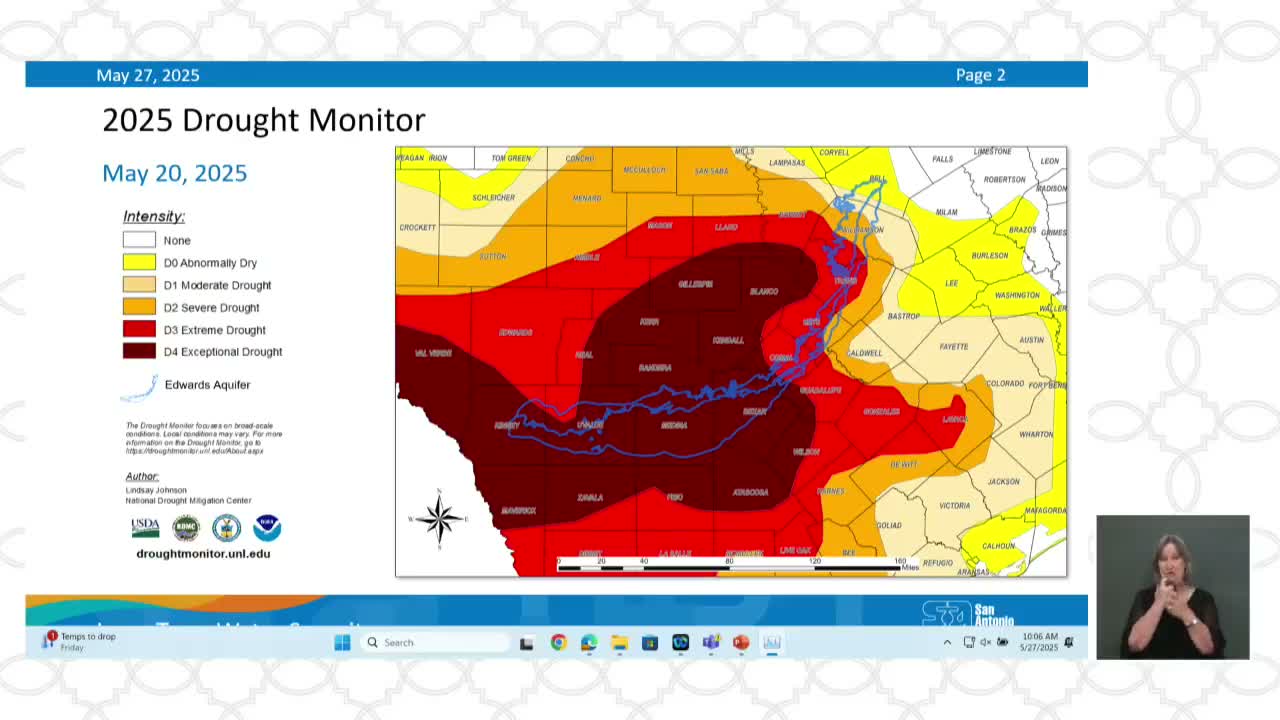
Summary
San Antonio Water System officials told the Municipal Utilities Committee May 20 that Bexar County is in "exceptional" drought, outlined stage‑5 curtailments to Edwards Aquifer permits and described the 2025 Water Management Plan and a sequence of projects to secure supplies through 2075.
San Antonio Water System officials told the Municipal Utilities Committee on May 20 that Bexar County is in "exceptional drought" and presented a 2025 Water Management Plan that combines conservation, storage and multiple new supply projects to meet the city’s projected needs through 2075.
The 2025 plan is intended to address the current multiyear rainfall deficit and long-term growth. "This is about as bad as a drought can get," said Steven Siebert, manager in SAWS’ Water Resources Department, summarizing the drought-monitoring data showing the region inside the darkest, most severe U.S. Drought Monitor category. Siebert said May rainfall had improved the monthly average to roughly 65% at the airport after a major rain event, but the city remained deep in a long-term deficit: since 2020 SAWS has recorded about a 55‑inch rainfall shortfall.
The nut of the presentation was immediate supply constraints and planned supply additions. Siebert said Edwards Aquifer Authority curtailments for permit holders have ranged from a 40% reduction under stage 4 to a recently reached stage 5 that SAWS estimates equates to about a 44% curtailment. "We are forecasting about a 40% critical period reduction off of permit, which is over a hundred thousand acre feet," he said, noting that amount exceeds annual potable use by other Texas cities.
To reduce reliance on the Edwards Aquifer, SAWS presented its diversified portfolio and the next development steps in the 2025 Water Management Plan. Key elements and schedule cited by SAWS staff: ASR (Aquifer Storage and Recovery) treatment-plant expansion in design to recover up to 45 million gallons per day of stored water; expanded Carrizo treatment capable of about 21,000 acre-feet per year; brackish groundwater project phases 2 and 3 expected to bring online about 22,000 acre-feet in the early 2040s; and a longer-term Regional Wilcox brackish project targeted for the mid‑2040s. Taken together, SAWS said the plan adds roughly 74,000 acre-feet of new supplies through the planning horizon to 2075.
SAWS also reviewed recent supply history and portfolio diversity. The utility said production at the end of last year showed about 52% of supply still originating from the Edwards Aquifer but noted SAWS now operates 13 supply projects drawing from seven different water sources, including desalination, reuse and regional pipeline purchases. The agency reported a service-area population of about 2.1 million in 2024 and a planning forecast to roughly 3.5 million residents by 2075.
Siebert framed the plan as a mix of demand management and supply development: conservation, reduced water loss, optimized contract use and new projects. He emphasized that past council investments — including water-supply fees and multi-year rate adjustments used to finance projects — enabled the current diversified portfolio. "We have a resilient and secure water supply inventory to meet the needs of a growing population and thriving economy," he said.
The committee did not take formal action on the plan during the meeting. SAWS staff said elements of the plan are already in design or construction and that many projects will come online in phased timelines through mid‑century.
Looking ahead, SAWS told the committee it will continue annual reporting and planned updates to the water-management modeling as projects, permits and weather conditions evolve.