Get Full Government Meeting Transcripts, Videos, & Alerts Forever!
Get email alerts on the Education Freedom Scholarship topic
No spam. Unsubscribe anytime.
Committee reviews emergency rules to implement Tennessee Education Freedom Scholarship; House backs rules, Senate does not
Summary
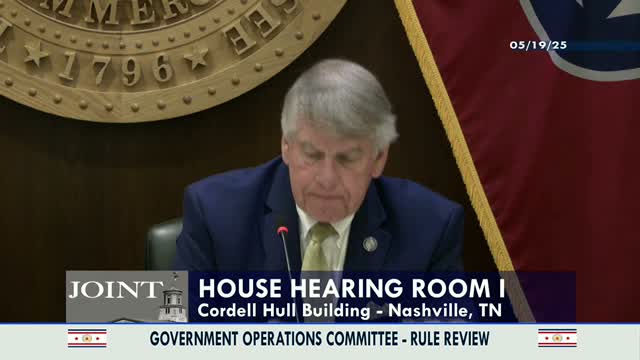
State Board of Education and Tennessee Department of Education officials on the Government Operations joint rule‑review panel explained the emergency rules created to implement the Tennessee Education Freedom Scholarship (EFS) program and answered extensive member questions about eligibility, documentation and program safeguards.
State Board of Education and Tennessee Department of Education officials on the Government Operations joint rule-review panel explained the emergency rules created to implement the Tennessee Education Freedom Scholarship (EFS) program and answered extensive member questions about eligibility, documentation and program safeguards.
The emergency rules before the committee implement Public Chapter 7 (2025), which creates the Education Freedom Scholarship Program and directs the State Board of Education to promulgate rules “narrowly tailored to enforce the requirements of the program.” Nathan James, representing the State Board of Education, said the rules define key terms, set application and eligibility processes, establish appeals procedures and cover logistical matters so the program could operate in the 2025–26 school year.
Why it matters: PC 7 creates a new statewide school‑choice scholarship tied to private school attendance; the committee hearing was the public forum to explain how the State Board and department plan to administer the program immediately under emergency rules and later under permanent rules.
What officials said Nathan James, State Board of Education: James told members the statute requires the program be available for the 2025–26 school year, which made emergency rules necessary. He said the rules limit state regulatory authority to requirements necessary to run the program and that payments are scheduled in four installments “specifically to prevent” payment remaining with a school if a student is expelled midyear.
Emily Cornute, Department of Education director of legislative affairs: Cornute clarified school eligibility for virtual programs, saying participating virtual providers must have a brick‑and‑mortar presence in Tennessee — either an owned or leased space or a location where students can receive instruction or assessment — consistent with the rule language.
Rachel Cuppay (general counsel to the State Board of Education): On whether a private school may require employees to apply for an EFS scholarship as a condition of a staff discount, Cuppay said she was “not aware of anything in either the statute or the rule that would authorize a private school participating in this program to require that of their employees.”
Major questions from lawmakers - Applications and timing: Representative McKenzie asked what had been done with applications already submitted; James and department staff said the emergency rule is already in effect and the application process is being handled under that emergency authority. The department said applications are processed in the order received.
- Income verification and documentation: Representative Oliver asked why Form 1040 is required and whether pay stubs could be used for current‑income verification; staff pointed to the rule language that allows alternative documentation (for example, SNAP or TANF enrollment) and said the department may request additional documentation if discrepancies arise.
- Targeting low‑income students: Representative McKenzie and others queried how the statutory income set‑asides (for example, the 300% of poverty bucket and the set‑asides described in statute) align with the program’s stated purpose. James repeatedly told members that income‑allocation rules are statutory and would require legislative change to alter.
- School eligibility and virtual programs: Representative McKenzie flagged one approved virtual school based outside Tennessee; Cornute answered that the statute and the rule require a physical in‑state presence (lease or deed) and described how that requirement is interpreted for certain virtual providers.
- Free/reduced lunch: Representative Reno asked whether private schools that accept EFS recipients would be required to provide free or reduced lunch to eligible students; department counsel said participation in the federal child nutrition program is optional for nonpublic schools and the rule does not require private schools to opt in.
- Fraud, waste and abuse; payment platform: Representative Oliver asked about preventing misuse of funds. The department explained that all funds flow through a digital vendor (Student First Technologies) and that tuition payments go directly to schools; families may use remaining funds for authorized purchases through the vendor’s e‑wallet, and the department will review those purchases before funds are released. The rule also sets a process for reporting alleged violations and gives the department authority to investigate or refer allegations to appropriate agencies.
Votes and committee action The hearing included a formal motion for a positive recommendation on the emergency rules. The transcript records the House and Senate roll‑call outcomes separately: the motion “prevails in the House” but “fails in the Senate.” Committee counsel later noted that, by longstanding practice, action in a single chamber can constitute approval for that chamber and that the committee staff would prepare drafting instructions to reflect the split action. The committee record therefore shows that the rules were presented and debated at length and that the two chambers recorded differing recommendations.
Next steps James told members a permanent version of the rule will be considered by the State Board of Education at its May 30 board meeting (as stated during the hearing) and that the permanent rule filing will follow the emergency implementation. The department committed to follow up with members on several outstanding operational questions — including details about application confirmation emails and data security — after the hearing.
Ending The hearing highlighted the tradeoffs the State Board and department navigated to implement a new scholarship program on an accelerated timeline: lawmakers pressed for clarity about income targeting, documentation and program safeguards while implementing staff stressed statutory limits and the emergency timeline required to make the scholarship available for the coming school year.