Get Full Government Meeting Transcripts, Videos, & Alerts Forever!
Get email alerts on the Immigration Enforcement topic
No spam. Unsubscribe anytime.
Loudoun speakers press board on sheriff’s 287(g) agreement; supervisors say they lack authority
Summary
Dozens of residents urged the Loudoun County Board of Supervisors to oppose the sheriff's 287(g) agreement with ICE, citing increased traffic stops, detentions and community fear. Board members said they have no operational control over the elected sheriff and urged constituents to address the sheriff’s office directly.
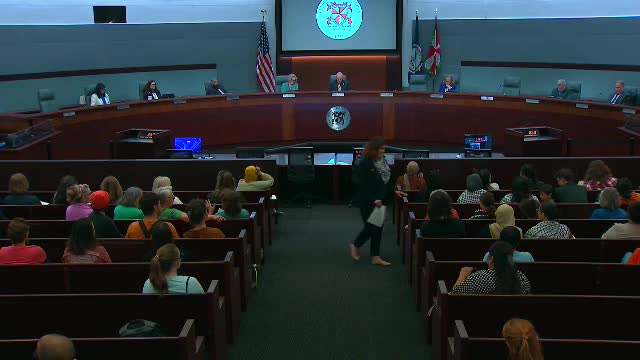
At the May 20 Loudoun County Board of Supervisors business meeting, about 25 residents used the public-comment period to urge the board to oppose the Loudoun County Sheriff's Office's memorandum of agreement with U.S. Immigration and Customs Enforcement (commonly called a 287(g) agreement). Speakers described increased traffic stops and searches of Latino residents, reports of detentions that lead to deportations and widespread fear among immigrant families.
"They both fail to keep people safe," said Joel Cornell, a Sterling resident and preschool aide, referring to ICE and the sheriff's office. "They prey on our community through fear, intimidation and unaccountable violence." Cornell and other speakers said the county’s cooperation with federal immigration enforcement is driving people into hiding, reducing cooperation with police and causing mental-health harms for children.
Why it matters: Residents and immigrant-rights groups told the board the agreement is harming public safety by eroding trust between law enforcement and immigrant communities. Speakers said the county bears financial and social costs when people avoid reporting crimes, stop attending school events, or withdraw from the workforce. Several speakers urged the board to press the sheriff or to use the budget process to limit county support for enforcement that results in extended holds for ICE.
Multiple speakers cited arrest and search statistics during remarks. Joel Cornell said "55% of those searched by LCSO are Latino, even though Latinos are only 14% of our county's population." Other speakers described year-over-year increases in traffic stops and vehicle searches; one commenter said searches had increased by about 65% this year, another said traffic stops were up almost 30% since the start of the year. Several speakers also noted that local residents can be held "up to 48 hours" after their scheduled release while ICE evaluates a detainer.
Elected supervisors told speakers the board has limited powers over the sheriff. "The board of supervisors has no operational authority over Sheriff Chapman," Supervisor Phyllis Briskman (Finance Committee) said during board comments. "He is an elected constitutional officer and thus makes all decisions on personnel, agreements with other agencies, policies on traffic stops and searches, and management of the adult detention center."
Chair Kirk Turner similarly noted structural limits: "We do not control the sheriff," Turner said. He encouraged concerned residents to contact Sheriff Michael Chapman directly and to seek meetings with the sheriff's office to press for answers. Several supervisors said they had requested information from the sheriff's office and were working to obtain records about detainers and transfers.
Board members shared some figures attributed to the sheriff's office: according to information the board said it received, there were no ICE pickups from Loudoun County detention for 2019 through 2023; in 2024 the sheriff's office recorded 233 detainers and 97 people were taken into ICE custody; through May 15, 2025, the board reported 20 detainers and 67 transfers to ICE. Supervisors framed these numbers as the sheriff's operational data, not actions approved by the board.
Community groups represented at the meeting included the Hama Kai Center, New Virginia Majority and the Virginia Coalition for Immigrant Rights. Monica Sarmiento, executive director of the Virginia Coalition for Immigrant Rights, told the board she had seen similar agreements cause economic harm in neighboring counties and urged Loudoun to avoid the same outcome.
Speakers offered policy and moral appeals: some urged abolition of 287(g)-style cooperation, budget conditions on sheriff funding, and stronger county protections for immigrant residents. Others described personal harms: a parent testified her 12-year-old daughter had self-harmed after fearing family separation, and farmers and employers warned of labor shortages if immigrant workers are detained.
What the board can do next: Supervisors reiterated their limited authority and encouraged constituents to present their concerns to Sheriff Chapman, to submit public-record requests, and to organize at the sheriff’s office and through the budget process. Supervisor Briskman said she had been trying for weeks to obtain public records from the sheriff’s office and called for protests or organized advocacy directed at the sheriff’s office rather than the board.
The meeting record shows this issue dominated the public-comment segment but produced no formal board action to change the sheriff’s agreement. Several supervisors said they would continue to seek data and press for transparency; community groups signaled they would continue advocacy efforts.
Ending: Speakers and board members left the meeting with sharp disagreement over whether the county can or should act. Residents urged more immediate remedies—ending cooperation with ICE and adding local protections—while supervisors emphasized structural limits and recommended pushing the sheriff’s office for information and accountability.