Get Full Government Meeting Transcripts, Videos, & Alerts Forever!
Get email alerts on the Public Safety topic
No spam. Unsubscribe anytime.
Sacramento council adopts higher fire‑prevention fees, eases hit for small assembly businesses
Summary
After public testimony from business groups and neighborhood associations, Sacramento City Council approved a revised fire‑prevention fee schedule, setting most inspections to full cost recovery while limiting A2/A3 small assembly occupancies to 75% recovery and using $175,000 from a city fund to offset the change.
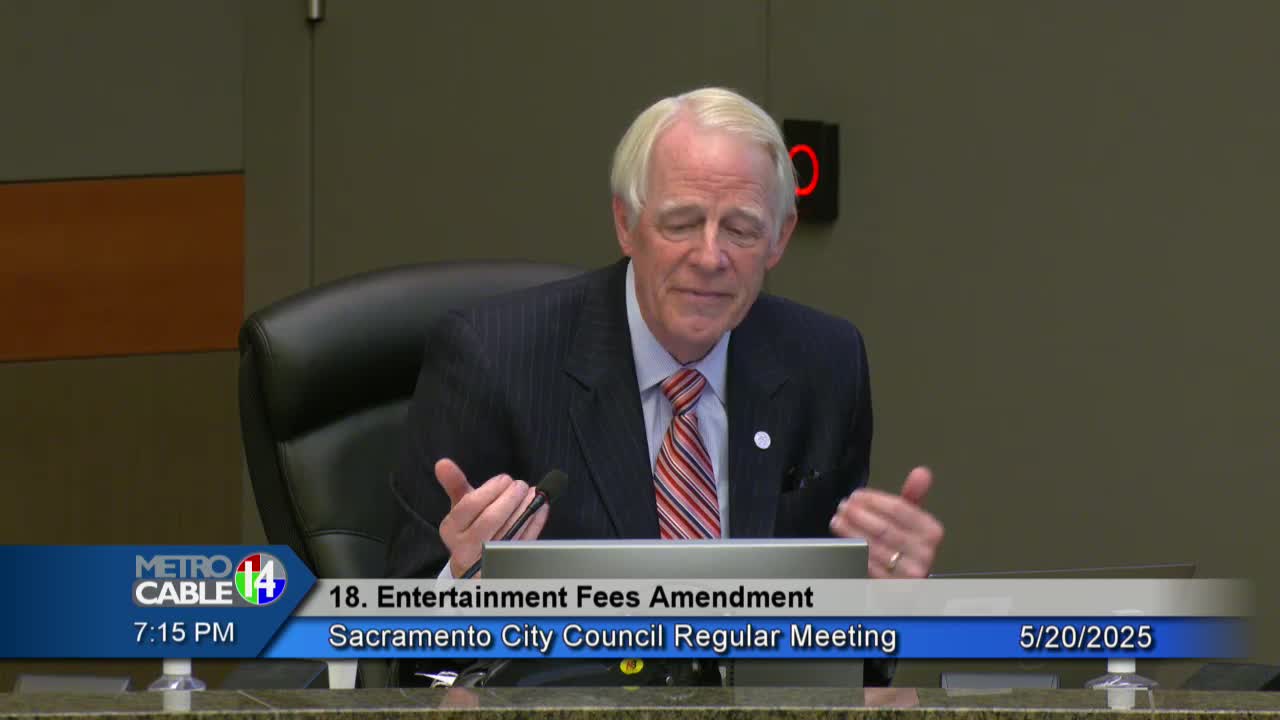
Sacramento City Council voted unanimously Tuesday to adopt updated fire‑prevention fees after weeks of study and more than two hours of public testimony from small business owners and industry groups.
The council approved a fee schedule that moves the Fire Department toward full cost recovery for most inspection and prevention services but maintains a reduced rate for A2 and A3 occupancies — a category that includes many restaurants, cafes and similar small assembly businesses — at 75% of the department’s calculated costs. Councilmember Katie Maple made the motion to adopt the fee changes with that modification; Mayor Pro Tem Guerra seconded. The tally was 9‑0 in favor.
The Sacramento Fire Department told the council its last comprehensive fee study was in 2018 and that expected workload increases — a reported 83% jump in special events and a 40% rise in plan checks and inspections — left the department recovering roughly 54% of its costs under current charges. The department’s deputy chief, Tilden Billador, said a new study commissioned in 2024 recommended raising fees to more closely match actual program costs; an annual CPI adjustment will apply each July going forward and a new fee study is planned every three years.
Business groups — including the California Apartment Association, Sacramento Metropolitan Chamber of Commerce, North State Building Industry Association and local business improvement districts — urged the council to phase in increases or exempt small mom‑and‑pop providers. Several speakers asked the council to preserve the current self‑certification process for small multiunit landlords (3–15 units), arguing the immediate changes would be disruptive to low‑margin operators.
After discussion, the council adopted Maple’s motion to set A2/A3 occupancies at 75% cost recovery. To offset the partial reduction in projected fee revenue for next year, council directed $175,000 from the city’s NUR‑one (non‑utility, restricted) fund; staff said that allocation would be a one‑time offset. The council also directed the Fire Department to continue working with stakeholders on implementation and to come back with clearer fee‑study documentation and outreach plans.
Votes at a glance
- Motion: Adopt FY2025–26 fire‑prevention fee schedule with A2/A3 occupancies set to 75% cost recovery and $175,000 from the NUR‑one fund to offset revenue loss. Mover: Councilmember Katie Maple. Second: Mayor Pro Tem Guerra. Vote: 9 yes, 0 no, 0 abstain (Kaplan, Dickinson, Talamantes, Pluckettbaum, Maple, Guerra, Jennings, Vang, McCarty).
Why it matters
The change brings the department closer to full cost recovery, a common municipal budget step, but the council’s concession for small assemblies reflects concern about the cumulative effect of rising fees on restaurants, small event venues and mom‑and‑pop landlords. Councilmembers and business representatives said the size and timing of increases matter as businesses face other city and market pressures.
What’s next
Staff will finalize the amended fee schedule for inclusion in the June budget adoption process, proceed with the planned CPI indexing next July, and conduct the next fee study in three years. The Fire Department also will provide additional documentation and outreach materials explaining how fees were calculated and the options available to small businesses.