Get Full Government Meeting Transcripts, Videos, & Alerts Forever!
Get email alerts on the Housing Workforce Funding topic
No spam. Unsubscribe anytime.
Skagit County expands 0.09 economic development grant criteria to include affordable workforce housing
Summary
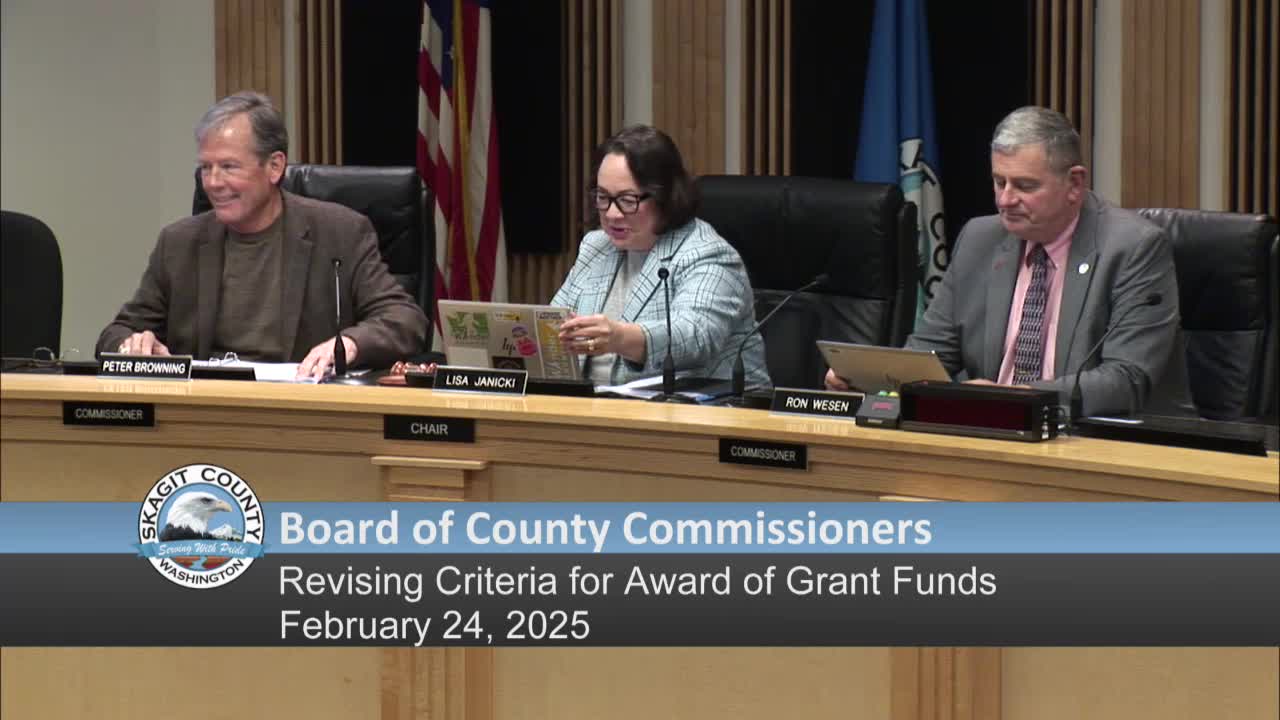
Skagit County Commissioners on Monday approved a resolution revising the county's criteria for awarding rural county economic development public facilities grant funds (0.09 funds) to include eligible uses for affordable workforce housing; the board voted 3-0.
Skagit County Commissioners on Monday approved a resolution revising the county's criteria for awarding rural county economic development public facilities grant funds (the '20.09'2 funds) to allow funding for affordable workforce housing and to set application, scoring and award limits. The board voted 3-0 to adopt the revised criteria.
The change follows a state-law revision cited during the meeting (pursuant to RCW 82.14 0.37) that added "affordable workforce housing infrastructure or facilities" to eligible uses for the 0.09 sales-and-use-tax distribution to distressed counties. Jennifer Johnson, deputy county administrator, presented the resolution and said it updates the 7-member advisory committee composition and the county's eligibility and scoring criteria.
George Kosovich, senior public health analyst, told commissioners the statutory change broadened allowable uses to include housing infrastructure, facilities or land and clarified that funds may be used by nonprofit or public entities but not for-profit developers. Kosovich said the statute uses a 120% area median income standard but the county's recommendation narrows funding focus to projects serving households at or below 80% of area median income to target subsidy need.
The resolution and staff presentation set eligibility and limits for both economic development and housing uses. Key details presented to the board include:
- Timeline: notification by March 10; applications due April 25; committee review beginning May 5; advisory committee meeting to make recommendations May 30.
- Advisory committee composition: a seven-member panel that includes the chair of the Board of County Commissioners, one mayor from a large city, one mayor from a small town, a port district representative, a business community representative, the county administrator and the executive director of EDASC (Economic Development Alliance of Skagit County). For workforce housing projects, the Northstar leadership team will review requests and forward recommendations to that advisory committee.
- Award limits and matching: for economic development projects the presentation said no more than $750,000 will be awarded to a single entity per project; for workforce housing projects staff proposed a cap of $1,000,000 per project and per-unit maximums intended to secure leverage from other public and private funding sources (up to $50,000 per unit for units serving 30% AMI or below; up to $30,000 per unit for units serving 50%–80% AMI).
- Eligibility and scoring: threshold criteria include developer capacity, jurisdictional support and a demonstrable connection to economic development (proximity to transit, commercial space or services). Scoring preferences favor projects with site control, financing commitments, less environmental mitigation, local jurisdiction financial commitment beyond letters of support, readiness, and alignment with Northstar priorities (serving high-need populations and integrating services).
Commissioners discussed implementation questions, including whether the county could bond against the revenue stream in the future and whether funds already spent on property acquisition could be reimbursed. The county's budget-and-finance staff said a future board could amend the resolution and that the county could issue general obligation bonds using the 0.09 revenue as a committed repayment source, but warned of the risks if state distributions change.
Commissioner David Janicki said the program's statutory history and community outreach informed the recommended approach. Commissioner Ron Wesen and Commissioner Peter Browning both spoke in favor. Browning said, "I'm really excited about this. I think this is really, really good," while Wesen noted the law changed recently and asked for clarification about use for property purchase and reimbursement.
The board moved and seconded the resolution and approved it by voice vote, 3-0. Record motion language on the transcript was: "move to approve the resolution revising the criteria for the award of the rural county economic development public facilities grant funds." The motion was carried by the three commissioners present.
Staff said the county will publish application materials and begin outreach to prospective applicants and partners; applicants must show efforts to secure other funding sources. The Northstar leadership team and an appointed advisory committee will weigh requests under the adopted scoring criteria before the county makes final awards.
The resolution and scoring criteria now guide applications for 0.09 funds for this funding cycle and will be used in outreach and evaluation for projects seeking either economic development or workforce housing support.