
ADOT outlines Loop 101/I‑10 interchange improvements and SR 30 freeway plan; construction timelines and impacts described
Get AI-powered insights, summaries, and transcripts
Subscribe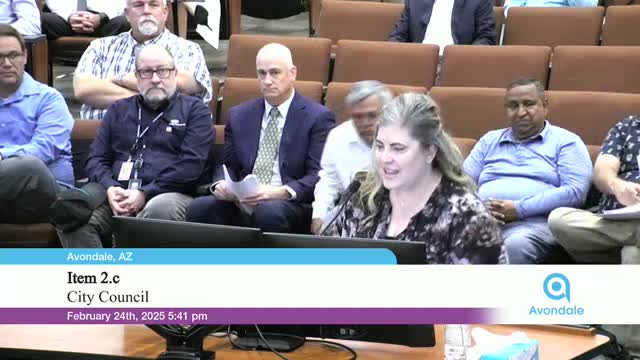
Summary
Arizona Department of Transportation staff briefed the Avondale City Council on two major freeway projects: interchange improvements at the Loop 101/I‑10 system interchange and the SR 30 segment between 90th Avenue and Loop 202. ADOT described design and construction schedules, estimated costs, traffic impacts and funding sources.
Arizona Department of Transportation officials presented plans for two large Phoenix‑area freeway projects to the Avondale City Council, detailing schedules, traffic impacts and funding. ADOT said both projects are in advanced design and described construction timelines that will affect travel in and around Avondale.
ADOT Community Relations Project Manager Kimberly Larson said the Loop 101/I‑10 system interchange improvements aim to reduce existing and future congestion by adding direct HOV connections, new ramps and noise walls. "The project is in the final design phase, and we'll be wrapping up the final design very soon," Larson said. ADOT listed key elements: a direct HOV ramp from Loop 101 HOV lanes to I‑10 HOV lanes, a new ramp from southbound Loop 101 to 90th Avenue, and a combined southbound Loop 101 exit to Thomas and McDowell roads. The agency plans to advertise for construction bids in the second quarter of the year and anticipates construction beginning this fall; ADOT estimated the construction program at $291,000,000 funded through Maricopa County’s Proposition 400 sales tax program.
ADOT staff warned of construction impacts: periodic overnight and weekend freeway closures, cross‑street and ramp restrictions that could last up to 60 days, and localized lane restrictions on frontage roads. Troy Siglitz, a design project manager on the interchange, said ADOT’s sequencing plans aim to keep ramps open for most of the project and avoid closing parallel ramps at the same time. "We would not close them both at the same time," Siglitz said, adding the Thomas Road exit is planned to remain open because of a nearby hospital. ADOT estimated about a 30‑month construction duration after contractor mobilization.
ADOT also described the SR 30 project (90th Avenue to Loop 202), a new approximately 4.5‑mile freeway segment intended to include three general‑purpose lanes each direction initially, multiple traffic interchanges, bridges to separate cross‑street traffic, drainage and lighting improvements and noise walls where warranted. ADOT project manager Guy Alduna said the project is in final design, which began in October 2024; design completion is planned for fall 2026, with construction tentatively beginning in spring 2027 and anticipated completion in 2029. Funding for SR 30 and related segments is identified under Proposition 479, the transportation sales tax.
Alduna said portions of SR 30 west of the shown project limits would later include work within Avondale and Goodyear; ADOT noted that Avondale segments under discussion in regional planning are likely to be Bullard to Dysart, Dysart to Avondale, and Avondale to 90th Avenue. When Councilmember White asked whether Avondale might see development related to SR 30 by about 2032, ADOT staff said phasing remains under discussion at the Maricopa Association of Governments and they would follow up with more detail.
ADOT officials said the projects are intended to improve mobility and reduce weaving and bottlenecks approaching the interchange, but they emphasized that specific phasing and short closures will be finalized after a contractor is selected and preconstruction coordination with local stakeholders is complete. ADOT committed to advance notice and partner coordination for major holidays and events.
Proposed next steps: ADOT will complete final design, advertise for construction bids (Loop 101/I‑10), continue public outreach, and coordinate contractor preconstruction meetings with city representatives to refine phasing and mitigation plans.