Get Full Government Meeting Transcripts, Videos, & Alerts Forever!
Get email alerts on the Roads And Infrastructure topic
No spam. Unsubscribe anytime.
Cochise County details Davis Road safety upgrades, right-of-way acquisitions
Summary
At a Feb. 20 work session, county engineering staff outlined plans to add shoulders, replace culverts and acquire right-of-way on Davis Road to reduce flood closures and improve safety; funding is a mix of state earmarks, discretionary funds and county HEERF dollars, with full construction dependent on grants.
Cochise County engineering staff presented a plan Feb. 20 to reduce flooding and improve safety on Davis Road, a roughly 7.8-mile corridor that has repeatedly closed during heavy rains.
The presentation to the Cochise County Board of Supervisors at a special work session in Bisbee said design work is under way and that right-of-way acquisitions are in progress. Engineering staff said, “We have right of way perfected on 97 properties, and we still need to acquire on 49 properties,” and described targeted work at Milepost 5 and Milepost 13 to replace culverts and improve site distance at a low point that frequently floods.
The update framed the work as largely safety- and drainage-focused rather than an immediate conversion to a four-lane highway. Engineering staff said the current design includes widening shoulders (to about 8 feet) and targeted box-culvert installations at critical locations; the existing westbound lane in places would become the shoulder rather than adding a new travel lane.
Why it matters: Davis Road has a history of closures during monsoon events. County staff said improving drainage and shoulder width will reduce closures and improve safe passage for oversized and commercial vehicles.
Key details and funding: engineering staff said the project has multiple funding pieces but not enough yet to construct the full corridor. They reported a $1,000,000 design contribution from the MPO (referred to in the presentation as the “service to MPO”), a state earmark of $6,100,000, design costs of about $1,800,000, and an estimated $2,000,000 for additional right-of-way for this segment. For the full 7.8-mile project, staff estimated an all-at-once construction cost of $25 million–$30 million and said the county will pursue grants to cover remaining needs.
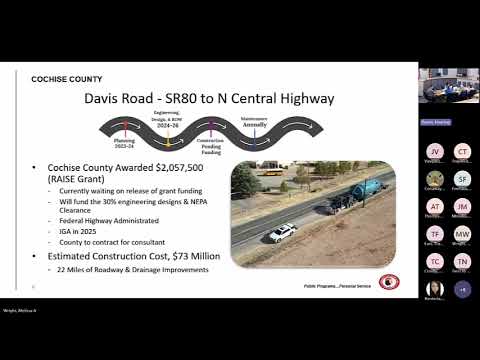
Staff also described a separate Davis Road study (listed in the presentation as the Highway 80 to Central segment) that received a RAISE planning grant of roughly $2,000,000 to reach 30% design and obtain NEPA clearance. That study covers a longer corridor (about 22 miles in presentation remarks) and carried a staff-estimated eventual construction cost of about $73,000,000; staff emphasized that those larger construction costs would depend on future grant awards.
Project status and schedule: staff said the targeted culvert/shoulder work for the immediate safety fixes should be designed by 2026 and that environmental clearances (NEPA) are expected toward the end of the year for the shown design elements. ADOT will provide construction oversight where federal funds are used, staff said.
Right-of-way process: because federal funds are part of some project elements, staff described following federal acquisition procedures: title search and insurance, an appraisal, an offer to property owners, and negotiation. The presentation noted 11 right-of-way acquisitions complete on one Davis segment, two more in escrow, and one still under negotiation. A property owner identified in the presentation as “Cody” was referenced as having an easement/title issue that has moved to escrow.
Context and background: staff said Davis Road has been the subject of engineering investigation since the early 2000s, with drainage investigations beginning around 2010 and design work previously completed by about 2015; the current effort is updating older designs and securing NEPA clearance so construction grants can be pursued.
Next steps: staff said the county will continue design work, pursue grants and acquire remaining right-of-way where required. No formal board action or vote occurred during the work session; the presentation was informational only.
Ending: The supervisors did not take action during the work session. Staff said they will return with further design rollouts and grant-application updates as they are available.