Get Full Government Meeting Transcripts, Videos, & Alerts Forever!
Get email alerts on the Automated Enforcement topic
No spam. Unsubscribe anytime.
Maryland hearing advances bill to let state, local prosecutors sue out-of-state drivers over unpaid camera citations
Summary
Lawmakers heard testimony on HB915, the "Out of State Driver Accountability Act," which would allow Maryland attorney general or local state's attorneys to bring civil actions against out‑of‑state drivers with overdue automated‑enforcement citations and require better statewide data reporting.
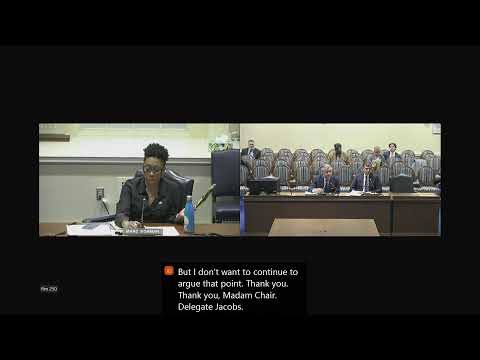
Delegate Linda Foley, sponsor of House Bill 915, told the House Environment and Transportation Committee on Feb. 20 that the bill—dubbed the Out of State Driver Accountability Act—would give Maryland prosecutors civil authority to pursue out‑of‑state drivers who do not pay automated‑enforcement citations, and would require quarterly reporting on out‑of‑state citations to the state Vision Zero coordinator.
"This piece of legislation is a Vision 0 bill," Delegate Foley said, explaining the bill was in part a response to the District of Columbia’s 2024 Steer Act. She said Maryland currently lacks statewide mechanisms to collect and aggregate automated‑citation data and to hold out‑of‑state drivers accountable for unpaid camera tickets.
The bill drew support from transportation and safety advocates who urged expansion. Ben Ross of the Action Committee for Transit told the committee his organization supports the bill "but with the amendment that it should apply to all states." Dan Reed of Greater Greater Washington said the measure reflects the region’s multi‑jurisdictional travel patterns and would help Maryland capture revenue and improve safety. John Singh of Safe Roads Maryland also urged a favorable report, framing the measure as reciprocity with D.C.
Sponsor and witnesses highlighted data showing a large share of camera citations go unpaid by out‑of‑state drivers. Delegate Foley cited a WBAL investigation of speed camera enforcement on I‑83, saying the Baltimore City Department of Transportation data showed 43% of out‑of‑state drivers did not pay camera tickets; between 7/13/2022 and 3/31/2023 about 237,000 speed camera tickets were issued on I‑83, 51,000 went to out‑of‑state drivers and more than 22,000 remained unpaid at the time of the investigation.
Supporters asked the committee to broaden the bill later in the legislative process to include other neighboring states, especially Virginia, which witnesses said accounts for a sizeable share of out‑of‑state tags in the Baltimore region. Delegate Foley said she was open to changes but prefers first to collect the quarterly data mandated by the bill to identify which states most commonly account for unpaid citations before expanding reciprocity.
Committee members questioned how the bill would treat rental cars and company vehicles. Witnesses and the sponsor said automated camera enforcement sends a citation to the vehicle’s registrant; rental firms often receive camera notices and then pursue customers for reimbursement. Delegate Foley said the bill focuses on automated enforcement and out‑of‑state tags rather than traffic stops by officers.
The bill also proposes to allow MDOT to collect uniform ticketing data statewide to enable better analysis. Delegate Foley said the lack of centralized data is a barrier to estimating the fiscal impact and identifying problem jurisdictions.
The committee did not take a vote during the hearing. Delegates and witnesses agreed the bill merits further work on amendments to address reporting burdens for municipalities with no out‑of‑state citations and to refine which jurisdictions would be included if the bill is later expanded beyond D.C.
Ending: The committee moved on to the next agenda item after the testimony; sponsors and supporters said they would provide the cited WBAL study and work with municipalities and the Maryland Municipal League on technical amendments.