Get Full Government Meeting Transcripts, Videos, & Alerts Forever!
Get email alerts on the Solid Waste Recycling topic
No spam. Unsubscribe anytime.
Polk County approves series of contracts and purchases to expand recycling and organics processing
Summary
Polk County commissioners on Monday approved a package of contracts and purchases to expand recycling and organics processing at the county’s transfer station and landfill, including grant‑funded equipment intended to improve glass recovery and to automate removal of organics from the waste stream.
Polk County commissioners on Monday approved a package of contracts and purchases to expand recycling and organics processing at the county’s transfer station and landfill, including grant‑funded equipment intended to improve glass recovery and to automate removal of organics from the waste stream.
County staff told the board the work is funded through two Minnesota Pollution Control Agency (MPCA) grants plus local matching funds and county bonds. The board approved multiple, related motions: a systems integration contract, purchase and installation of a bag opener and fine screen, procurement of two robotic pickers for an organics line, and a larger integrator/installation contract for the back‑end modifications.
Why it matters: County presenters said the package is designed to raise material quality (especially glass) and reduce disposal of contaminated fines, which improves marketability and long‑term operating economics. The project also prepares the facility to accept new compostable bag streams being tested under producer responsibility (EPR) planning in other counties.
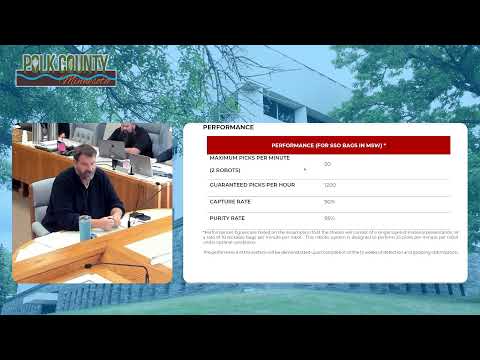
Key approvals and details - Integration contract (first tranche): board approved a contract shown on the agenda at approximately $499,000 for integration services to install conveyors, chutes, supports and to supervise on‑site modifications tied to the MPCA recycling grant. - Bag opener purchase (Viably): commissioners approved the purchase and installation package for a bag opener at $481,627 (mechanical install firmed at $21,000 after packet issuance). The bag opener is intended to liberate contents from plastic bags to prevent material loss. - Fine screen: the board approved purchase of a rubber‑deck fine screen to better separate the <2‑inch fraction (current packet figure $128,680). The screen uses a rubber deck that resists plugging and is intended to improve capture of flat aluminum and recoverable glass. - Larger integration / back‑end contract (Titus/prime integrator): the board approved a larger integration/installation contract (shown in the packet at about $996,000) that covers the more extensive modifications to install the organics line, relocate conveyors and tie systems together. - Robots for organics sorting: the board approved purchase of two robotic picking arms and associated vision/control systems from a vendor in Quebec, shown at $550,000. County staff described the robots as industrial arms used to pick liberated organic bags and other target items, with the potential to reduce manual sorting costs over time. - Landfill Phase 15 pay request and retainage: in related landfill business the board agreed to release pay request No. 3 while maintaining a revised retainage tied to seeding/establishment issues (see Votes at a glance). - Air compliance testing: the board approved a proposal from a test consultant (Brian Durkop named in the packet) for required stack compliance testing at the Fosston incinerator at $49,220.
Presenter summary and schedule: County solid‑waste staff explained that many pieces have long lead times; deliveries and installation are expected in the August–September window. Staff said the bag opener and robots will be installed and integrated with minimal downtime by staging work during off hours and using temporary conveyors, as with prior projects. Staff also noted tariffs and global supply‑chain timing as a reason to finalize orders soon.
Financial and grant context: Staff said the MPCA grants fund substantial shares of the projects, with local match covered by previously authorized county bonds and local funds. Officials noted the project was sized to avoid sales tax by purchasing larger equipment directly and using vendors only for installation and small components.
Board discussion: Commissioners largely supported moving forward; questions centered on lead times, whether screen hole‑size changes could alter price (staff said any small change would be handled as a change order), and how the robots will be trained and programmed on site. Staff said the integrator will perform on‑site programming and calibration and that the vision system can be updated remotely.
Ending: County staff said they would return with any necessary change orders and will proceed with ordering and scheduling to meet the planned installation window.