Get Full Government Meeting Transcripts, Videos, & Alerts Forever!
Get email alerts on the Elections topic
No spam. Unsubscribe anytime.
Blount County commissioners debate shift to voting centers; amendment to split vote fails, no final vote recorded
Summary
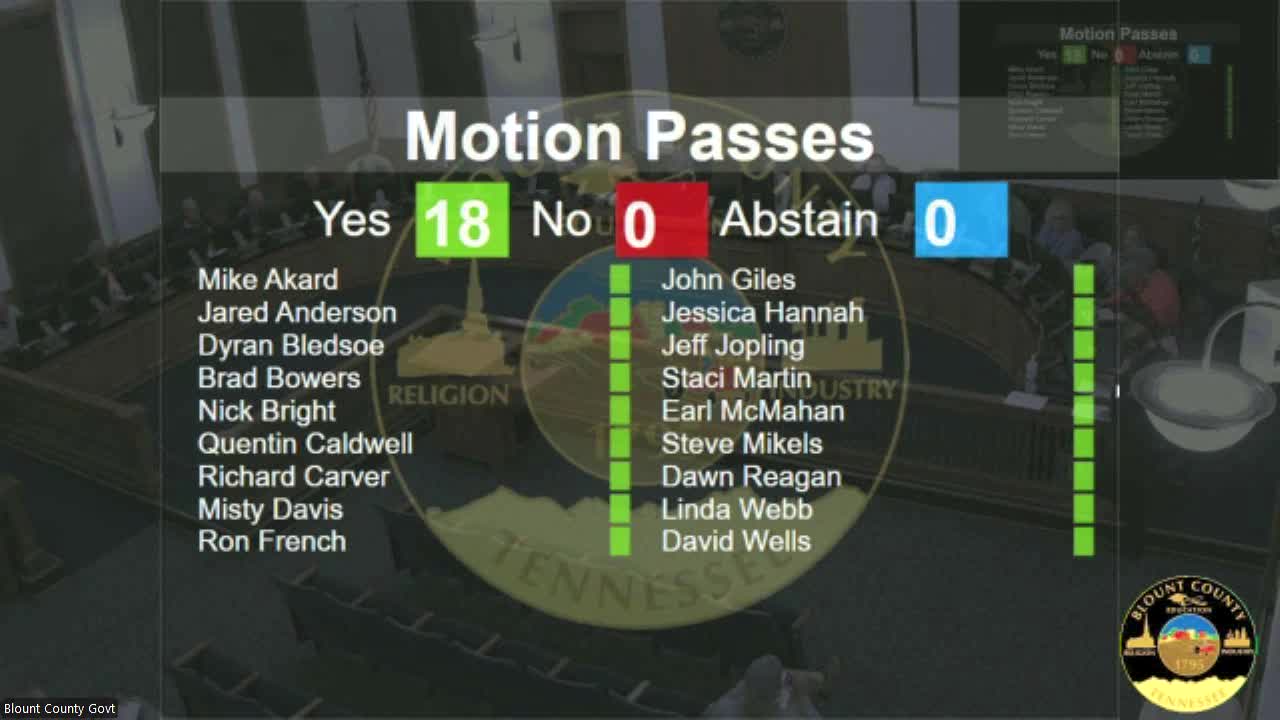
Commissioners spent more than two hours debating a proposal that would fund and authorize a move to countywide voting centers. An amendment to separate the funding from the policy failed 10–7 with one abstention; the main motion received discussion but no final recorded vote at the workshop meeting.
Blount County commissioners spent a large portion of a workshop meeting discussing Resolution 25‑2‑0‑1‑7, a $110,000 budget increase tied to a plan to adopt voting centers countywide and expand convenience voting options.
The item was read into the record as a budget increase to “appropriate funds for convenience voting centers due to the increased number of registered voters.” Commissioners debated whether the appropriation also constituted approval of the shift from precinct-based elections to voting centers and whether the commission should first take a separate vote on the policy change.
“It's time to pick . . . pick the path and let's roll,” said Moe, the elections official who addressed commissioners multiple times during the debate, urging the commission to choose a direction and move forward. Moe told commissioners that adopting voting centers would allow “one in each county commission district” and that the county could initially locate roughly 15 voting centers, with others placed “strategically” by population and travel routes.
Commissioners who opposed the change stressed community ties to local precincts. “We are supposed to be a voice for the people,” Commissioner Michael Michaels said. “If we continue to get rid of community, we're not gonna have it anymore.” Commissioner Reagan said he had voted against advancing the change the last time it came before the commission, adding that the precinct model preserves a local sense of community.
Supporters and the elections office emphasized logistical and operational reasons for the change: a projected need to replace or add poll pads, voting machines and staffing as registered-voter rolls have increased. The elections official said registered voters rose from roughly 79,000 in November 2016 to about 100,000 in November 2024, and argued that the 70% share of votes cast during early voting in typical general elections points to the value of more accessible early voting locations. The official also estimated that staying with the current precinct model could require a worst‑case additional investment “over $300,000” for extra machines, poll pads and staffing versus an estimated $110,000 to move toward voting centers.
Commissioner Wells proposed an amendment to adjust the funding structure for a different item earlier in the packet (relating to clerk staff) and later Commissioner Michaels moved to separate the voting‑centers policy from the appropriation, proposing that the commission vote on adopting voting centers before any budget increase be considered. That motion to separate failed on a voice/recorded count: 10 yes, 7 no and 1 abstention. The chair declared the motion failed and the meeting moved on. The transcript records the failed separation motion but does not show a subsequent final vote to forward Resolution 25‑2‑0‑1‑7 to the full commission at that workshop.
Because the meeting did not record a final roll-call on the main resolution, the commission left unresolved at that session whether it would formally forward the $110,000 appropriation and a statement of support for voting centers to a subsequent full-commission meeting. Several commissioners asked for more information and invited the elections office to meet with them before the next meeting.
Key factual details discussed in the meeting included: the elections office's projection of about 15 voting centers (one in each commission district), current early‑voting locations numbered five in November, registered‑voter growth from about 79,000 (Nov. 2016) to roughly 100,000 (Nov. 2024), and the estimate that approximately 70% of votes in typical general elections are cast during early voting. The elections official cautioned that the timing to secure state approval is compressed because the state must approve any county plan to use voting centers and the plan would need the state election commission's signoff and state legislation to be passed for Blount County to implement the model.
Commissioners who wanted more time asked county staff to provide more granular cost breakdowns, historical appropriations for equipment, and details about how many early‑voting participants cast ballots “out of district.” Moe invited commissioners to meet one‑on‑one and to review the packet materials. Several commissioners said they would continue to review the options before any vote at the next meeting.
The workshop record shows substantial debate and no final action to move Resolution 25‑2‑0‑1‑7 forward during that session.