Get Full Government Meeting Transcripts, Videos, & Alerts Forever!
Get email alerts on the Transportation topic
No spam. Unsubscribe anytime.
Council asks staff to explore automated enforcement to protect bus riders and school buses
Summary
The council unanimously approved a policy order directing staff to study how new state laws authorizing automated enforcement can be used to prevent illegal parking in bus zones and illegal passing of stopped school buses.
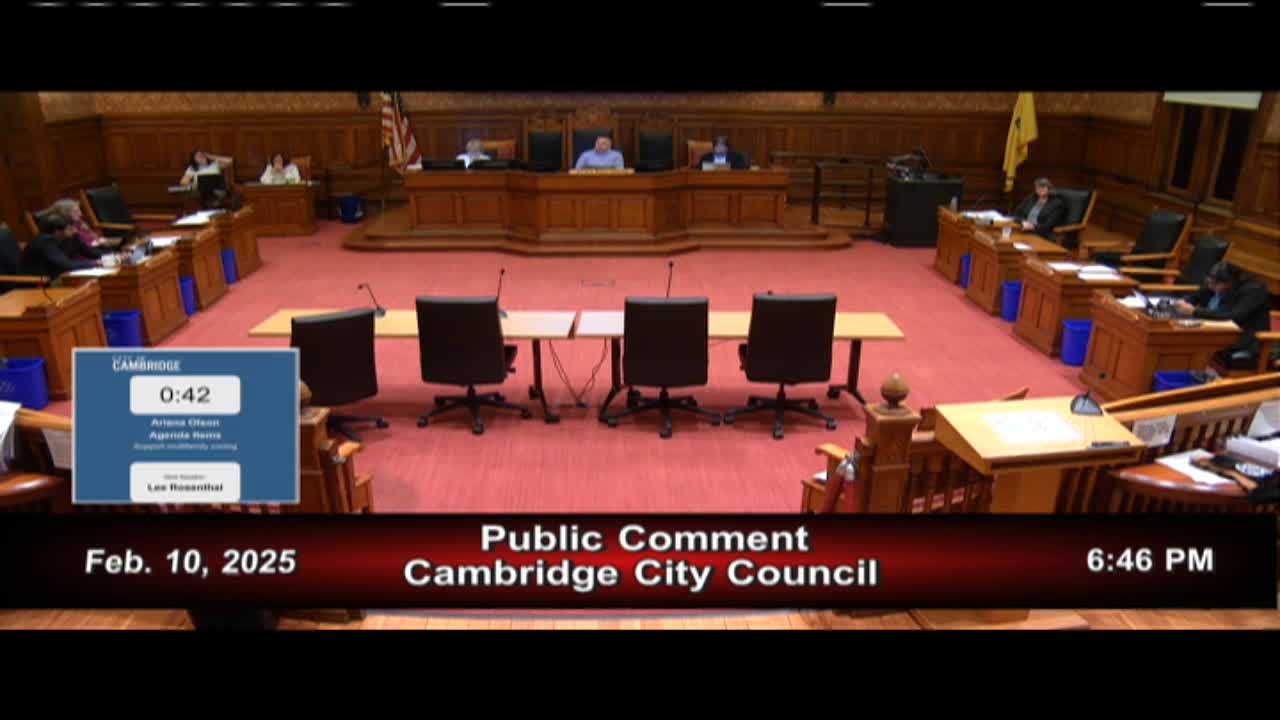
The Cambridge City Council unanimously adopted a policy order on Feb. 10 asking city staff to explore how recently enacted state laws could be used to enforce illegal parking in bus boarding areas and to prevent motorists from illegally passing stopped school buses.
Councilor Sabrina Wheeler introduced the order, which noted recent state legislation signed by the governor that enables municipalities to adopt automated enforcement in those two areas. The council amended the order to add Councilors Nolan, Toner and Wilson as co-sponsors before taking the vote; the final motion passed 9–0.
Why it matters: Councilors and several residents described traffic conflicts near bus stops and a dangerous intersection at Cambridge Street and Cardinal Medeiros as problems needing attention. City staff were asked to report back on implementation options, enforcement technology, privacy protections, and estimated operating costs.
What the order requests: The Community Development Department and Transportation & Parking staff were directed to study statutory implementation steps, required software/hardware options (camera-based enforcement or other approved technologies), and privacy and operational policies required by state law. Counselors noted other related enforcement work, such as the broader safety-stick/automated parking enforcement efforts, that may be coordinated with this implementation.
Next steps: Staff will prepare a written report for the council detailing statutory steps, likely locations for pilot programs, public outreach needs, and estimated costs and revenues. Councilors expressed bipartisan interest in using the state authority to reduce unsafe driving around buses and improve rider safety.