Get Full Government Meeting Transcripts, Videos, & Alerts Forever!
Get email alerts on the Broadband topic
No spam. Unsubscribe anytime.
Council asks city to present plan for municipal broadband after feasibility study; policy order adopted
Summary
The council voted to direct staff to present a plan for municipal broadband at the finance committee, after a feasibility study and public comment showing strong resident interest. The motion, introduced by Councilor Sabrina Wheeler and amended by Vice Mayor McGovern, passed 8–1.
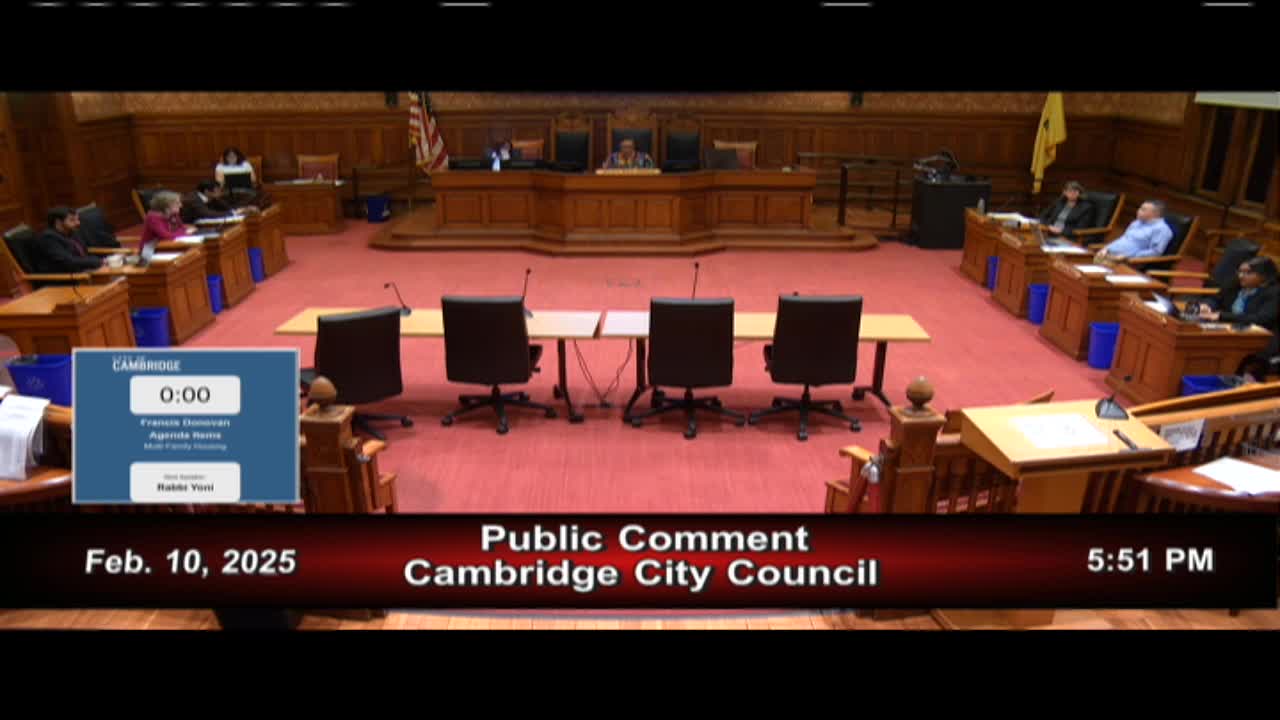
The Cambridge City Council on Feb. 10 adopted a policy order directing city staff to present a plan and timeline for a municipal broadband option at an upcoming finance committee meeting. The vote followed public comment urging action and a feasibility study that had shown strong resident interest.
Councilor Sabrina Wheeler introduced the policy order, which asked the city manager to “create a plan with a schedule and milestones to move forward with the creation of a municipal broadband network.” Vice Mayor McGovern offered an amendment that removed language implying immediate creation and instead asked staff to present what a plan would look like (financing, timeline and trade-offs) to the finance committee. The amended order passed on a roll call of 8–1.
Supporters cited resident surveys and the limits of current private providers. Rabbi Yoni, speaking in public comment and referencing a city feasibility study, said a resident survey showed “87% felt that Cambridge needed another Internet service provider” and pointed to strong town support for city action. Residents and advocates told the council that municipal broadband could lower costs, improve reliability and better protect net neutrality and privacy for residents who lack alternatives.
Opponents and some councilors raised fiscal questions. Councilor Toner said he would vote no, arguing the project could be a large long-term infrastructure commitment and that near-term city budget constraints required careful prioritization; he emphasized the need to understand trade-offs among other capital needs.
What the order requests: staff were asked to present to the finance committee an outline of possible business models, estimated capital costs and operating scenarios, options for phasing or partnering, and impacts on other capital priorities. The amendment clarified the immediate intent: study and report back, not a final authorization to bond or build.
Financial context and legal notes: the feasibility work referenced in public comment did not automatically obligate the city to fund construction; the council’s vote authorized only a staff report to finance committee. Public comment and council discussion noted recent federal and court developments affecting net neutrality and regulation of Internet service providers, and speakers argued municipal action could provide net neutrality protections at local scale.
Next steps: The finance committee will set a date for the staff presentation. Staff were asked to include debt-service scenarios, potential phasing and affordability protections for lower-income residents in any plan presented to council.