Get Full Government Meeting Transcripts, Videos, & Alerts Forever!
Get email alerts on the Housing topic
No spam. Unsubscribe anytime.
Cambridge Council ordains citywide multifamily zoning after months of debate
Summary
After months of hearings and more than 90 public-comment speakers, the Cambridge City Council voted to ordain a sweeping multifamily zoning change (the "4+2" package) to allow more multifamily housing broadly across the city. The ordinance passed in two parts after amendments and compromise; votes were 8–1 on each part.
The Cambridge City Council on Feb. 10 voted to ordain a package of multifamily zoning changes intended to allow more multifamily housing across the city, ending long-standing exclusionary restrictions in much of Cambridge.
The package — commonly referred to in public testimony as the “4+2” multifamily zoning proposal — passed in two ordinance votes. Councilors voted 8–1 to ordain Part 1 (the zoning amendments as amended) and 8–1 to ordain Part 2. Councilor Siddiqui moved the ordination of Part 1; Councilor Siddiqui moved Part 2 as well. The votes were taken by roll call; eight members voted yes and one member voted no on each ordinance vote.
Why it matters: Supporters said the changes will increase housing supply throughout Cambridge and are a necessary step to address affordability, displacement and climate goals tied to denser, transit-oriented living. Opponents warned the changes will accelerate luxury development, threaten neighborhood character and strain infrastructure.
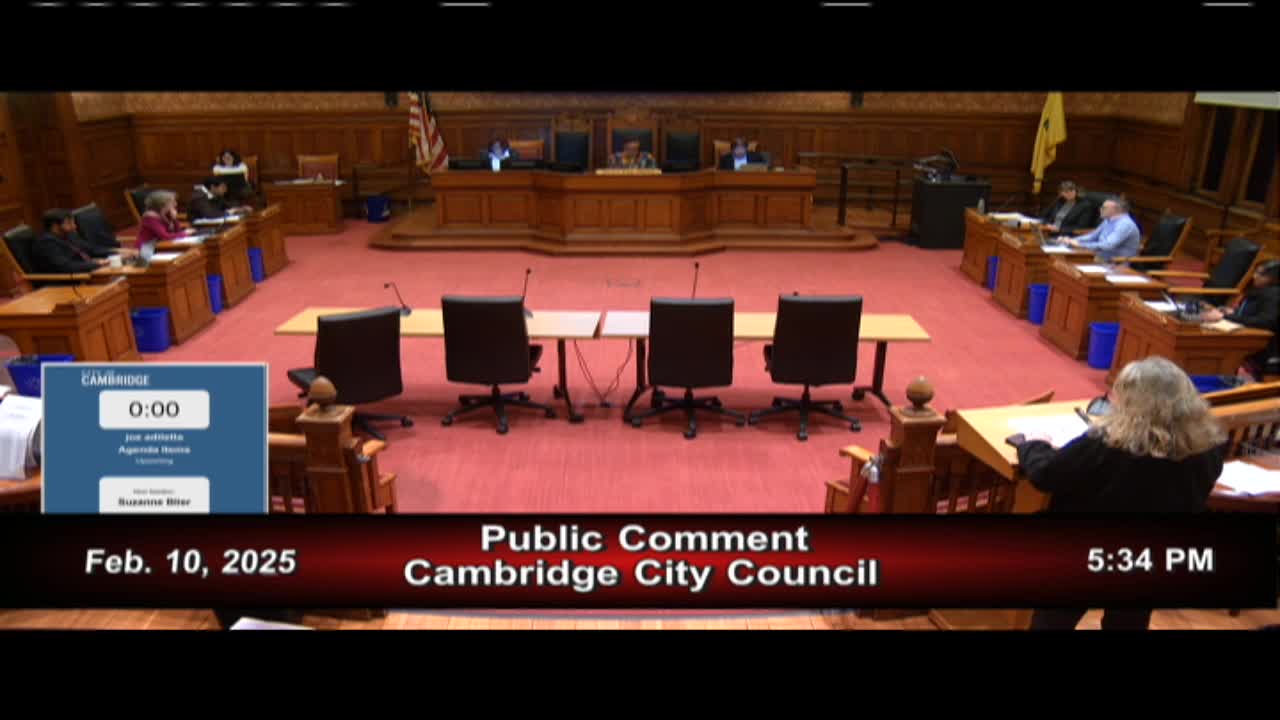
The council’s action followed a marathon public-comment period. The city gave one-minute speaking slots and heard about 95 sign-ups; dozens of residents, renters, homeowners and advocates spoke for and against the ordinance. Supporters said the zoning change will “end exclusionary zoning” and create more opportunities for renters, young families and workers to live in Cambridge. Opponents said the measure risks producing primarily luxury units and urged delay for further study and neighborhood planning.
Public voices: Resident Mark Rifkin told the council the ordinance “is a fantastic step in the right direction” and called Cambridge “a nationwide leader in progressive housing policy.” Multiple speakers urged passage “as is,” citing study findings and a statewide housing production target one speaker quoted as “222,000 new homes in the next decade.” Other residents, including several long-time homeowners and architects, warned that developers will assemble lots and build larger, higher-margin projects that could displace existing lower- and middle-income housing.
Council debate and amendments: Councilors and staff negotiated several amendments before the final votes. Council discussion noted compromises on height limits, unit-size thresholds, and where design review would still apply. Councilors who opposed the measure urged adoption of an alternative “3+3” approach; supporters argued the package before them represented a practical compromise arrived at after extensive public hearings and staff work.
Implementation and next steps: Council members and staff said they will continue monitoring outcomes and follow up with additional zoning or policy fixes (for example, protections for solar arrays and updated design guidance were discussed as subsequent steps). Councilors also pointed to related programs — the Affordable Housing Overlay and inclusionary zoning mechanisms — that will run in parallel to the ordinance to produce subsidized units.
Votes at a glance: - Multifamily zoning ordinance, Part 1 (ordain as amended). Motion: ordain multifamily housing zoning petition, Part 1 (as amended). Mover: Councilor Siddiqui. Result: approved, 8–1 (Yes: Councilors Azim, Vice Mayor McGovern, Nolan, Siddiqui, Sabrina Wheeler, Toner, Wilson, Mayor Simmons; No: Councilor Zusi). Outcome: adopted. - Multifamily zoning ordinance, Part 2 (ordain). Motion: ordain multifamily housing zoning petition, Part 2. Mover: Councilor Siddiqui. Result: approved, 8–1 (same vote alignment). Outcome: adopted.
What the ordinance does (summary): The council’s ordinance reworks residential zoning to allow more multifamily housing by right in areas previously limited to single-family structures, adjusts height and density rules in certain districts, and sets thresholds for when design or planning-board review applies. It also links newly allowed by-right development to the city’s inclusionary zoning mechanisms so a share of new units will be set aside or otherwise supported as affordable housing according to existing local rules.
What councilors said: Councilor Azim, Councilor Nolan and Vice Mayor McGovern and others emphasized the urgency of increasing housing supply. Councilor Toner and other skeptics urged caution, asked for stronger neighborhood design safeguards and said they preferred different zoning parameters. Councilors repeatedly said the change will not stand alone — they pointed to future work on squares and corridors, design review thresholds and community outreach.
Clarifying details recorded in the meeting record: the city clerk recorded the roll calls and the full meeting transcript shows the extensive public comment record. The transcript cited a planning-board finding quoted by a resident saying the planning board was “unanimous” that there was no justification for restricting housing types in different neighborhoods. The record also includes resident-cited figures: a state executive office report and a vacancy-rate figure (one speaker said Massachusetts has a 1.6% vacancy rate). The transcript shows both procedural votes and several related policy orders discussed before and after the ordination.
Ending note: Councilors and staff said the work is not finished: they called for follow-up reviews, monitoring of development outcomes, and further zoning work (squares and corridors, solar protections, and design guidelines) to shape how new multifamily housing is built in Cambridge.