Get Full Government Meeting Transcripts, Videos, & Alerts Forever!
Get email alerts on the Wildlife Predator Control topic
No spam. Unsubscribe anytime.
Predator-on-public-land vehicle ban fails in committee after split vote; supporters seek to close 'torture' gap
Summary
House Bill 331, which would have banned intentionally injuring or killing predatory animals with vehicles on public land, failed in committee on a 4–4 vote with one member excused after divided testimony and debate.
House Bill 331 — aiming to ban the intentional use of vehicles to injure or kill predatory animals on public land — failed to advance from the Agriculture, State & Public Lands & Water Resources Committee after a tie vote Thursday night.
Representative Schmidt, the bill sponsor, told the committee the measure was designed to stop the practice of using snowmobiles, ATVs, trucks or other vehicles as weapons to repeatedly run over predators on public land. “All it basically does is make it illegal to use a vehicle … as a weapon to kill any wildlife including predators on public land,” Schmidt said. He emphasized that the bill would not change a landowner’s ability to control predators on private land and that government trappers and agency aircraft operations would remain exempt.
Why it matters: supporters said the bill would close what they called a final legal gap permitting the kind of conduct widely condemned after last year’s high‑profile incident. Opponents and some lawmakers said the recently passed House Bill 275 already covers the offending conduct or should be given time to work. Testimony showed a division among agricultural groups, wildlife advocates and hunting organizations.
Amendment and exemptions: the committee adopted an amendment offered by Representative Schmidt that replaced the word “harassing” with “intentionally” in several subsections to clarify that accidental strikes (for example, colliding with an animal while driving) are not the target of the prohibition. The amendment passed on a voice vote. The bill explicitly exempts government agency uses of aircraft and retained existing Game and Fish statutory authority and penalties (committee members cited Game and Fish statutes, e.g., 23‑3‑306(a)).
Public testimony: testimony split. Supporters included hunting and conservation groups and some agricultural voices who called the vehicle-based killings “torture” and urged the Legislature to close the gap. Sabrina King of Backcountry Hunters and Anglers said sporting-members “do not consider that fair chase.” Kristin Combs of Wyoming Wildlife Advocates called the act “torture” and urged passage. Opponents included the Wyoming Farm Bureau Federation; Brett Moline said his organization believed House Bill 275, as amended, addresses the problem and that a separate bill was unnecessary.
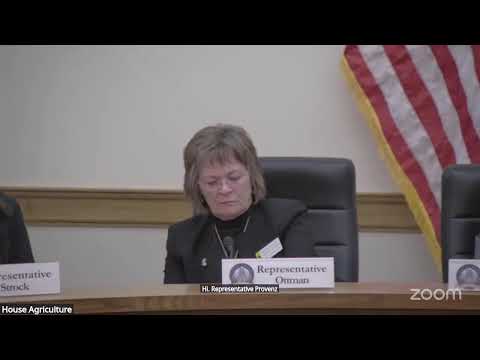
Committee action and outcome: Representative Johnson moved the bill; Representative Otman seconded. After the amendment was adopted, the committee recorded a final roll-call vote: Representative Banks—No; Representative Davis—No; Representative Eklund—No; Representative Johnson—Yes; Representative Otman—Yes; Representative Provenza—Yes; Representative Schmidt—Yes; Representative Straka—No; Chairman Winter—Excused. Tally: 4 ayes, 4 no, 1 excused. Outcome: failed to pass out of committee.
Points of continued disagreement: supporters say HB275 does not fully prohibit the vehicle‑as‑weapon conduct on public lands and that HB331 would close that last gap. Opponents say the substance is already covered in HB275 or that the measures should be reconciled; some lawmakers noted the challenge of carrying similar language on the floor after an earlier amendment effort was struck down.
Ending: The bill failed on a tie vote. Committee members said they will continue discussions about whether HB275 can be amended or whether alternative statutory language is needed to address public concern about vehicle-based killings on public lands.