Get Full Government Meeting Transcripts, Videos, & Alerts Forever!
Get email alerts on the Foreign Ownership Land topic
No spam. Unsubscribe anytime.
Committee advances bill to bar land purchases by federally defined foreign adversaries; assessors, homeland security flag data concerns
Summary
A Wyoming House committee on Thursday approved a bill to bar land purchases by entities the federal government designates as foreign adversaries, adding amendments to narrow definitions and to trigger the law only if a companion constitutional amendment passes.
A Wyoming House committee on Thursday approved a bill aimed at preventing land ownership by entities the federal government designates as foreign adversaries, while adding amendments to align definitions across related bills and to trigger the measure only if a companion constitutional amendment is approved by voters.
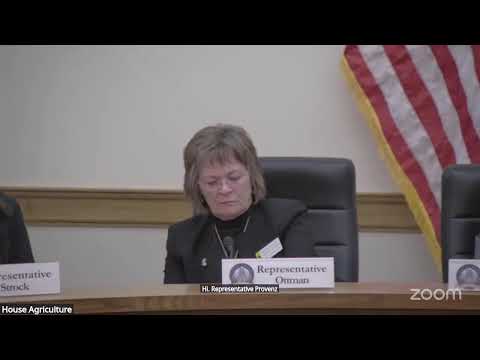
The Agriculture, State & Public Lands & Water Resources Committee voted to “do pass with amendments” on House Bill 224 by a 7–1 vote with Chairman Winter excused. Representative Davis moved the bill out of committee; Representative Otman seconded the motion.
Committee members and a range of industry and agency witnesses described the bill as narrowly targeted to entities listed under the federal foreign-adversary definition in 15 CFR 791.4 and to state sponsors of terrorism. Jody Levin, representing the Trona industry, said the bill’s definitions were revised to avoid unintentionally restricting extractive-industry employers: “So what all that language does is then say that the entities that are being defined as a foreign adversary that are prohibited from owning land would be those defined by the federal government as an adversary in 15 CFR 791.4 or entities that are state sponsors of terrorism.”
Why it matters: committee members and witnesses said the package is intended to protect state national-security interests while avoiding collateral impacts on Wyoming employers and routine conveyancing processes. Lynn Budd, director of the Wyoming Office of Homeland Security, told the committee the office supports narrowing the bill’s scope but raised a security and technical concern about the statutory data flow for “critical infrastructure zones.” Budd said the current statute requires the office to share secure zone information with all 23 counties for them to compare real‑time conveyances — a process she said risks exposing sensitive data and places a heavy technical burden on counties.
Budd urged reversing the data flow so counties upload conveyance records to the Office of Homeland Security for centralized comparison, and she identified House Bill 97 as legislation that would implement that change. “We are not very excited about sharing critical infrastructure information with 23 counties,” Budd said. She told the committee the office has not been asked to prepare a fiscal note for HB224 but that software and implementation details would need funding and further work.
Committee amendments and next steps: the committee approved several technical amendments offered by witnesses and staff. Members fixed repeated typographical uses of the word “county” when the intent was “country,” directed Legislative Service Office (LSO) to add conforming language to match House Bill 97 if it becomes law, and amended the enactment clause so HB224 would take effect only upon passage of the related constitutional amendment the committee previously sent to voters. The assessors’ association asked for clear, uniform language on how the new requirements will appear on notice-of-value forms; Todd Ernst, Laramie County assessor, said counties will need guidance because notices vary and there are “over a million conveyances in the state every year.” Ernst asked for direction on the exact text and placement for any notice language.
Public testimony: supporters who testified included industry groups (Trona industry, Wyoming Mining Association, Petroleum Association), the Wyoming Farm Bureau, and the Wyoming Farm Bureau Federation. Brett Moline of the Wyoming Farm Bureau said he supported the bill and its amendments and the approach of making the statute effective only if the constitutional amendment passes. Opposing testimony in the record was limited; the clerks association previously asked that the data flow be reversed to protect sensitive information, a point echoed by Homeland Security.
Formal action recorded: the committee motion to pass HB224 with amendments was moved by Representative Davis and seconded by Representative Otman. The roll call recorded: Representative Banks—Aye; Representative Davis—Aye; Representative Eklund—Aye; Representative Johnson—Aye; Representative Otman—Aye; Representative Schmidt—Aye; Representative Straka—Aye; Representative Provenza—No; Chairman Winter—Excused. Tally: 7 aye, 1 no, 1 excused. Outcome: approved by committee with amendments. The vice chair said he will carry the measure on the House floor.
What remains unresolved: funding and technical design for the secure crosswalk software are not finalized; the Office of Homeland Security recommended the statutory data flow be reversed (counties upload conveyances) and asked that conforming language be included so the bill can be reconciled with House Bill 97 if enacted. The assessors requested specific, uniform notice text and guidance for how to present the information to property owners.
Ending: Committee members said they would work with LSO and affected agencies to finalize conforming language and enactment timing before the bill reaches the full House. The committee meeting record shows the matter advanced with direction to coordinate language on implementation and data security.