Get Full Government Meeting Transcripts, Videos, & Alerts Forever!
Get email alerts on the Elections Voting Technology topic
No spam. Unsubscribe anytime.
Committee hears bill to ban electronic voting equipment; county clerks warn of major cost and logistical challenges
Summary
Senate File 184, which would require hand‑counted paper ballots and ban electronic voting equipment, drew lengthy testimony. Proponents cited security concerns and cited local anomalies; county clerks and the secretary of state warned that hand counting would be costly, slow, and pose privacy, chain‑of‑custody and federal‑compliance issues.
Senate File 184, a proposal to prohibit electronic voting equipment and require paper ballots counted by hand, received extensive testimony in the Corporations, Elections & Political Subdivisions Committee. Sponsors argued the measure would increase election integrity; clerks and the secretary of state said the bill would impose major operational and fiscal burdens and could create privacy and compliance problems.
Sponsor Senator Darren Smith framed the bill as an election‑integrity measure intended to restore public confidence. He told the committee that “hand counting … you might have some human errors and you might be off by 1 or 2 votes but programming errors can be hundreds if not thousands,” and said the bill’s provisions address testing, auditing and observer access.
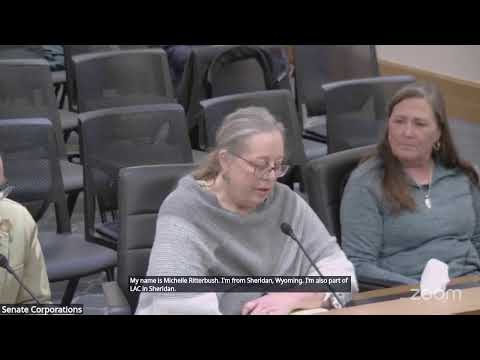
Proponents’ testimony: Several citizens and local groups urged the committee to move away from electronic systems. Jill Kaufman of Platte County and other witnesses described county-level examples they said exposed vulnerabilities: outdated software and antivirus on county machines, alleged failures in logic‑and‑accuracy testing, proprietary vendor controls over system components, and localized tabulation anomalies. Witnesses asked for a statutory prohibition or for the legislature to place a ballot initiative before voters.
County clerks’ and officials’ testimony: County clerks and the Secretary of State urged caution. Mary Langford, representing the County Clerks Association, and county clerks from Campbell, Fremont and Laramie counties testified that electronic systems have been used in Wyoming for decades and that the association opposes an outright ban without an interim study. The Campbell County clerk, Cindy Lovelace, described a hand‑count pilot her office hosted and presented the pilot’s timing and cost estimates. She said a larger, fully implemented hand‑count system in Campbell County could require hundreds to more than two thousand volunteer counters, would demand substantial training hours and staff oversight, and could cost tens or hundreds of thousands of dollars per election; the facilitators’ best‑case estimate provided to her office was 536 counters for the county and tens of thousands in implementation costs.
Lovelace also raised logistical and legal questions the bill does not resolve: how to preserve voter privacy when ballots are hand‑counted in small precincts, how to prevent or address overvotes (current optical‑scan systems prevent overvotes at the point of marking), how to staff counting operations when judges and poll workers already serve long Election Day shifts, and how to meet federal certification and audit timelines. Laramie County Clerk Deborah Lee said vote centers cannot operate without electronic poll books and that eliminating e‑poll books while allowing vote centers would create operational problems. Clerks asked the committee to refer the topic to an interim study, or to consider narrower statutory remedies (for example, more frequent or more robust post‑election audits and hand recount procedures).
Secretary of State Chuck Gray said his office supports improvements and investigations but emphasized the practical consequences. He recounted the Weston County anomaly in 2024 and said staff worked with the county and the county association to retest devices and, where appropriate, conduct a hand recount. Gray said retesting and clearer administrative guidance are among the actions his office has taken and suggested that some questions could be resolved through targeted fixes rather than a complete ban.
Other witnesses: Civic groups, election‑integrity activists and initiative backers argued hand counting is feasible and cited foreign practices and small‑scale pilots. Supporters pointed to local groups’ document requests and audits they said identified irregularities. Opponents — including several clerks and the secretary of state — said the pilot data show substantial time, cost and personnel requirements and cited privacy, chain‑of‑custody and federal‑compliance concerns.
Outcome and next steps: The committee took testimony throughout the hearing and did not adopt the measure during this session portion. Multiple witnesses asked for an interim study; county clerks urged that any change receive thorough administrative review and funding. The committee scheduled continued consideration after the Senate’s floor schedule and signaled it will take additional testimony and technical drafts before advancing any ban or major procedural change.