Get Full Government Meeting Transcripts, Videos, & Alerts Forever!
Get email alerts on the Reapportionment topic
No spam. Unsubscribe anytime.
Committee approves interim study on constitutional reapportionment after hours of rural testimony
Summary
The Corporations, Elections & Political Subdivisions Committee voted to advance Senate File 174 to form a legislative interim study on reapportionment. Sponsors and rural witnesses urged either following Article 3, Section 3 of the Wyoming Constitution or amending it to resolve conflicts with U.S. equal‑protection precedents.
Members of the Corporations, Elections & Political Subdivisions Committee voted to advance Senate File 174, a measure that would create an interim legislative management council to study constitutional apportionment and report recommendations before the 2026 session.
The bill’s sponsors, Senator Ogden Driscoll and Representative Williams, told the committee the measure is intended to give the legislature and the public time to evaluate whether Wyoming’s apportionment process can be reconciled with U.S. constitutional equal‑protection rulings or whether the state constitution should be amended. Senator Driscoll said the panel would hold meetings around the state and “make a good faith effort to apportion itself … in conformance” and, if necessary, propose constitutional changes for the 2026 session.
Why it matters: Speakers described an ongoing tension between the text of the Wyoming Constitution—particularly Article 3, Section 3, which the bill’s backers say preserves county‑based representation—and federal court rulings applying the Fourteenth Amendment’s one‑person, one‑vote principle. Backers said studying options in the interim will give rural communities a formal venue to present proposals and reduce conflict during future redistricting.
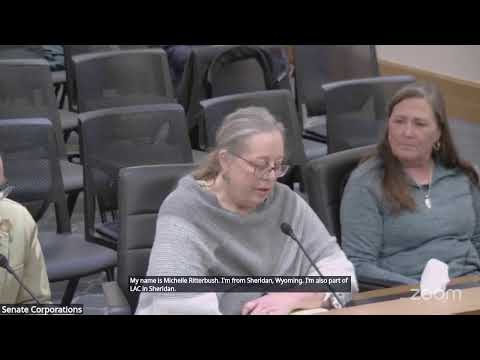
Supporters emphasized rural representation. Several citizens and local officials from Weston County and other small counties pressed the committee to either require plans that follow county lines or put a constitutional amendment to voters. Tricia Bauman of Weston County told the committee, “The people of Wyoming must authorize the legislature to act otherwise than in strict conformity with Article 3, Section 3 when redistricting.” Sue Morales, who identified herself as Weston County’s constitutional district senator, also testified in favor of the study committee.
Committee discussion focused on practical options. Witnesses and members discussed alternatives mentioned in past proceedings, including (1) increasing the size of the legislature to preserve county representation, (2) assigning weighted votes to representatives, and (3) trying to use sideboards that keep counties whole where possible while remaining within federal law. Several members said last cycle’s redistricting left some counties feeling disenfranchised and said an interim study could produce “sideboards” to reduce contention in the next plan.
Several senators who participated in prior redistricting described how political and personal considerations affected mapmaking and said a pre‑set study might reduce that influence. Sponsors told the committee the management council would gather public input statewide and “report its findings … no later than December 5” of the study year and that the council could introduce legislation in the 2026 budget session.
Vote and next steps: On a roll call in the committee the measure passed on a 5‑0 voice/roll call, with the clerk recording five ayes. The committee bill advances as a direction to form the interim study group; it does not itself change apportionment rules. If the interim group recommends statutory or constitutional changes, that would require additional legislative action and, for constitutional changes, voter approval.
What the bill does not do: The measure does not immediately alter district lines or adopt a new apportionment formula. It directs a legislative study and potential committee‑sponsored legislation for the 2026 session but leaves any final mapmaking decisions to later legislative or voter action.