Get Full Government Meeting Transcripts, Videos, & Alerts Forever!
Get email alerts on the Mental Health Services topic
No spam. Unsubscribe anytime.
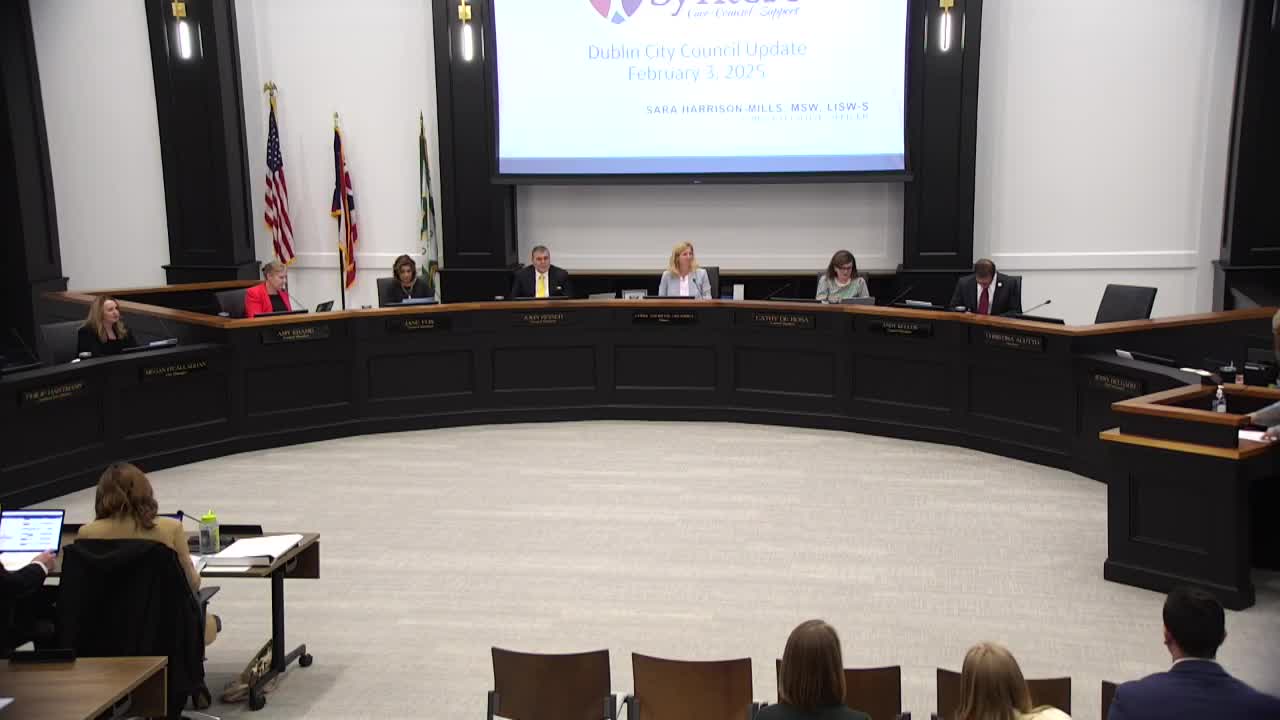
Sentaro CEO updates Dublin council on rising local behavioral‑health needs and same‑day access pilot
Summary
Sarah Harrison Mills of Sentaro briefed Dublin City Council on expanded behavioral‑health demand, workforce shortages, and a same‑day access pilot funded by the Delaware Memorial Mental Health Board; she described school‑based prevention services, an embedded public‑safety services liaison and partnerships supporting older adults.
Sentaro CEO Sarah Harrison Mills told Dublin City Council on Feb. 3 that behavioral‑health needs in Central Ohio have increased substantially and said the nonprofit is expanding services to meet demand through outreach, school‑based prevention and same‑day access pilots.
Mills said Sentaro (the organization name used in the presentation) traces its current name to a 2013 merger and has provided community behavioral‑health services for more than 45 years. She said state and national trends show an increase in adults reporting frequent poor mental‑health days and a continuing rise in suicide rates since 1999; she referenced the Franklin County Suicide Prevention Coalition’s 2024 report showing higher suicidality rates among Franklin County residents aged 75–84.
Mills said workforce shortages are limiting access and that many callers face wait times of six‑to‑nine months for treatment. To increase access, Sentaro is piloting same‑day access at its Lewis Center office with grant support from the Delaware Memorial Mental Health Board; the pilot lets individuals walk in for same‑day screening and linkage to a clinician, with the goal of expanding the model in Franklin County.
Mills described Sentaro’s school‑based prevention work in Dublin City Schools, targeted to elementary‑age students at elevated risk, as a pathway to earlier linkage to care. She also described Sentaro’s intensive outpatient programs and community outreach; more than half of Sentaro’s services, she said, occur in community settings where clinicians meet clients in homes or schools rather than at office locations.
Mills highlighted a public‑safety services liaison (PSSL) partner embedded with Dublin Police that Sentaro launched with city support. Over the past year the PSSL received 158 unique referrals and engaged 77% of those individuals in ongoing supports across roughly 1,000 encounters, according to the presentation. The liaison also helped link people to care and navigate social‑service systems; Sentaro said city and police feedback has been “overwhelmingly positive.” Sentaro said it expects to expand the PSSL model to Washington Township Fire Department.
Mills listed several community partnerships and roles Sentaro plays in Dublin: hosting the Forever Dublin Hub for older‑adult navigation services, fiscal agent for the Dublin Act Coalition (a youth substance‑use prevention coalition), contributions to the city’s community health needs assessment and participating in Envision Dublin working groups. She closed by thanking the city for support and invited questions.
Council members thanked Sentaro for the update and for its collaboration with police and the Forever Dublin program. Mills and council members discussed the workforce shortage and the role of same‑day intake in reducing wait times; Mills reiterated that the organization is piloting service models and pursuing partnerships to expand access.