Get Full Government Meeting Transcripts, Videos, & Alerts Forever!
Get email alerts on the State Legislation topic
No spam. Unsubscribe anytime.
City briefed on 89th Texas Legislature; commissioners warned of bills that could affect music and events
Summary
The City of Austin's deputy intergovernmental relations officer outlined key bills and committee changes in the 89th Texas Legislature he said could affect city authority, funding and event operations, including proposed limits on DEI programs and legislation affecting firearms at events on government property.
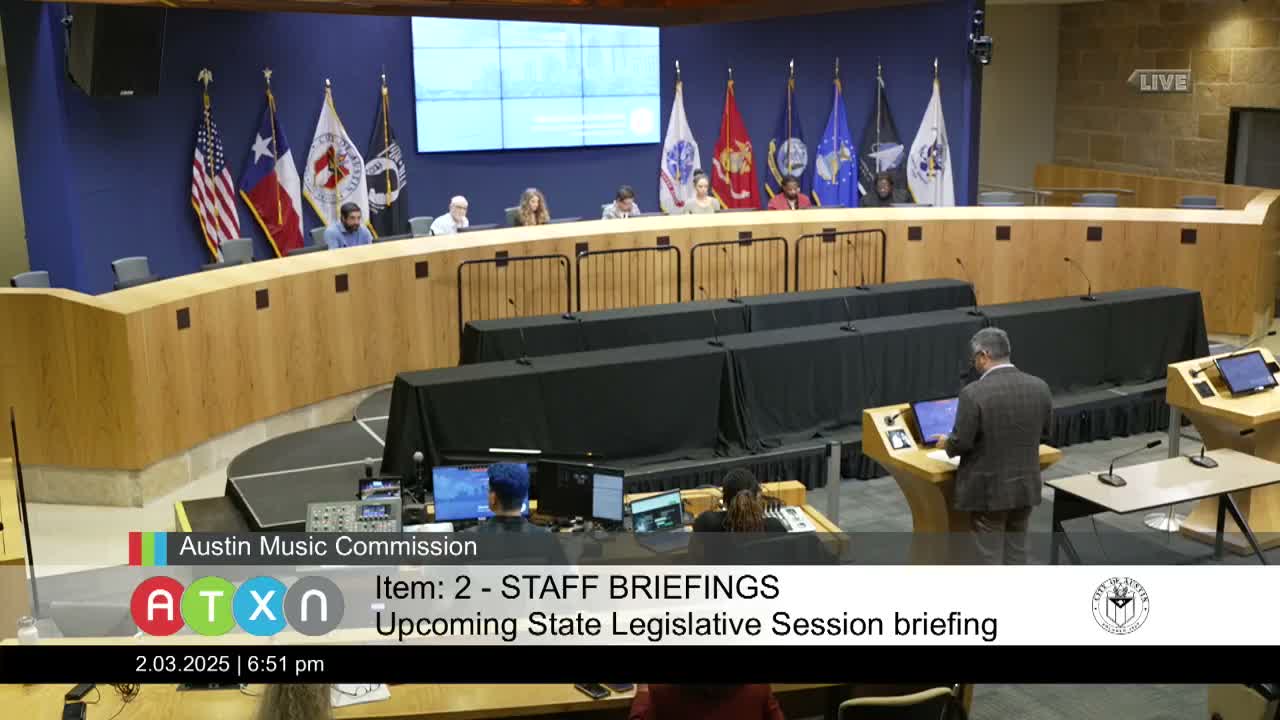
Rick Ramirez, deputy intergovernmental relations officer for the City of Austin, briefed the Music Commission on the 89th Texas Legislature and the city’s legislative priorities, telling commissioners the session will be politically charged and that several bills could affect Austin’s music and events economy.
Ramirez described the city’s legislative priorities as preserving local authority, opposing unfunded mandates, protecting natural resources and supporting vulnerable populations. He highlighted committee and leadership changes in the Texas House and Senate and warned that changes in House rules and the increase in freshman legislators will shape which bills get attention.
Ramirez flagged a set of bills of specific interest to the commission and to the city’s events infrastructure: proposed measures that would restrict the use of certificates of obligation (HB 1453; SB 470); a bill that would limit the ability of event organizers to prohibit firearms at events held on government property (HB 1715); data-sharing legislation related to homelessness (HB 636); an artificial intelligence bill (HB 1709); bills to make birth certificates available to people experiencing homelessness at no cost (HB 505, HB 1042); and a suite of bills and executive actions targeting diversity, equity and inclusion programs (HB 167, HB 1521, HB 436).
On HB 1715 — the firearms-related bill Ramirez said is “being watched closely” — he explained how the measure as filed would prohibit event organizers from forbidding licensed handgun carriers from bringing firearms to events held on government property, which the city believes could affect large festivals and city-hosted events such as South by Southwest or Austin City Limits. Ramirez said this is a matter the city is monitoring with other municipalities and event organizers.
Commissioners asked questions about the bills’ effective dates, legal challenges and what parts of the city’s programming could be affected. Ramirez urged commissioners to treat news reports that a bill has “passed the House” cautiously because passage in one chamber does not make law; after conference, a bill still must go to the governor and could be vetoed.
Ramirez also outlined that the city’s intergovernmental relations office has launched a Unified Grants Program to develop a coordinated strategy for competitive grant-seeking at state and federal levels, and he invited commissioners to contact his office with questions and to request clarifying materials on the governor’s recent executive orders. The office will provide updates to departments on effective dates and work with legislators if an effective date is too short for city compliance.
Ramirez closed by saying the city will continue to monitor bills that affect Austin Water and Austin Energy, homelessness, land-use preemption, debt restrictions and other local-government matters and would return with more detail as bills develop.