Get Full Government Meeting Transcripts, Videos, & Alerts Forever!
Get email alerts on the Austin Live Music Fund topic
No spam. Unsubscribe anytime.
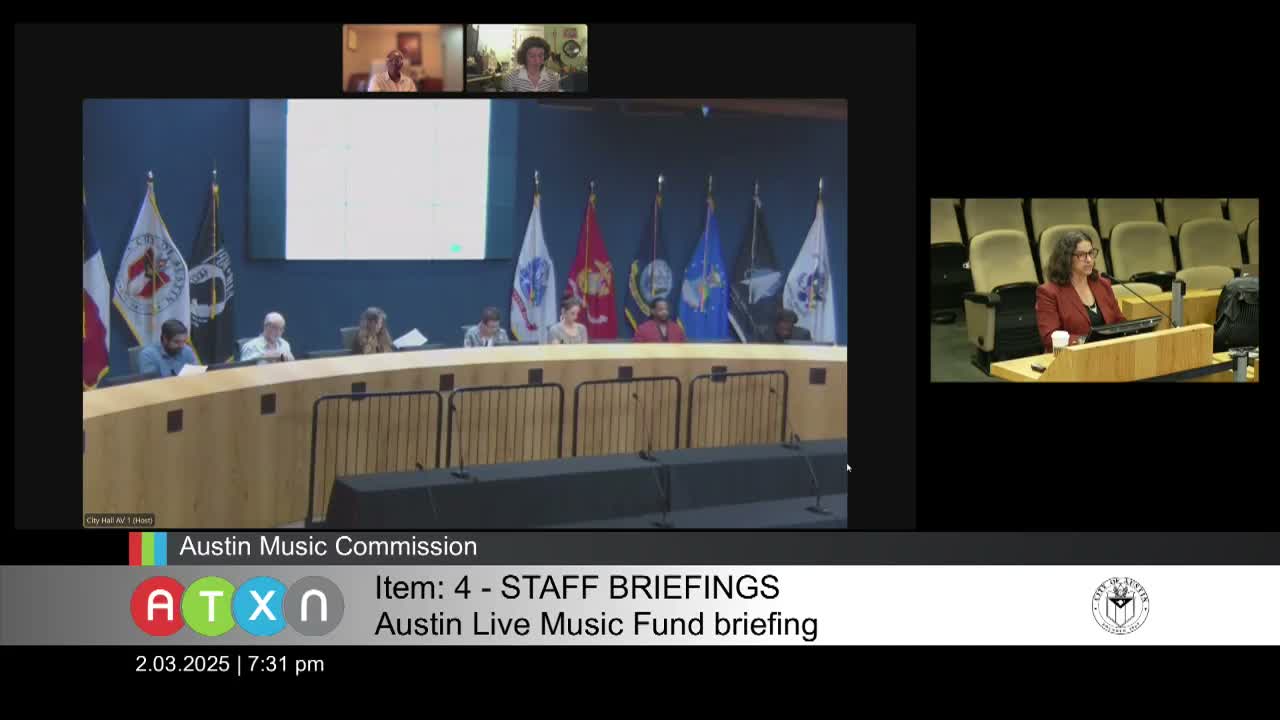
Music Commission approves updated Austin Live Music Fund guidelines after contested debate
Summary
The Austin Music Commission voted to approve revised guidelines for the Austin Live Music Fund, changing award tiers, scoring emphasis and outreach requirements amid debate about eligibility, project definitions and community input.
The Austin Music Commission on March 3 approved updated guidelines for the Austin Live Music Fund, adopting a two-tier award structure, new scoring priorities and a renewed emphasis on outreach to ensure applicants understand the program.
Commissioners voted to keep venue awards at the previously adopted $30,000 and $60,000 tiers while restructuring musician and independent-promoter awards into $5,000 grants (one-year) and $20,000 grants (two-year). The motion was presented to the commission and announced as approved during the meeting; the transcript records the chair’s announcement that the motion passed.
The commission and staff described the change as an effort to expand the program’s reach while prioritizing demonstrable musician career accomplishments. Under the approved guidelines, applications for musicians and promoters will be scored with 50% weight on career accomplishments, 25% on local economic impact, 20% on past and future marketing plans and 5% on accessibility features (pending legal review). Staff clarified that allowable uses of funds remain those enumerated in hotel occupancy tax rules and the program’s published guidance.
The vote followed lengthy public and commissioner discussion. Commissioner Scott Strickland, who led community outreach and presented a separate set of recommendations gathered from musicians and promoters, repeatedly pressed for tighter residency verification, project-based awards with a required public-facing exhibition component, and a larger number of smaller grants. Strickland said the working-group and community feedback showed concern that prior rounds had allocated awards to projects with limited public exhibition and that verification and audit processes should be strengthened: “The proof of work: what has the artist done to qualify them receiving the funds for the project that they want to create?” (Commissioner Scott Strickland).
Staff and working-group members pushed back on some of the stricter proposals while accepting several changes. Erica Shamley, music and entertainment division manager, summarized program metrics from 2024 and the planned adjustments, including the two-tier award structure and a revised online application workflow intended to reduce missing documentation. Shamley told the commission: “We give this to you every month that you can kind of go through and see. We have a 131 signed agreements so far for 2024… and we have 124 first payments, which is wonderful, 85%.” (Erica Shamley).
Community representatives and the Austin, Texas Musicians (ATXM) presentation informed the discussion. Pat Gupta and other community presenters urged continued transparency of scoring and recommended prioritizing economic-impact metrics and clearer outreach to underserved musicians. The commission accepted a staff recommendation to expand outreach and publicize application guidance earlier and more widely, including workshops and preview materials.
The approved motion directs staff to implement the new scoring and award structure for the next funding cycle and to continue coordinating with the live-music working group and community partners on outreach and application assistance. Staff also will continue using Submittable and the city’s public-input tools for surveys and feedback. The motion was announced as approved by the chair during the meeting; the transcript does not record a full roll-call vote with individual tallies.