Get Full Government Meeting Transcripts, Videos, & Alerts Forever!
Get email alerts on the Immigration Enforcement topic
No spam. Unsubscribe anytime.
Committee approves bill banning sanctuary policies in Wyoming, adds enforcement amendment
Summary
The Corporations, Elections & Political Subdivisions Committee voted 8–1 to pass House Bill 133, a measure that would prohibit sanctuary policies at state and local levels; the committee adopted an amendment clarifying which employees are treated as "peace officers" for enforcement provisions.
The Corporations, Elections & Political Subdivisions Committee voted 8–1 to pass House Bill 133, “Sanctuary Cities, Counties, and State Prohibition,” advancing a measure that would prohibit sanctuary policies and add penalties for local governments and certain local officials who refuse to cooperate with federal immigration authorities.
Sponsor Representative Joel Guggenmas introduced the bill, saying it would “ensure uniform enforcement of federal immigration laws across Wyoming” and would create two new statutes, define prohibited policies for cities, towns and counties, and establish penalties for noncompliance. He said the measure is intended as a preemptive step to prevent sanctuary policies from developing in Wyoming.
The bill drew support from Wyoming Secretary of State Chuck Gray, who told the committee he backed the measure and urged adding a private civil cause of action to allow individuals to sue where prosecutors or the attorney general do not enforce the statute. Secretary Gray also said a sanctions approach that withholds state funding from noncompliant jurisdictions would be an effective enforcement tool.
Opponents included Antonio Serrano, advocacy director for ACLU Wyoming, who said the episode in Teton County cited by supporters did not show wrongdoing and that local law enforcement there had followed the law. Serrano said the bill would erode trust between immigrant communities and local law enforcement, risking underreporting of crimes by immigrant residents.
Jim Ford, speaking for the Wyoming County Commissioners Association, told the committee the association opposes the bill as drafted because some penalty provisions (identified in testimony as provisions beginning on page 4, line 20, and page 6, line 7) are overly harsh and target local government without addressing state employees. The association requested deletion of those penalty subsections or other changes to reduce the burden on counties.
Representatives also heard technical wording changes and a proposed amendment offered by the Wyoming Association of Sheriffs and Chiefs of Police (read into the record by Colter Felton). The committee approved that amendment, which moves the phrase “peace officer” in the statutory definition for “local official or employee” so that peace officers are listed immediately after “managerial employee” (the amendment was described as appearing on page 3, line 7, romanette 5 in the draft). The amendment passed by voice vote.
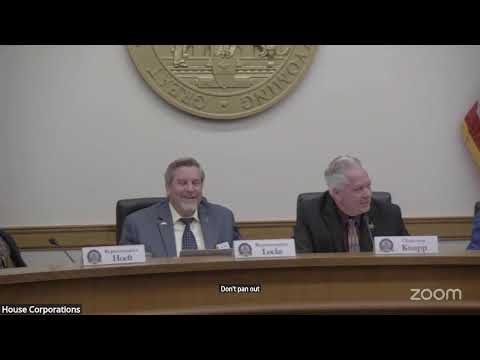
After public and agency testimony and debate, Representative Brown moved to advance the bill and Representative Weber seconded. The committee adopted the amended bill on a roll-call vote: Representatives Brown, Locke, Heft, Johnson, Lucas, Webb, Weber and Chairman Knapp voted aye; Representative Yin voted no. The clerk recorded the tally as 8 ayes, 1 no.
The committee minutes show the measure would also amend identified Wyoming statutes as referenced in the bill text and provide for an immediate effective date. Committee members and witnesses flagged three implementation concerns: (1) whether local officials would have adequate training or authority to respond to immigration inquiries, (2) whether enforcement would rely solely on prosecutors and the attorney general, and (3) whether a private right of action should be added to provide alternative enforcement.
The committee record shows the bill now proceeds from committee as amended. No floor adoption or enactment date was recorded in the committee hearing.