
School board approves first readings of several policy changes, defers weapons clarification
Get AI-powered insights, summaries, and transcripts
Subscribe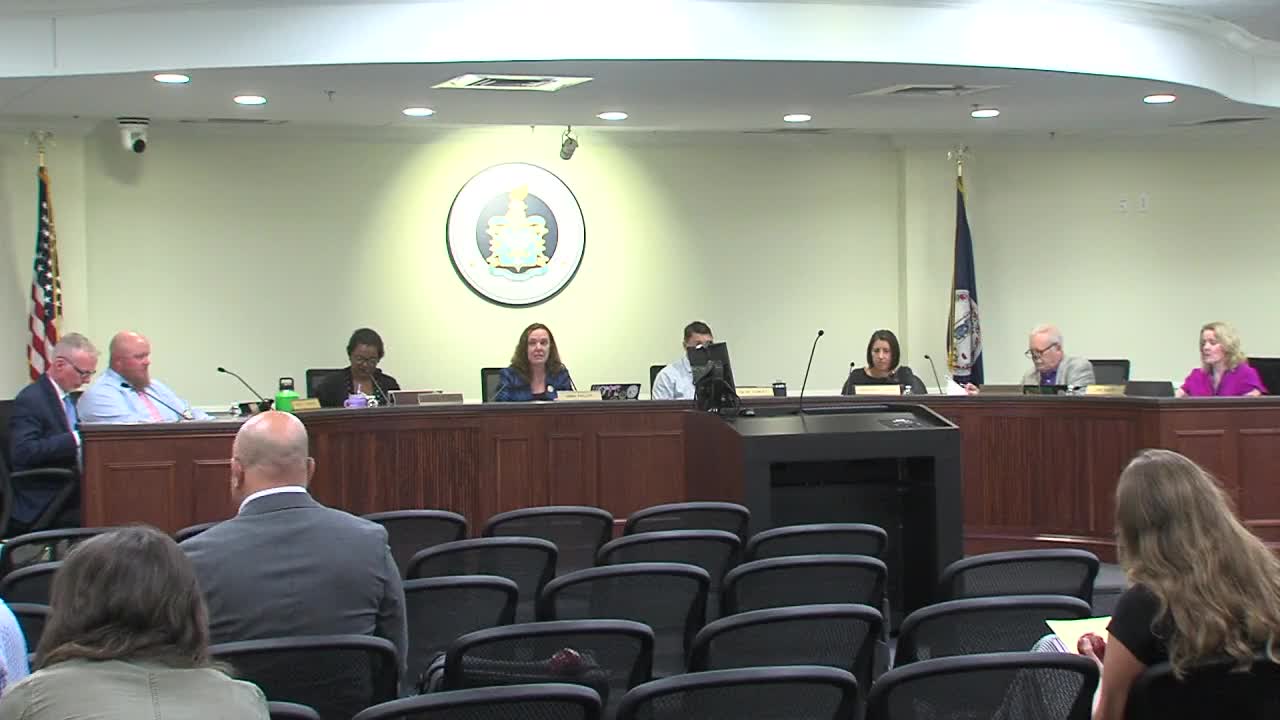
Summary
At its Oct. 7 business meeting the Harrisonburg City School Board approved first readings of multiple policy revisions—covering attendance-area waivers, facilities wording, crisis teams, student transcripts, opioid antagonists and more—while asking staff to return with clarifications on weapons language related to non‑firearm items.
The Harrisonburg City School Board on Oct. 7 approved first readings of multiple policy revisions and additions, and asked staff to clarify language on weapons in school policy before returning it to the board.
Board members voted to approve on first reading updated or new policies including Policy 2-15 (communication), Policy 402 (school attendance areas), Policy 337 (buildings and grounds maintenance), Policy 418 (crisis and emergency management), Policy 442 (opioid antagonists), student transcripts policy, alternative pathways for credit policy (credit by exam/language proficiency), college- and career-readiness policy (7.55), and a new accelerated-mathematics placement policy required by state legislation. Most approvals were made by motion and unanimous voice vote on first reading; several items were described as aligning the division with Virginia School Boards Association (VSBA) model language or recent state requirements.
Why it matters: The package touches core operations—where students attend, how credits and transcripts are handled, building and safety wording, and how the division responds to medical emergencies (opioid antagonists). The board’s request for clearer weapons language signals attention to how the division will document discipline for firearms and other weapons separately.
Key details
- Policy 2-15 (communication): Staff removed a reference to the “student‑superintendent’s advisory council” after the board’s collective bargaining resolution designated the Harrisonburg Education Association (HEA) as the exclusive representative for staff in the two bargaining units that cover all staff except administrators. The change was described in board discussion as an alignment step following the collective bargaining resolution.
- Policy 402 (school attendance areas): Sal Romero, Chief of Staff, described an added clarification: when students move mid‑semester the division will generally offer them the option to remain at their current school through the semester, with a waiver process for staying beyond that point. Romero said the policy text intends that “we intend for them to stay if they choose to stay,” and explained waivers will require principal and superintendent approval.
- Policy 337 (buildings and grounds maintenance): The board directed a wording change in the policy’s last sentence so it reads that school administration “is responsible for equipping” exit doors with panic hardware (rather than language that could be read to require principals to perform physical installation).
- Policy 418 (crisis and emergency management): Board members asked staff to change singular references to “crisis intervention team” to plural form because the division maintains both building‑level teams and a divisionwide team that provides additional support. A regulation detailing requirements from the Code of Virginia will be posted alongside the policy, staff said.
- Policy 440 (weapons in school): Board members and staff flagged that one subsection appeared limited to firearms while other weapons and associated disciplinary language are handled elsewhere (Policy 412 on student conduct). Mr. Prince (policy presenter) and staff said they will “go back and ensure that we’re covering other weapons outside of firearms” and return amended language.
- Policy 442 (opioid antagonists): The board approved adding a standalone policy on opioid antagonists. Staff noted the new policy reflects existing language cross-referenced in Policy 428 (administering medicines) and is consistent with VSBA model language.
- Student transcripts and alternative-credit policies: The student-transcript update formally records an existing practice that families who choose to expunge a middle‑school, high‑school‑credit grade (for example Algebra I taken in eighth grade) cannot later reverse that expungement; if the grade is removed the student must retake the course for credit. A separate update clarified the division’s credit-by-exam pathway for world languages and added authority for a locally developed proficiency test when national or vendor tests are not available (the presenter described Kurdish as an example where a local test has been used).
- College and career readiness; accelerated math placement: Updates were largely to align with state requirements and clarify practice across elementary, middle and high school. Staff described a new state-driven requirement for automatic placement into accelerated math based on SOL quartile results; the division will place students if there is course availability and families may opt out.
Board process and next steps
Most policy edits were described as aligning HCPS with VSBA model policies and Code of Virginia requirements. The board approved the items on first reading and asked staff to refine the weapons language and to post related regulations or cross‑references where necessary. Staff said the weapons policy will return with clarifications and that regulations required by the Code will be posted after the board’s action.
Quotes
Sal Romero, Chief of Staff: “...when a student moves in the middle of the year...we intend for them to stay if they choose to stay.”
Mr. Prince (policy presenter): “We will go back and ensure that we're covering other weapons outside of firearms.”
Ending
The board handled the package as information items and first‑reading approvals; follow-up language on weapons and the posted regulations for crisis management were the main items staff must return with at a later meeting.