Get Full Government Meeting Transcripts, Videos, & Alerts Forever!
Get email alerts on the Voting Methods topic
No spam. Unsubscribe anytime.
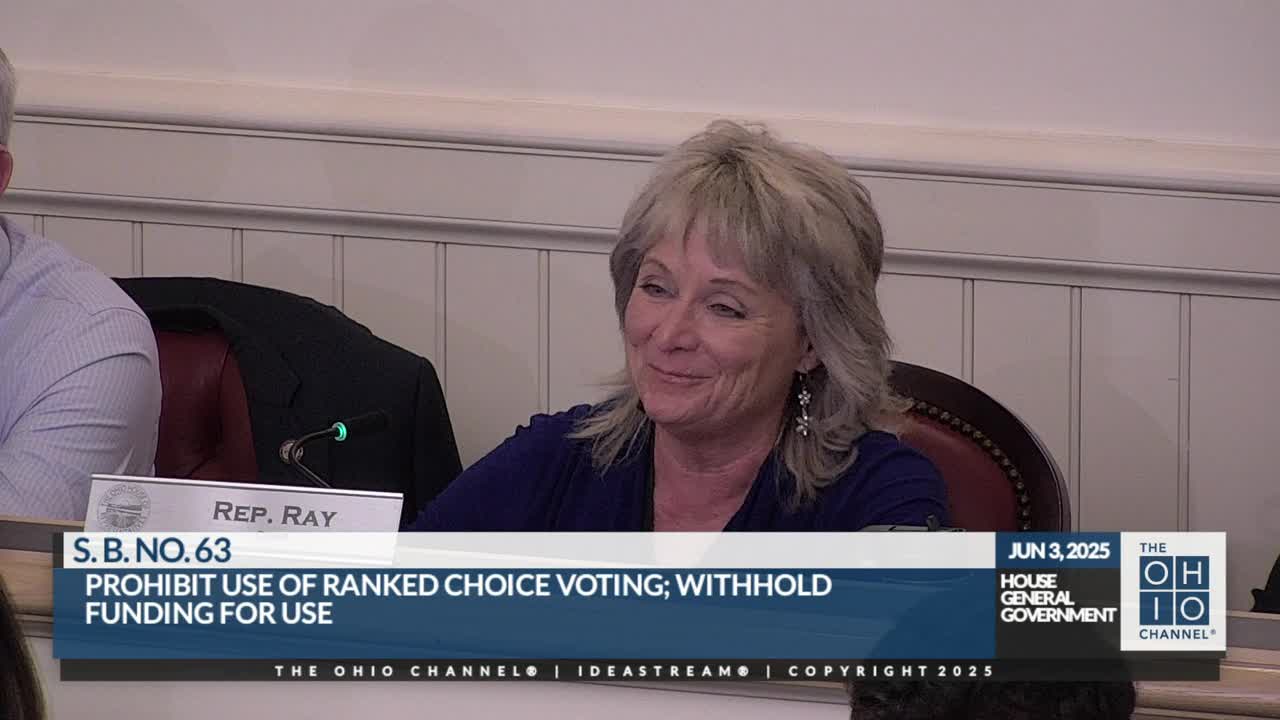
Sponsor urges committee to ban ranked-choice voting statewide in Senate Bill 63
Summary
At its first hearing, a Senate sponsor urged the committee to prohibit ranked-choice voting statewide, citing tabulation delays, voter confusion and examples of tabulation errors; members pushed back with historical context and questions about local control and turnout.
A senator appearing before the Ohio House General Government Committee at the first hearing for Senate Bill 63 urged members to pass legislation that would prohibit ranked-choice voting (also called instant-runoff voting) in Ohio, arguing it would reduce confusion, speed results and preserve confidence in elections.
The sponsor told the committee that ranked-choice voting “continuously eliminates candidates in a series of rounds until one candidate wins a majority, 50% plus 1 vote,” and said the method can delay final results for days or weeks and has produced tabulation errors in other jurisdictions. The sponsor cited examples including a California school board contest in which an audit changed a certified result and said five states rejected ranked-choice voting ballot measures in 2024.
The bill as described by the sponsor would prohibit ranked-choice voting in all elections in Ohio except as permitted under an Ohio Supreme Court decision from 1923 for municipalities or chartered counties; the sponsor added that municipalities choosing ranked-choice voting could be deemed ineligible for local government fund distributions. The sponsor said the bill was supported by an overwhelming Senate vote.
Committee members pressed the sponsor on historical context and equity concerns. Representative Friend said the 1931 repeal of ranked-choice voting in some Ohio cities was driven, in part, by party bosses and racist backlash; she told the committee that the historical record shows racial and political motives behind that repeal. Other members asked for evidence on turnout effects, the length of time required to tabulate ranked-choice elections, and whether the bill would unduly limit local control. The sponsor cited anecdotes of lengthy tabulations and described scenarios in which final winners differ from initial round leaders.
No committee vote was taken during the first hearing. The committee concluded the hearing after multiple questions and indicated stakeholders on both sides could return with data and testimony in later hearings.