Get Full Government Meeting Transcripts, Videos, & Alerts Forever!
Get email alerts on the Opioid Overdose Prevention topic
No spam. Unsubscribe anytime.
Clackamas County public health trains Estacada committee on fentanyl, naloxone distribution and local outreach
Summary
April Herron of Clackamas County Public Health briefed the Estacada DEIC on rising fentanyl-related deaths, local trends and how to use and obtain naloxone; the committee approved a newsletter blurb and the meeting recorded other outreach commitments.
April Herron, lead for substance use and overdose prevention at the Clackamas County Public Health Division, told the Estacada Diversity, Equity & Inclusion Committee on Tuesday that fentanyl-driven deaths remain the dominant driver of overdose fatalities in the U.S. and in Oregon and described county efforts to expand naloxone access and training.
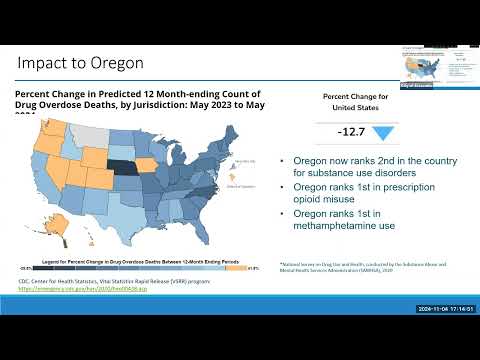
Herron said the nation has moved through several waves of the opioid crisis — prescription opioids, then heroin, then illicit fentanyl — and now sees more fentanyl mixed with other drugs. "Deaths from synthetic opioids, primarily fentanyl, made up about 70,000 of those deaths or 66 percent," she said, citing national data. In Clackamas County she said public-health tracking showed 119 county residents died of drug-induced causes in the 2023 numbers the county had been sharing.
The presentation focused on how naloxone (Narcan) works, common myths, legal protections and practical steps for responding to an opioid overdose. Herron said naloxone is a medication that "can reverse the effects of an opioid overdose," and clarified myths such as that naloxone encourages drug use or is itself addictive. She said naloxone is now available over the counter, costs about $38 for a two-dose box in retail pharmacies, and that the county stocks limited supplies for businesses and community partners.
Herron walked the committee through recognition and response steps: try to rouse the person, check breathing, call 911, administer naloxone (nasal spray) and time two minutes to see if a second dose is needed, and provide rescue breathing if comfortable doing so. She told the committee that the goal is to restore independent breathing, not necessarily to have the person immediately up and alert.
Herron described local harm-reduction and distribution efforts: three Narcan vending machines in Oregon City (a jail lobby, a parole-and-probation office and a transition center), county partnerships with the harm-reduction group OutsideIn, and a navigation campus and detox facility that Measure 110 funding helped advance. She also said Clackamas Fire District handles the majority of overdose responses in the county and that, in her experience, it is "very rare" someone needs more than two doses of naloxone in the field.
Herron reviewed two laws she said matter for community distribution: the Good Samaritan law that protects people who administer naloxone in good faith, and 2023 House Bill 2395, which she said extends liability protections for public businesses, schools and public buildings that make naloxone available to the public. She also said fentanyl test strips were legalized under components of that legislation and can now be distributed by harm-reduction partners.
Committee members asked about practical outreach steps. Herron recommended targeting apartment complexes and businesses in higher-rate ZIP codes and offered county flyers, training videos and upcoming county trainings (a Zoom session and an in-person training). She said the county can supply naloxone to organizations that request it but places upper limits on direct distribution to individual residents because of staff capacity.
Tyra Baird, introduced as the new Estacada prevention specialist with "Todos Juncos" (as she identified herself), described planned school and community prevention activities and offered to coordinate with county work groups. Committee members and staff discussed using DEI committee funds to acquire additional naloxone for local distribution; staff indicated that city-level purchases would be possible but should be confirmed with budget-holding departments.
Votes at a glance: the committee approved two routine items during the meeting: approval of prior meeting minutes and approval of newsletter copy to include a DEIC blurb in the city newsletter. Both motions passed by voice vote of members present.
Why it matters: Herron framed naloxone distribution and outreach as harm reduction that saves lives and creates opportunities to link people to treatment and services. She emphasized gaps the county tracks: many people who die of an overdose are not connected to health care, about 36 percent of decedents had a diagnosed mental-health illness and nearly 20 percent were houseless at the time of overdose in the report she cited.
The committee asked the county to provide flyers, decals and contact information so local businesses and apartment managers could request kits and training. Herron said the county will support Estacada’s outreach and trade supplies as funding and supply allow; she noted naloxone boxes have expiration dates and county staff can swap out expiring boxes when resources permit.
The presentation included a request for the committee to map local “hot spots” and to partner with the county and local nonprofits to put naloxone in the field. For youth resources, staff announced a local youth-recovery group schedule provided by Ant Farm, and committee members offered to coordinate outreach to downtown businesses and the local chamber of commerce.
Sources: presentation and Q&A with April Herron, Clackamas County Public Health Division; local announcements from Estacada DEIC members and community partners.