Denver committee presses administration for clearer best‑value contracting rules and more transparency
Loading...
Summary
The Budget and Policy Committee heard agency briefings on Denver's use of "best value" procurement, discussed worker protections, small‑business barriers and on‑call contract transparency, and requested follow‑up materials and draft policy language.
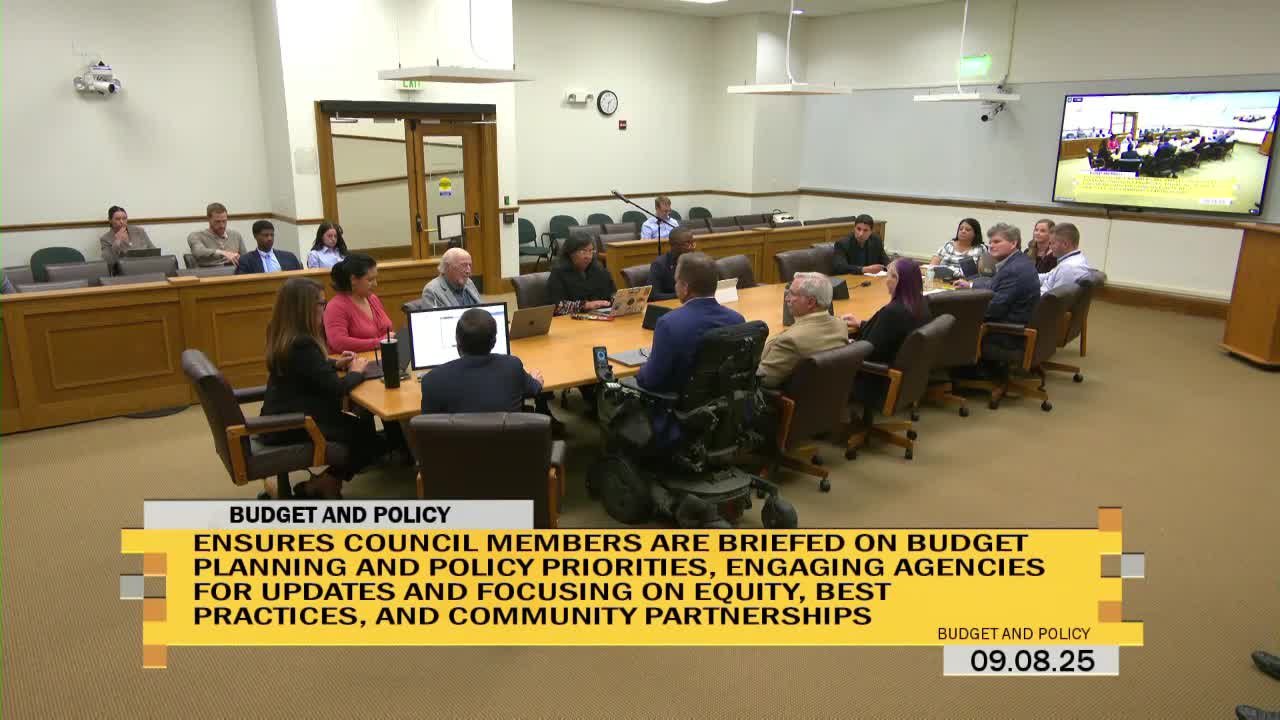
The Budget and Policy Committee of the Denver City Council heard a briefing Oct. 29, 2025, on the city's use of "best value" contracting, with presentations from General Services, the Department of Transportation & Infrastructure (DOTI), the mayor's office and the city attorney's office. Council members pressed staff about how best value is defined and applied, how worker protections and small‑business participation are weighed, and what transparency measures the city will adopt for on‑call contracts.
Committee members said the topic matters because procurement choices affect worker pay and safety, subcontractor payment, small‑business opportunity and how public money is spent. Councilwoman Amanda Sawyer and several colleagues asked for clearer, citywide criteria and for the administration to publish evaluation matrices so prospective vendors know how proposals will be judged.
Agency presenters outlined the legal and operational framework that currently allows Denver to contract on a best‑value basis rather than on price alone. Michael Romero, director of purchasing for General Services, told the committee the Denver Revised Municipal Code includes a definition of best value and that some solicitations are evaluated on criteria beyond price. Romero said the code definition appears in "chapter 20, article 4, division 2, definition section 20‑61" and that the city's request‑for‑proposal method permits awards where "an award is made in consideration of best value and not necessarily lowest price." Nicole Sundreth, citywide contracts manager, added that evaluation factors can include local service availability, life‑cycle cost and past performance: "we actually are very thoughtful when we're awarding agreements based on what the service type is."
Speakers from DOTI described how construction and public‑works contracting use a prequalification process for larger projects. Dave Adams, DOTI's director of contracts and procurement, said vendors typically must prequalify for projects valued at $1,000,000 or more and that prequalification evaluates bonding, financial condition and safety history (including experience modification rate, or EMR). Adams said the EMR is reviewed across multiple years and that a single year's incident would not generally disqualify a small firm.
Council members raised specific concerns and examples. Amanda Sawyer asked why, despite a best‑value framework, lower‑price bidders often win. Adams and other procurement staff said some solicitations remain price‑focused because the service is narrowly defined or because only a single responsive bidder existed. Councilman Hines (reported in the briefing as Councilman Hines/Hineskind) and others pressed about on‑call contract usage and transparency; committee members cited one example where about $7,000,000 was awarded to an on‑call vendor for a transportation project funded after a ballot measure, a decision that some council members said warranted fuller public procurement.
Labor and equity issues also featured. Dominic Moreno of the mayor's office told the committee a memo from SEIU and related labor partners raised concerns about whether the city's procurement processes consistently incorporate labor and safety protections; Moreno said those concerns informed the slide titled "union concerns." Robert Wheeler of the city attorney's office said the administration is drafting revisions to Executive Order XO8 that will explicitly mention and encourage best‑value contracting and that a draft will be available "in the very near future." Moreno and staff said the administration has engaged with multiple labor organizations, including building trades and IBEW, about these issues.
Committee members asked about how the city measures contractor performance and whether performance ratings could allow subcontractors to advance to prime status. DOTI and General Services staff discussed work to reduce paperwork in prequalification (from a prior 34 pages to 17) and to move to a biennial renewal cycle, and they said certified audited financial statements are required only once firms reach a $15,000,000 threshold. Staff also described efforts to consolidate contracting functions, create a central resource hub inside General Services and migrate the small‑business compliance team to General Services to standardize practices across agencies.
Host (the city's homeless services agency) told the committee it incorporates best‑value principles and is also shifting toward performance‑based contracting, Jeff Kositzky, Host deputy director, said.
Committee members asked for more detail on several items: the proposed XO8 revisions, the administration's responses to the SEIU memo, the mechanics of prequalification for smaller firms, how EMR and past performance are weighted, and improved reporting on how much on‑call contracts are actually spent. Staff said briefings on on‑call contracts and specific procurement categories would follow; they also said a draft policy will be circulated for committee review once staff have compiled council preferences from the discussion. No formal action or vote was taken at the meeting.
"We're currently working on a revision to XO8, and one of the changes that I think you can expect to see in that is explicitly mentioning and encouraging best value contracting," Robert Wheeler said. Dominic Moreno summarized the labor input: "Those are all concerns that were brought forward by some of our labor partners." Michael Romero noted the municipal code basis for RFPs: "we do have a definition for best value within our code."
Committee leaders asked staff to return with more detailed matrices and a draft policy. Staff said they would hold additional briefings on on‑call contracts and circulate a draft policy for committee review and continued discussion.
For next steps, staff said they will compile feedback from council members, circulate draft language tied to the XO8 revisions and schedule follow‑up briefings on on‑call contracts and agency implementation plans. Committee members indicated they want published evaluation criteria so businesses can prepare proposals to the city's stated priorities.