
TACIR subcommittee: virtual school counts distort county fiscal capacity; staff recommends reporting student residence
Get AI-powered insights, summaries, and transcripts
Sign Up Free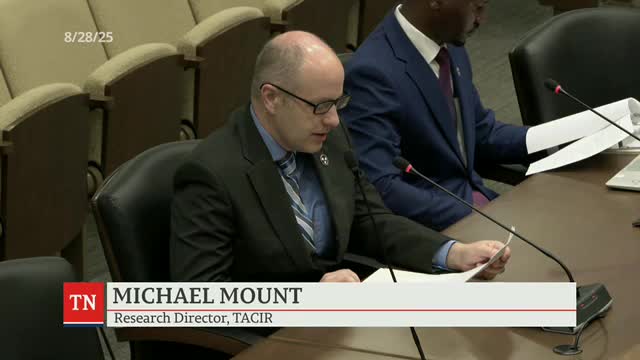
Summary
Members of the Tennessee Advisory Commission on Intergovernmental Relations Education Finance Subcommittee heard that virtual-school ADM reporting can distort county fiscal-capacity calculations and unanimously recommended the commission ask the state to report each virtual pupil's county of residence.
Members of the Tennessee Advisory Commission on Intergovernmental Relations (TACIR) Education Finance Subcommittee heard staff findings that the way virtual-school students are recorded for average daily membership (ADM) can produce distortions in the state fiscal-capacity calculation and recommended the state collect each virtual student's county of residence.
TACIR Director Lippert summarized staff work and said the commission's fiscal-capacity model uses multiple linear regression to calculate per-pupil fiscal capacity and that virtual students affect several variables in the model. "These students can increase the host county service responsibility," Lippert said, which "can cause the fiscal capacity for the host county to go down," while in other cases including virtual students in the model "can increase the fiscal capacity of a county that hosts a virtual school," with offsetting effects on other counties.
Research Associate Ismael Tanui presented the staff analysis. He said virtual students are counted as enrolled where the virtual school is located rather than where the student resides and that the Department of Education does not publish residency data for virtual pupils. Tanui reported enrollment growth in virtual schools from 3,872 ADM in 2019–20 to 14,495 ADM in 2024–25 and showed county examples: Union County has 2,685 virtual ADM out of a reported total ADM of 5,730, and Johnson County has 2,893 virtual ADM out of a reported total ADM of 4,501 (as presented to the subcommittee). Tanui also showed changes in state-share percentages for those counties across recent years.
Committee members pressed staff on which counties are advantaged or disadvantaged in any given year. Director Lippert and members explained the net effect varies year to year because the regression model's coefficients (the relative weights on tax-base, income and service-responsibility measures) change with underlying data. "It depends," Lippert said. "It varies from year to year."
Several members argued the missing residency data is low-hanging fruit. Lippert and Tanui said local systems and virtual schools already collect residency information, but the Department of Education does not publish county-of-residence breakdowns for virtual pupils; staff recommended the commission ask the state to collect and report that information so TACIR can run more precise analyses. The subcommittee voted by voice to forward that recommendation and the memorandum to the full TACIR; the chair recorded the voice vote as unanimous.
The staff cautioned that this analysis focused solely on funding ramifications of enrollment reporting, not on program quality or educational outcomes. Lippert described one modeling option the staff could test if residency data were available: assign a virtual student's ADM to the resident county for some tax-base factors while retaining the host county ADM for service-responsibility measures and local-revenue calculations, rather than removing virtual students entirely from the model.
The subcommittee asked staff to include the memorandum and the residency-reporting recommendation in the packet for the full commission meeting on Sept. 18.
Ending: TACIR staff will present the subcommittee's summary and recommendation to the full commission; staff said additional modeling or comparative research could follow if the state begins reporting county-of-residence for virtual pupils.