Get Full Government Meeting Transcripts, Videos, & Alerts Forever!
Get email alerts on the Liheap topic
No spam. Unsubscribe anytime.
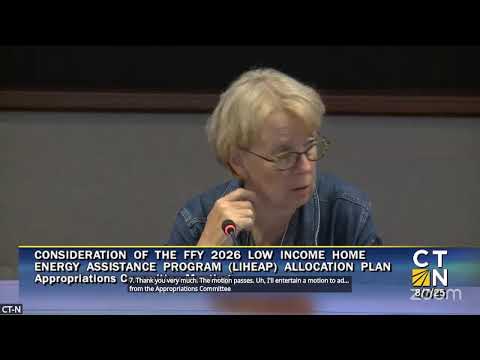
Connecticut details FFY2026 LIHEAP allocation plan; committees approve amid federal uncertainty
Summary
The Department of Social Services on Aug. 1 presented its proposed federal fiscal year 2026 allocation plan for the Low Income Home Energy Assistance Program (LIHEAP), outlining flat federal block-grant assumptions, increases in basic benefit levels and new vendor payment options while warning of federal funding and administrative uncertainty.
The Department of Social Services on Aug. 1 presented its proposed federal fiscal year 2026 allocation plan for the Low Income Home Energy Assistance Program (LIHEAP), outlining flat federal block-grant assumptions, increases in basic benefit levels and new vendor payment options while warning of federal funding and administrative uncertainty.
Commissioner Andrea Barton Reeves told members of the Appropriations, Human Services and Energy & Technology committees that the state projects level federal block-grant funding and plans to use carryforward funds to meet an anticipated 5% enrollment increase. "LIHEAP's purpose is to assist low income families with heating assistance," Reeves said, describing the proposal as data-driven and intended to preserve both basic and crisis benefits for vulnerable households.
The plan keeps the LIHEAP block-grant spending near recent levels and builds multiple crisis payments into the benefit structure. Reeves said the administration proposes a basic benefit increase across income bands — for the program’s most vulnerable tier the benefit rises from $530 to $645 — and incorporates up to three crisis rounds (the plan also includes four rounds in some projections) based on prior-year usage data. Income eligibility remains tied to the federal/state standard used by LIHEAP programs, the commissioner said; the transcript noted the program applies to households at or below 60% of state median income.
Why it matters: LIHEAP is the principal source of federally funded heating assistance for low-income Connecticut households. State choices about how to allocate a finite block grant affect how many households receive basic benefits, which households can access additional crisis payments, and how quickly vendors are paid for deliverable-fuel deliveries.
Key funding and program details - Block-grant and carryforward: DSS presented past-year figures and projections showing roughly flat federal block-grant assumptions, with the plan using carryforward dollars to create flexibility. The plan referenced roughly $89.2 million in total available funds when carryforward and refunds are included and cited approximately $7.2–$7.3 million in carryforward on hand. Reeves said the budget projection assumes a 5% increase in enrollment for the coming program year. - Benefit structure: The plan raises the basic benefit across income tiers (the highest basic level increased from $530 to $645, per DSS) and explicitly folds multiple crisis payments into the allocation so households that exhaust initial benefits can receive additional crisis rounds. DSS confirmed crisis benefits are limited to deliverable-fuel households (oil, propane, kerosene) while all eligible households receive the basic benefit. - Vendor payments and pricing options: DSS described two new vendor payment options created after a stakeholder work group: a margin-over-rack reimbursement tied to multiple regional racks (Bridgeport, Hartford, Norwich and New Haven) to better reflect geographic price differences, and a discount-off-retail (DOR) option. DSS also noted an improved vendor portal and statutory vendor payment timing intended to speed payments to vendors.
Vendor, marketer and terminal concerns Connecticut Energy Marketers Association director Nikki Kiley told legislators the proposed DOR of 35¢ per gallon is well above regional comparators and urged the legislature to re-evaluate that figure. "The rate is more than double the rates in neighboring states that offer the same payment option," Kiley said, citing 13¢–15¢ discounts used in New York and Vermont.
CEMA president Chris Herb warned of fuel-supply infrastructure risks in eastern Connecticut if the Groton (Buckeye) terminal were to cease broader operations after the coming winter. "If the Groton terminal were to close, the existing infrastructure in that part of the state is not adequate to serve all oil-heat customers," Herb said, adding that a closure would force deliveries from more distant terminals and could require emergency waivers for driver hours and vehicles to get fuel to impacted homes.
Federal staffing, funding uncertainty Several legislators pressed DSS on the implications of recent federal staffing changes and the White House budget proposal. Reeves said Connecticut continues to prepare its plan and has not been directed to pause operations. "We really are just continuing to administer the program in the best way that we can with what we have in front of us right now," she said, noting the Office of Management and Budget and Congress will determine final federal allocations.
Local administrators and community-action feedback Representatives of the nine regional community action agencies and nonprofit emergency-assistance providers described year-over-year demand and how LIHEAP dollars circulate locally. Rhonda Evans of the Connecticut Association for Community Action said CAAs helped more than 108,000 households apply last year and that more than 89,000 households received assistance. Gannon Wong of Generation Power Connecticut reported that his organization approved 5,665 households for emergency help in the last program year and that 16% of clients reported being out of fuel or without power at intake.
Statutory and planning notes DSS said it will comply with state law that requires prompt vendor payment (the agency referenced a 10-day payment requirement after delivery) and that some legal and program details stem from two enacted public acts discussed during the hearing: Public Act 23-204 and Public Act 24-145, which guided the stakeholder work group and statutory reforms the agency implemented.
Questions remaining and next steps Lawmakers pressed DSS for follow-up information on several items: a county- or region-based pricing approach for deliverable fuels, detailed formulas used to set benefit levels by fuel type and income band, and a crosswalk analysis that compares LIHEAP assistance against participants who receive low-income utility discounts. DSS said it can run scenario spreadsheets rapidly and will provide further breakdowns to the committees, but that any major changes that shift more than $50,000 of block-grant funds must be brought back to the same committees for approval.
Votes at a glance The three committees that heard the plan approved the FFY 2026 LIHEAP allocation plan by roll call votes: Energy & Technology committee approved the plan (23 yes, 0 no, 3 absent); Human Services committee approved the plan (18 yes, 0 no, 5 absent); Appropriations committee approved the plan (46 yes, 0 no, 7 absent). Each committee recorded a formal roll-call vote to adopt the allocation plan.
DSS and stakeholders said they will continue contingency planning and outreach. The Low Income Energy & Water Advisory Board signaled it will revisit the allocation and federal funding developments at its October meeting and provide advice to state agencies as federal appropriations and administrative guidance become clearer.
Ending note: The allocation plan sets benefit increases and payment reforms intended to stabilize vendor participation and preserve multiple crisis payments for deliverable-fuel households. Lawmakers and industry groups left the hearing asking DSS for additional regional pricing details, vendor-payment clarifications and contingency scenarios should federal funding or administrative support change.