Get Full Government Meeting Transcripts, Videos, & Alerts Forever!
Get email alerts on the Subdivision Seqra Drainage Wetlands topic
No spam. Unsubscribe anytime.
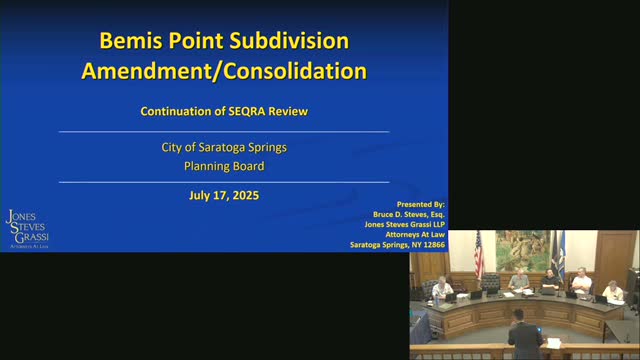
Board delays SEQRA determination on Lexington‑area subdivision after extensive drainage and wetlands concerns
Summary
A proposed multi‑lot subdivision in the Lexington/Concord Drive area drew detailed scrutiny over drainage, wetlands and stewardship of a large wetlands parcel; the board asked the applicant and engineers to provide clearer drainage plans and meet with staff before the board proceeds with SEQRA.
The Planning Board did not reach a final SEQRA determination on a proposed multi‑lot subdivision in the Lexington/Concord Drive area, citing outstanding questions about stormwater management, wetland impacts and long‑term stewardship of a large conservation area. The board directed the applicant and engineering team to provide clearer, larger‑format drainage plans and to meet with staff reviewers before the board continues SEQRA review.
Bruce Steeves and project engineer Dom Areco presented the subdivision and said that the project team had prepared a basic SWPPP and added two sediment basins to capture the “first flush” of runoff from roads and impervious surfaces. Areco described the project’s drainage pattern, noting that much of the site drains to a single low spot and an existing open channel; the team proposed two sediment basins and a culvert to carry a road crossing. He summarized that wetland disturbance for the roadway grading would be roughly 0.43 acres and said the applicant expects to purchase mitigation credits to offset disturbed wetland area.
Board members and staff raised multiple technical and policy issues. Planning Board member Bill (surname not specified) asked for readable, large‑format drainage drawings including invert elevations and pipe sizes; he said the documents submitted to the board did not make the drainage routing and pipe sizing clear. Amy, the city engineering reviewer, said the submitted basic SWPPP was a useful start but lacked the detail she needed to confirm whether all stormwater flows and outfalls were appropriately handled. The New York State Department of Transportation had also submitted comments noting possible connections to downstream water bodies, but staff noted DOT’s letter appeared to reference an earlier plan set rather than the latest submission.
Board members also discussed the ownership and management of a large wetland and rear‑lot area (lots 13–14 in the submission). Members suggested consolidating the conservation area into a single parcel or arranging a conservation easement so the city or an easement holder would have a single point of stewardship, and they discussed risks such as beaver dams that could impair drainage and require maintenance over time.
The board concluded it could not complete SEQRA review at this meeting. It asked the applicant to provide: clearer, large‑format drainage plans showing inverts, pipe sizes and how proposed basins and culverts carry flows; to meet with staff reviewers (engineering and planning) and the concerned board members for a detailed review; and to respond to outstanding DOT comments where they apply to the updated plan set. The board left its prior SEQRA determination open pending that follow‑up.