Get Full Government Meeting Transcripts, Videos, & Alerts Forever!
Get email alerts on the Transportation Safety topic
No spam. Unsubscribe anytime.
Maine DOT defends flashing yellow arrows at Pearl Harbor Remembrance Bridge as residents and council press for changes
Summary
Maine Department of Transportation officials told the Gardiner City Council the new flashing yellow arrow pattern at the Pearl Harbor Remembrance Bridge has reduced some crash types but will be monitored; residents and councilors urged faster adjustments and local education after reports of near-misses.
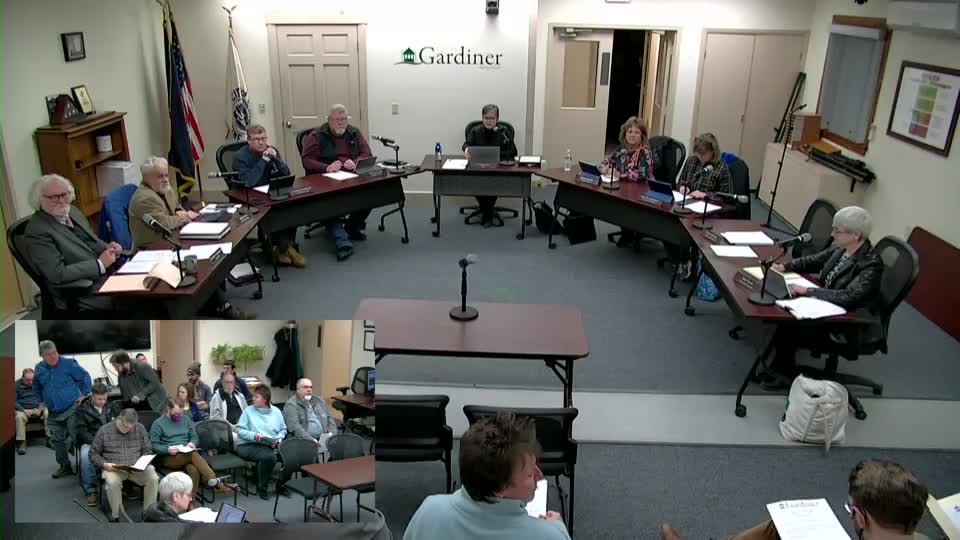
Maine Department of Transportation traffic engineers told the Gardiner City Council on Feb. 12 that a new signal pattern using flashing yellow arrows at the Pearl Harbor Remembrance Bridge has so far reduced rear-end crashes but has prompted resident complaints about confusion and near-misses.
The exchange came during the council’s discussion of a moved-up agenda item so the DOT engineers could return to other commitments. "This change in traffic pattern has only been active for about six months," said Steve Landry, state traffic engineer for Maine DOT, adding the department conducted a preliminary evaluation comparing the most recent six months to the historic crash record for the intersection. "At least initially we're seeing improvement in safety at the intersection even with the flashing yellow arrow," Landry said, citing a preliminary crash frequency of 0.5 crashes in the recent period versus about 0.8 historically for crashes attributed to signal operations.
Residents and several councilors pushed back. "This is reckless to leave the lights as they are," said resident Zach Wannberg, who said he commutes through the intersection daily and has nearly been in multiple crashes. He described the geometry as having “blind turns” from three approaches and said flashing yellow arrows increase danger for drivers and pedestrians.
Councilor Rusty Greenleaf, who has raised the issue at multiple meetings, asked whether the flashing yellow could be disabled during peak commuter hours. "Typically, is it possible? Yes," Landry said, but he cautioned that changing signal operation by time of day can reduce safety because drivers learn a signal’s pattern and then anticipate it. "People get used to how a signal operates and anticipate it more so than what’s actually going on," Landry said, noting that unpredictability or changing operations can raise rear-end crashes and hesitation that may increase other crash types.
Curtis Thompson, traffic operations engineer at Maine DOT, said some of the council’s requested changes — including custom lane-use arrow signs and improved striping — are still feasible within the project’s warranty and before formal acceptance. "We're still within the window where the contractor would be able to get out there and change that sign," Thompson said, and he cited an example of a nearby intersection that uses angled-turn signs similar to what Gardiner requested.
DOT officials described other near-term and medium-term steps: continuing to monitor crash data over a longer period (they prefer one to three years for robust trends), improved durable striping in spring to reinforce lane use, and targeted public education. "We had put out Facebook posts when we first implemented flashing yellow arrows around the state," Landry said. "We can try to target Gardner-area people with that." Councillors asked DOT to provide brief public-facing language and a short video the city could use on its website.
Councilors and DOT agreed on follow-up: DOT staff will continue crash monitoring, return to discuss potential adjustments if crash trends worsen, and consider signing and striping changes. DOT said it will also evaluate a leading pedestrian interval — a three-second head start for the WALK signal — at some crosswalks to improve pedestrian visibility.
Why it matters: The intersection has a long crash history, and Gardiner leaders say the mix of commuter traffic, unusual geometry and pedestrian activity makes any signal changes consequential for public safety and downtown access. Residents urged a quicker tempo for tweaks than DOT’s preferred data timeline; DOT said it will pursue targeted fixes while collecting additional data.
Quotes in context: "This particular intersection has been a high crash location ... for the last 10 years," Steve Landry said, describing the project’s aim to increase capacity and reduce queue length. "We would like to see what we can do on the education piece," Landry added.
Next steps: DOT will schedule improved striping in spring, examine custom lane signs and continue crash monitoring; city staff will coordinate public education materials and the council asked DOT to return if safety metrics do not improve.