Get Full Government Meeting Transcripts, Videos, & Alerts Forever!
Get email alerts on the Veterans Services topic
No spam. Unsubscribe anytime.
Bannock County veterans services coordinator asks for higher grade, second service officer and modest budget increases
Summary
Melissa Hartman, Bannock County Veterans Services coordinator, asked the county commission to reclassify her position to grade 12 step 4, add a second veterans service officer, and approve modest operating increases to support training, phones and travel.
Melissa Hartman, the Bannock County Veterans Services coordinator, asked the county commission on an unspecified date to reclassify her position to grade 12 step 4, add a second veterans service officer to her office and approve modest operating increases to cover training, phones and occasional travel.
Hartman told commissioners that her original request for a grade 14 was inappropriate after reviewing human-resources job-family standards and that a grade 12 step 4 better matches her duties and HR’s budget recommendation. “So what I'm asking for is a 12 at a level 4, a a step 4,” she said.
Hartman said the office serves a substantial number of veterans and channels federal benefits into the local economy. She said there are 5,465 veterans who reside in Bannock County, 2,066 enrolled in VA health care and 2,426 active clients in her office, which she estimated represents roughly 44 percent of the county’s veteran population. “Compensation and pension … to veterans in our county, we are over $38,000,000 a year,” she said, adding that VA education benefits total more than $2 million annually and VA-covered medical services were about $31,000,958 in fiscal 2023.
Hartman described the scope of work performed by her office, saying she met with more than 1,100 clients in February 2024, filed more than 461 claims and handled roughly 1,900 telephone contacts in that period. She said her office provides one-on-one case management for veterans with complex, confidential needs and that her work supports outcomes such as moving veterans out of homelessness and into stable housing.
Hartman walked through her time-use calculations to justify adding staff. Using annual work-hour estimates, she said the face-to-face casework and related tasks approach the limits of a single full-time employee’s available hours, and that she lacks time to complete broader duties such as grant-seeking, training coordination and strategic planning. She asked the commission to add a second county veterans service officer (VSO) rather than another administrative assistant to handle claims and casework.
On operating costs, Hartman requested modest increases tied to the additional hire: roughly $3,000 for travel and lodging to send staff to the Idaho Division of Veterans Services school (the state reimburses mileage and per diem for one county attendee), $1,200 for training and professional membership (including $65 annual membership fees and $450 in training for two employees), and about $600 annually to add cellular service for a third phone. She also said one-time laptop and equipment costs could range from about $1,500 (if IT supplies equipment) up to $3,500 if the county must purchase a laptop for a new hire. Hartman noted copying-machine repair costs were reduced under a new purchasing contract, producing an approximately $700 savings compared with the prior year.
Hartman said she supervises two employees currently and works with VA-funded work-study outreach specialists who help with one-on-one client assistance. She described professional credentials that support a higher classification: 25 years in veterans advocacy, attendance at more than 20 Idaho Division of Veterans Services trainings, and recent accreditation through the National Association of County Veterans Service Officers.
Hartman referenced Idaho Code 65-601, noting the statute’s encouragement that counties employ a service officer, and argued that the county’s current staffing leaves the office overstretched. “I can't keep up with this anymore,” she said. She asked the commission either to add staff or accept that some of the office’s current activities would have to stop.
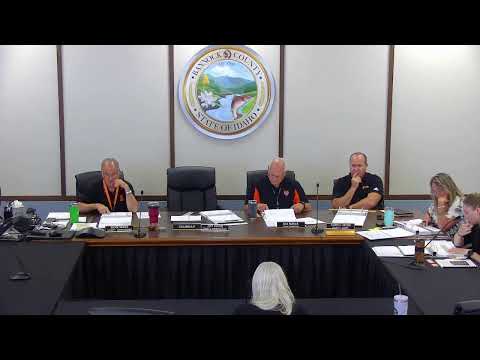
Commissioners made brief administrative remarks during the presentation (for example, about copies of handouts and a reminder that discussion of personnel names would require executive session). No formal motion or vote on Hartman’s requests was recorded in the transcript.
The commission did not make an immediate decision at the end of the presentation; Hartman thanked the commissioners and concluded her remarks.