Get Full Government Meeting Transcripts, Videos, & Alerts Forever!
Get email alerts on the Homelessness Healthcare topic
No spam. Unsubscribe anytime.
Senate panel advances AB 543 to let street-medicine teams order services and enroll unhoused patients in Medi‑Cal
Summary
AB 543 would create presumptive eligibility and allow street-medicine providers to order medically necessary services and equipment for unhoused Medi‑Cal enrollees; supporters described cases where network rules blocked timely care. Committee approved the bill and sent it to appropriations.
Assemblymember (presented as Assemblymember Gonzales in the transcript) introduced AB 543 to establish presumptive eligibility for people experiencing homelessness, allow street-medicine providers to directly order medically necessary services and equipment, and add a homelessness identifier in Medi‑Cal and public-assistance systems to improve coordination of care.
Dr. Jose Luis Gonzalez, vice president and medical director at Health Care in Action (HIA), and Brett Feldman, director of street medicine at the University of Southern California, described clinical situations where strict network assignment and primary-care provider (PCP) constraints delayed care for unhoused patients. Dr. Gonzalez said HIA operates 22 street-medicine teams across six counties and treats patients where they live — on sidewalks, in tents, vehicles and encampments. He described a patient with chronic lower-extremity wounds whose care was delayed because the patient could not reach a PCP for a specialty referral.
Feldman gave additional examples, including a patient who could not obtain an x‑ray and a referral because the street-medicine clinician was not the assigned PCP and therefore could not order diagnostic testing or specialty care. He said those delays led to worse outcomes and avoidable hospitalizations.
The bill’s supporters included a broad coalition from 35 counties (the author cited 175 organizations supporting the measure). Several county, hospital and public-health organizations recorded their support in the hearing.
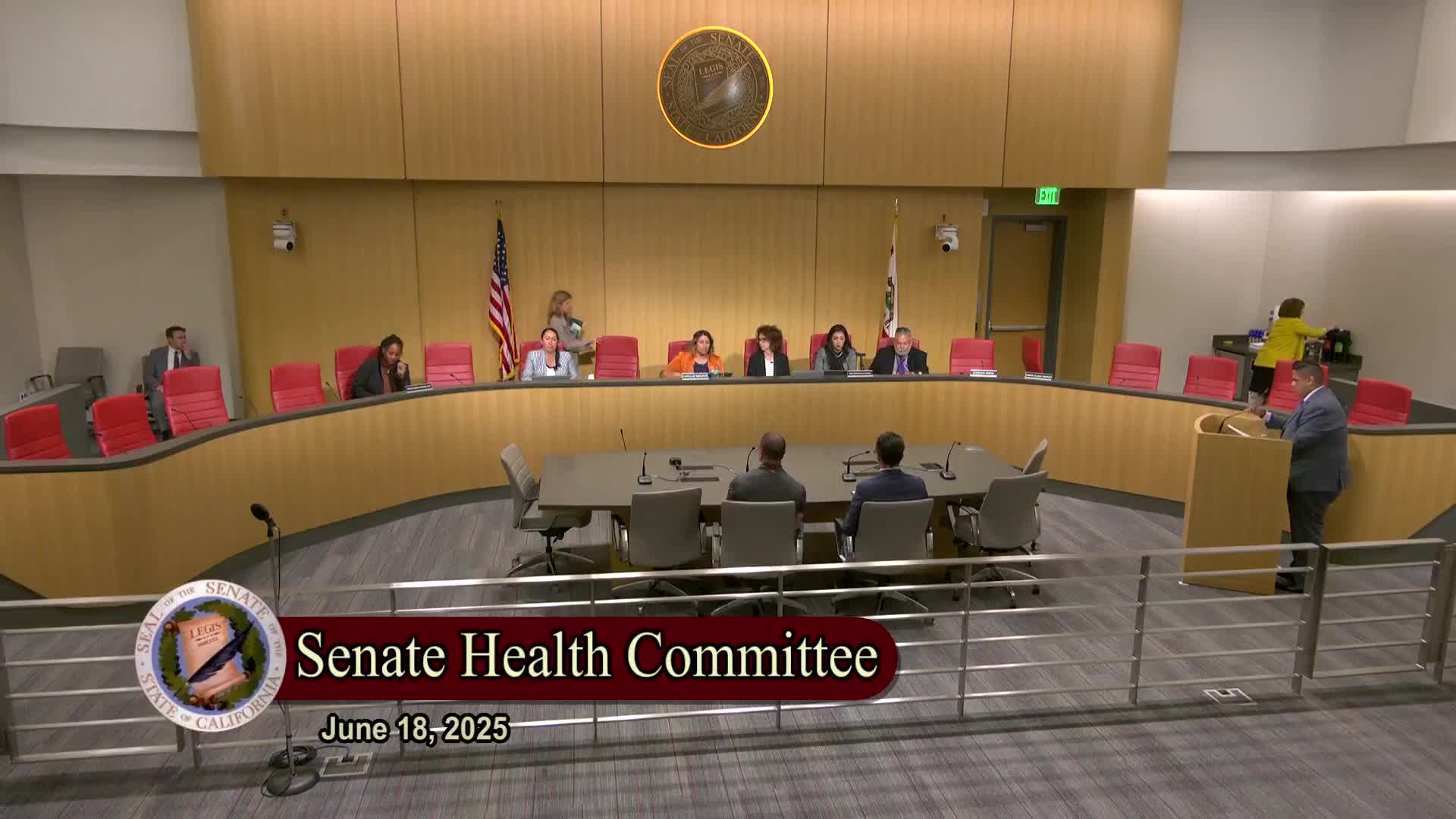
The committee moved to pass AB 543 as amended and refer it to the Senate Appropriations Committee. Senator Grama moved the motion. The recorded vote count shown in the transcript was 10 to 0 and the bill was referred to appropriations.
Ending: Proponents said the bill will reduce barriers to medically necessary care for unhoused Californians by enabling street-medicine clinicians to act without waiting for PCP referrals; the measure advances to appropriations for further consideration.