Get Full Government Meeting Transcripts, Videos, & Alerts Forever!
Get email alerts on the Public Safety Police Oversight topic
No spam. Unsubscribe anytime.
Civilian police auditor’s 2024 annual report finds most force incidents involved crisis conditions; recommends de-escalation training and better crisis-response
Summary
The civilian police auditor told the Olympia City Council that use-of-force incidents rose 46% in 2024, and that 74% of those cases involved people who appeared to be in crisis due to mental illness or drugs/alcohol.
The city’s civilian police auditor presented the 2024 annual report to the Olympia City Council, reviewing use-of-force incidents, misconduct complaints and recommendations to improve crisis response.
Tara Parker, the civilian police auditor, said use of force incidents rose from 52 in 2023 to 76 in 2024 — a 46% increase — and that a large share of those incidents involved people who “appeared to be mentally ill and or under the influence of drugs or alcohol.” Parker said 74 percent of the 2024 use-of-force incidents involved such crisis conditions and that many subjects did not respond to de‑escalation efforts captured on body-worn camera.
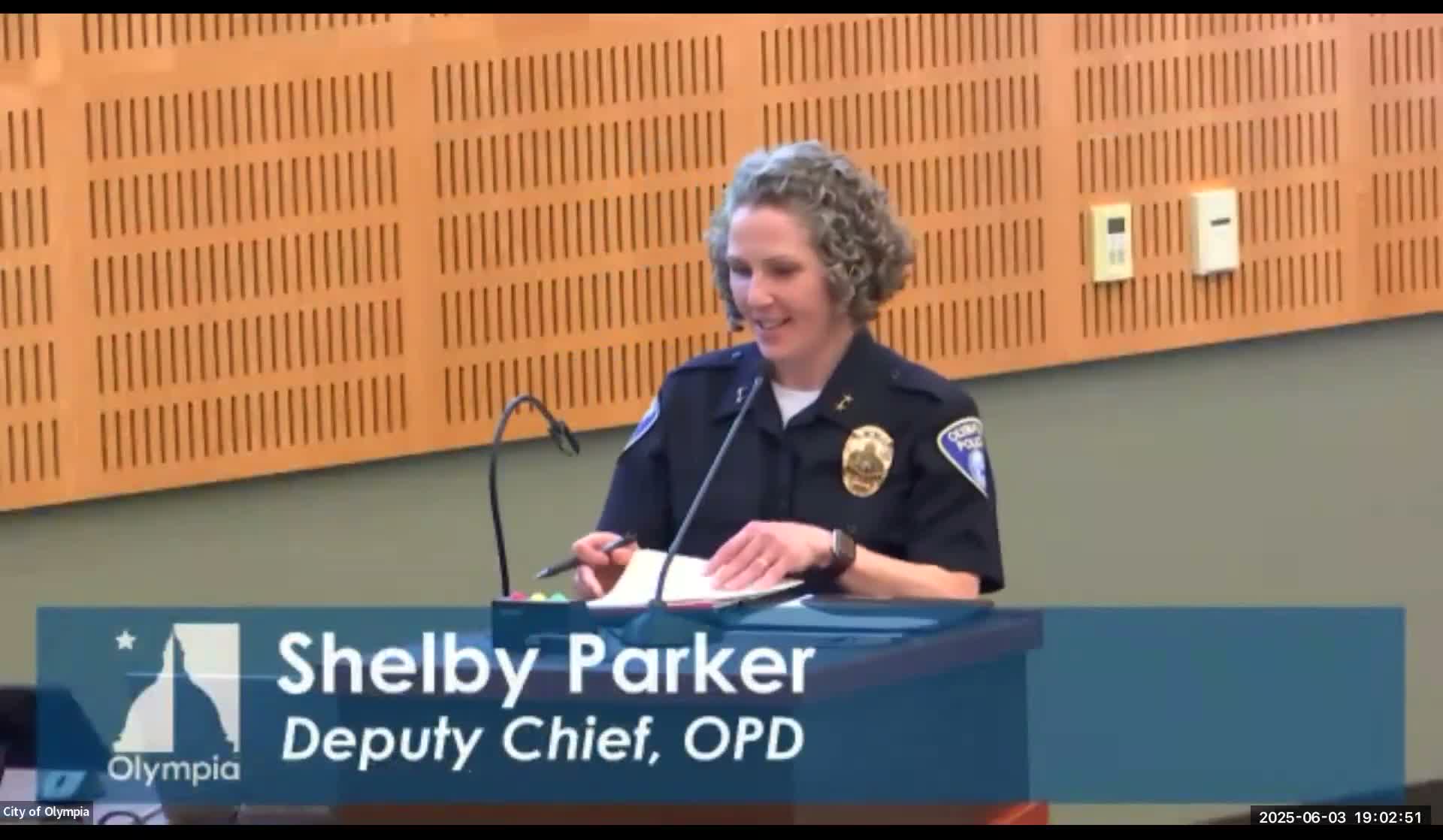
Deputy Chief Shelby Parker (Olympia Police Department) provided staffing and crime statistics, noting the department closed 2024 with 106 staff (71 commissioned officers and 35 non‑commissioned members), handled almost 55,000 calls for service and recorded an overall reduction in auto thefts, which the department attributed in part to camera deployments.
Tara Parker said auditors and the department’s multilevel review generally found officer conduct met standards; of 14 misconduct complaints in 2024, one resulted in a sustained finding and remedial training. She emphasized the value of body-worn camera footage in clarifying incidents, noting half of misconduct complaints were disproved in whole or in significant part by camera evidence.
Key recommendations in the auditor’s report include enhanced de‑escalation training — with a focus on techniques tailored for juveniles and for individuals experiencing mental-health crises or substance impairment — and improved documentation and tracking of crisis-responder involvement. The auditor said supervisors have begun adding crisis-responder information into review notes and the department is working to embed mandatory fields in a forthcoming records-management system to capture coordination details.
Deputy Chief Shelby Parker also said most uses of force (about 65% of incidents, per the department) involved takedowns — categorized by the department as the lowest level of force — and that 76 use-of-force incidents followed nearly 2,950 arrests from about 55,000 calls for service. The department said 13 incidents resulted in minor injuries and no incidents resulted in substantial bodily harm.
Council members asked how data distinguish mental‑health impairment from substance impairment and how the department tracks disabilities and other demographic factors. Parker said officers’ on-scene impressions are not clinical diagnoses and that records and body-worn camera evidence sometimes provide additional clarity; she recommended expanding mandatory data fields in the records system to improve future analysis.
Council members and staff praised the auditor’s work and noted the department has been responsive to recommendations. The city announced the community policing board recruitment remains open through July 11 to fill three vacancies, and city staff said they will continue to refine data collection and training plans.