Get Full Government Meeting Transcripts, Videos, & Alerts Forever!
Get email alerts on the Local Government Operations topic
No spam. Unsubscribe anytime.
Kenai Peninsula Borough Assembly receives refresher on powers, meeting procedure and the budget process
Summary
Borough attorney Sean Kelly, borough clerk Michelle Turner and finance director Brandy Harbaugh briefed assembly members on borough powers under state law, meeting rules and parliamentary procedure, public-comment time limits and the budget and mill-rate timeline.
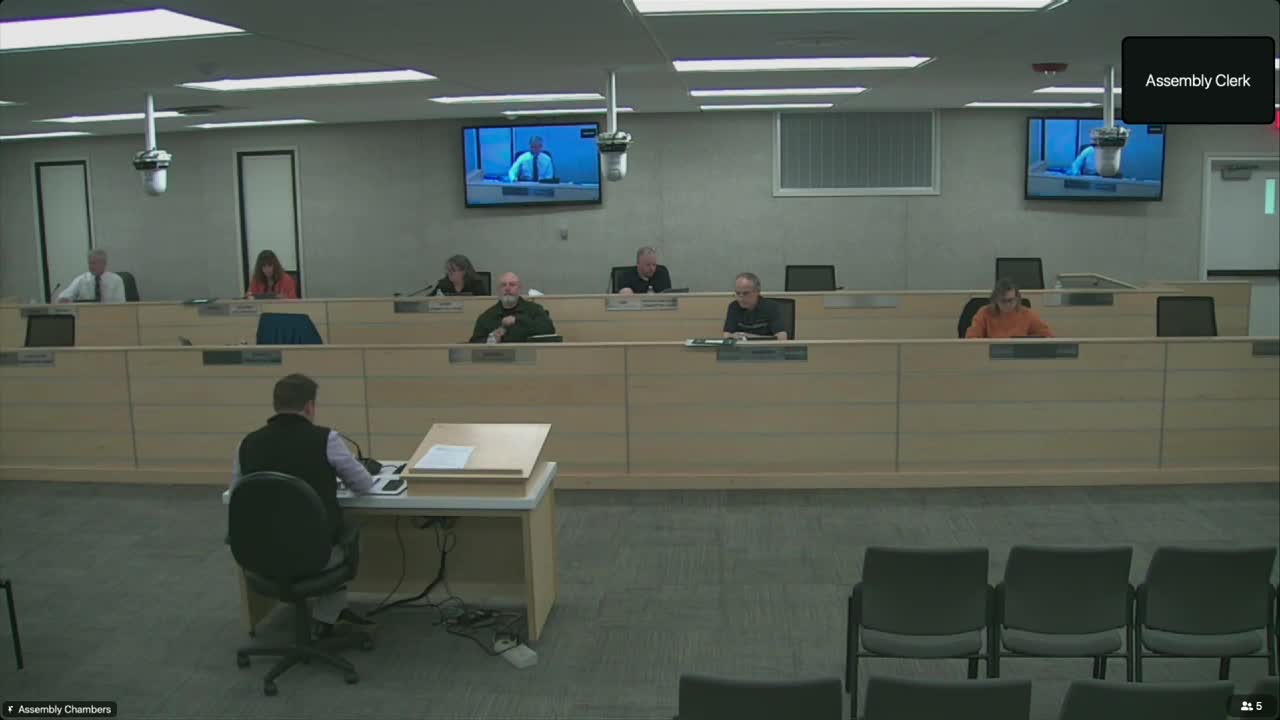
Borough attorney Sean Kelly, borough clerk Michelle Turner and finance director Brandy Harbaugh led a training session for Kenai Peninsula Borough Assembly members that reviewed the borough’s legal authorities, meeting and parliamentary procedures, public-comment rules and the borough budget process.
“For the record, I'm Sean Kelly, borough attorney, and joining me in this presentation is gonna be borough clerk Michelle Turner and finance director Brandy Harbaugh,” Kelly said, opening the session and describing the meeting as a “skills refresher” intended for members with a range of experience.
The session summarized three core areas: the legal framework for a second-class borough, meeting essentials and parliamentary procedure, and a finance overview timed to the annual budget cycle. Kelly emphasized that the borough’s powers are those “conferred by law,” pointing attendees to Alaska Statutes Title 29 as the primary source for second-class borough authority and noting that Title 14 contains several cross-references related to the school district. He described the borough as a “strong mayor” form of government, with executive and administrative functions vested in the mayor and legislative authority resting with the assembly.
Why this matters: the rules the assembly follows determine how legislation is introduced, debated and adopted, how public hearings are structured, and how the borough’s budget and mill rates are set.
Kelly and Turner reviewed ordinance and resolution practice: code changes and many appropriations are enacted by ordinance; state and local rules require notice between introduction and a public hearing (Kelly cited a 25-day interval used for code-change ordinances) and the borough’s budget ordinance requires two public hearings before a final vote. Turner added that both she and Kelly will honor confidentiality when an assembly member routes draft legislation through their offices prior to public introduction. “If you are bringing forward legislation and choose to route it through my department first…that confidentiality is still, adhered to,” Turner said.
The presenters outlined meeting procedure specifics used by the assembly. The borough follows Mason’s parliamentary practice with some local exceptions, such as its reconsideration rules. Reconsideration of a vote must be requested before the meeting is adjourned the same night; it will then appear on the next meeting agenda. The assembly’s rules do not require a second to a motion, a departure from Robert’s Rules used by some other local bodies. Kelly noted that members may request reconsideration whether or not they originally voted on the prevailing side.
Time limits for speakers were highlighted as a common recurring issue. Council code provides a three-minute limit for public commenters and a ten-minute limit for formal presentations (Kelly cited borough code section 22.41.30). Any grant of additional time for a speaker must be made by motion and approved by vote; the presenters cautioned that routinely extending time risks inconsistent or preferential treatment. “To grant additional time…has to be done by motion and a vote,” Kelly said.
The presenters discussed interaction with public speakers. They advised that extended question-and-answer sessions are generally best handled at the committee stage or during noticed presentations, not during the open public-comment period. Kelly described routine avenues for the assembly to obtain additional information, including formal requests routed through the presiding officer and the clerk or through committees.
Turner reviewed practical meeting-management tools: committee-chair agendas and presiding officer checklists, amendment memos, rules about lay-down items and distribution of materials to members participating remotely.
Brandy Harbaugh gave an overview of the borough’s budget process and fund structure. She said the local budget cycle begins with internal preparation in November, moves through department and service-area submissions in February–March, and culminates with the mayor’s proposed budget delivered to the assembly in May. The assembly then holds work sessions and two public hearings; the final budget and mill rates must be adopted before June 15 under state law. Harbaugh explained the school-district “floor” process: the school district submits its requested budget and the borough typically sets a minimum (a floor) by resolution; once set, the borough cannot later adopt a lower school contribution in the final budget.
Harbaugh summarized fund types and taxation. The borough maintains a general operating fund plus special revenue funds (including service-area funds), capital project funds, debt-service funds and internal-service funds (for example, an insurance/risk fund shared by borough departments and the school district). Primary revenue sources are property and sales taxes; Harbaugh said the borough currently levies a 3% sales tax dedicated to education and a general-fund rate of 4.3 mills. She noted an average boroughwide mill rate of 8.57 and gave a stacked-example total (10.22 mills) for areas subject to multiple service-area levies.
Kelly closed by reiterating that the session was intended as a refresher and a primer for more detailed training planned for March 18, when the assembly will address the Open Meetings Act, conflicts of interest in voting, the code of ethics and delineation of roles and responsibilities for the assembly and the mayor.
No formal votes or ordinances were taken during the training session; the meeting was instructional and focused on clarifying process and timing for future legislative and budget actions.