Get Full Government Meeting Transcripts, Videos, & Alerts Forever!
Get email alerts on the Maternal Health topic
No spam. Unsubscribe anytime.
MDH highlights widening maternal‑health disparities; committee hears bills on home births, annual maternal death reviews and consent for exams
Summary
The Minnesota Department of Health told the Senate Health and Human Services Committee on Feb. 20 that Black and American Indian birthing people face substantially higher risk of pregnancy‑related death and described programs and funding gaps; the committee then heard several maternal‑health bills, including measures on home‑birth Medicaid reimbursement, annual maternal‑death reviews and explicit consent for educational sensitive exams.
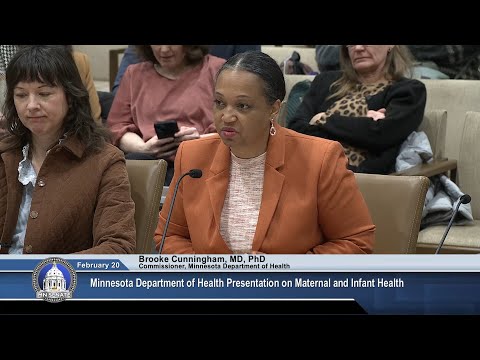
ST. PAUL — The Minnesota Department of Health told the Senate Health and Human Services Committee on Feb. 20 that maternal‑health outcomes in the state mask stark racial and geographic disparities and described several state and federal programs aimed at addressing those gaps. Committee members then considered multiple bills that target maternal care access and oversight, including proposals to expand Medicaid coverage and reimbursement for home births, require annual maternal mortality reviews, and require explicit consent before educational sensitive exams on unconscious patients.
Commissioner Cunningham and departmental staff briefed the committee on data and programs. “While Minnesota has lower rates of pregnancy‑related death compared to the U.S. overall, maternal‑health disparities in Minnesota tell a different story,” Commissioner Cunningham said. She told senators that from 2017–2019 Black pregnant people in Minnesota were 2.3 times more likely to die of pregnancy‑or childbirth‑related causes than white pregnant people, and that American Indian maternal mortality was roughly four times higher. The department noted that 40% of maternal deaths occur in Greater Minnesota and that 36 of 87 counties do not have a birthing hospital.
The department detailed social determinants linked to poor outcomes: housing instability, food insecurity, lack of reliable transportation, incarceration histories, and limited access to prenatal and postpartum care. MDH staff said maternal mental health and substance use remain leading contributors to severe maternal morbidity and pregnancy‑associated deaths. “Postpartum depression is a common but serious mood disorder,” the department said in the briefing, and they reported that in 2022 about 32% of Minnesota mothers said they needed mental‑health services after birth, with the highest need among American Indian and U.S.‑born Black mothers.
MDH described current programs and funding. Officials outlined PRAMS (the Pregnancy Risk Assessment Monitoring System) and said CDC funding covers $175,000 per year — about 36% of an annual PRAMS program cost they estimated at $485,000. Officials also described the Maternal Mortality Review Committee (MMRC), noting the committee is federally supported (CDC grant) and that the MMRC’s total annual cost is about $658,000, with roughly $500,000 from CDC and $163,000 from the state, per testimony.
After the presentation, senators discussed practical barriers and program implementation. Senator Abler and others urged MDH and partners to ensure recommendations convert into operational supports, including reimbursement rates for birth centers, stronger support for doulas and perinatal community health workers, and accountability for hospitals and payers so community options can be sustained.
Bills considered
- Senate File 1113 (home births and Medicaid reimbursement): Sponsor Senator McQuade introduced an amendment and described the bill as codifying Medicaid coverage for home birth services and increasing reimbursement so licensed home‑birth providers can serve Medicaid clients. Two licensed midwives testified by Zoom, describing closures of delivery units in Greater Minnesota and saying current Medicaid reimbursement (testimony cited $1,380 as the total global fee) is insufficient to cover months of prenatal, labor, delivery and postpartum care. The bill was laid over for possible inclusion, per the committee chair.
- Senate File 1167 (annual maternal‑death study): Sponsor Senator McQuade offered an oral amendment to require annual studies. McQuade said the state’s last study covered 2017–2019 and reported 8.9 pregnancy‑associated deaths per 100,000 (testimony cited higher rates among Black and Indigenous people). Following discussion about scope and the existing fetal‑death reporting process, the committee laid SF 1167 over as amended.
- Senate File 183 (consent for sensitive exams on unconscious patients): Sponsor Senator McQuade presented SF 183, which would prohibit students or clinicians from performing a sensitive examination (pelvic, breast, urogenital or rectal) on an unconscious or anesthetized patient without explicit informed consent, with narrow exceptions for diagnostic/treatment necessity or a court‑ordered exam to collect evidence. A witness from the national sexual‑assault advocacy organization described hotline reports of nonconsensual educational pelvic exams and urged lawmakers to adopt statutory consent requirements. The committee adopted an author’s amendment and laid the bill over for possible inclusion.
Committee action on other measures
Later in the hearing the committee considered a different health‑liability bill (Senate File 971). After adopting clarifying amendments to limit protections to honest medical errors and not criminal acts, the committee recommended SF 971 as amended and referred it to the Judiciary and Public Safety Committee.
What the testimony showed
MDH staff emphasized that rural hospital closures and uneven access to obstetric services have made birth centers and home‑based providers critical access points in some communities. Testimony from licensed midwives said higher reimbursement for Medicaid clients would help keep providers in Greater Minnesota; midwives reported private pay averages near $7,000 compared with an estimated Medicaid reimbursement of $1,380 for the global episode of care. MDH staff and several senators cautioned that reimbursement adjustments alone will not solve workforce and access issues without broader systems changes and sustainable funding.
Next steps
SF 1113, SF 1167 and SF 183 were laid over for possible inclusion in the committee’s package and further deliberation. SF 971 was referred to Judiciary and Public Safety. MDH staff told the committee they will provide additional data and follow‑up questions about program details and federal funding status.
Votes at a glance
- SF 1113 (home‑birth Medicaid coverage/reimbursement): laid over for possible inclusion (no committee final action recorded). - SF 1167 (annual maternal mortality study): laid over as amended for further consideration. - SF 183 (consent for sensitive exams on unconscious patients): author’s amendment adopted; laid over for possible inclusion. - SF 971 (medical‑error liability): amendment adopted to limit protections to non‑criminal honest errors; referred to Judiciary and Public Safety.