Get Full Government Meeting Transcripts, Videos, & Alerts Forever!
Get email alerts on the Water And Sewer Capacity topic
No spam. Unsubscribe anytime.
Hillsborough officials outline sewer pinch points, nutrient limits and planned utility upgrades
Summary
Town staff told a joint county‑town work session that Hillsborough faces collection-system constraints, wet‑weather flows tied to older infrastructure, and nutrient-permit limits that will shape near‑term growth; a capital-improvement plan and targeted rehabilitation work are already under way.
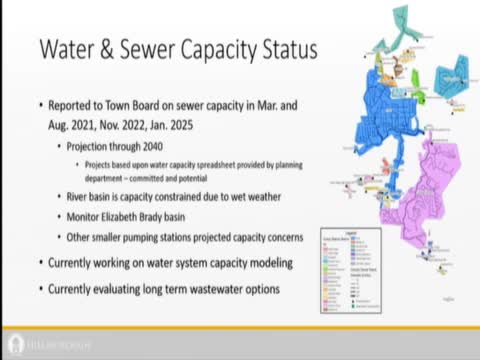
Hillsborough utilities staff told a joint work session Feb. 17 that the town has identified collection‑system pinch points, wet‑weather infiltration, and nutrient limits at its wastewater treatment plant as the key constraints for new development.
A town utilities presenter said the town’s network depends heavily on pump stations because of local terrain, and that several basins have been identified as priorities for early rehabilitation. “From a hydraulic perspective, we seem to be in a good place at our wastewater treatment plant,” a town utilities staff member said, while also warning that nutrient-discharge limits that protect downstream reservoirs could become the limiting factor for new wastewater service.
Presenters showed five‑year flow charts that include sharp spikes during heavy rain events — a pattern officials attributed to inflow and infiltration where rainwater enters older sewer pipes via leaks or improper connections. Staff said rehabilitation of older collection lines — including work on the Lawndale basin — is a high priority because reducing wet‑weather inflow directly reduces nutrient discharge after storms.
Town officials also explained the relationship between growth patterns and utility capacity. They said concentrating development where existing mains and pump stations can serve it is preferable to extending new infrastructure to low‑density sites outside the service core. That strategy reduces the number of older pipes the town must maintain and reduces long‑term inflow/infiltration risk while allowing higher densities where the system can accommodate them.
Staff described a multi‑year capital improvement plan that includes projects to add capacity, rehabilitate basins and improve distribution and fire‑flow reliability. Officials said developers seeking faster timelines than the town’s scheduled upgrades may be required to participate financially to accelerate specific projects.
Speakers also discussed water supply. The town relies on a reservoir and an allocation of treated water available via an interconnection with another provider; staff said available reservoir days and interconnection options are tracked daily and factored into review of new projects.
Elected officials asked how school capacity, nutrient rules (notably Falls Lake rules) and projected population changes would affect approvals. Staff replied that school‑capacity certificates, nutrient-permit limits and capital timing are all considered when evaluating permits and that several studies and reports — including an annual SAPFOTAC summary — inform decisions.
No vote was taken; staff asked for continued coordination with the county and municipalities as the town implements capacity projects and finalizes a new land‑use map.