Get Full Government Meeting Transcripts, Videos, & Alerts Forever!
Get email alerts on the Transportation Impact Fees topic
No spam. Unsubscribe anytime.
Polk County commissioners weigh large increases to warehouse, industrial transportation impact fees
Summary
Polk County Board of County Commissioners on Feb. 18 held a workshop on proposed changes to transportation impact fees that would significantly raise charges for warehouse and industrial development, citing rising construction costs and heavier truck impacts on roads.
Polk County—oard of County Commissioners on Feb. 18 held a workshop on proposed changes to transportation impact fees that would significantly raise charges for warehouse and industrial development, citing rising construction costs and heavier truck impacts on roads.
The county eputy county manager, John Bodie, told commissioners the staff and consultant prepared several options, each of which would require a four-of-five vote to invoke "extraordinary circumstances" and put higher fees in place faster than the statutory phase-in schedule. "If you don't have 4 votes... it'll stay at the current phasing schedule," Bodie said, noting state law also requires a 90-day notice period before new fees take effect.
Why it matters: transportation impact fees pay for capacity-related road projects in Polk's capital improvement program. Supporters of higher fees said they are needed to fund growing road needs and to reflect the greater wear large trucks and tractor-trailers impose on intersections and turn lanes. Opponents including local economic development groups warned that sharply higher fees could make Polk less competitive when companies choose where to locate.
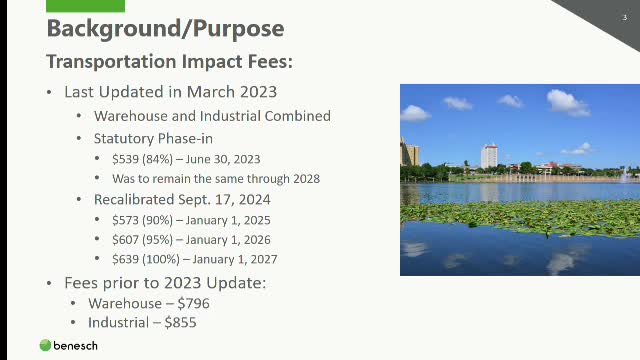
Staff presented a range of technical approaches. One option used a locally measured trip generation rate blended with national data to set a per-1,000-square-foot charge (the study's blended trip generation produced a $2,299 full fee per 1,000 square feet before phasing). Another scenario applies a "blockage" adjustment that reduces roadway capacity to reflect the outsized effect of large trucks; that approach produces higher per-square-foot fees. Bodie and staff emphasized that the county currently phases fees: a schedule adopted following the 2023 study moves to 90%, 95% and then 100% of the full study fee over time unless the board approves extraordinary circumstances to accelerate increases.
Economic development leaders pushed back. Sean Malat of the Central Florida Development Council said the proposed initial fees would be "off the charts high" compared with markets Polk competes against and urged a more modest adjustment if the county finds extraordinary circumstances. Steve Scruggs of the Lakeland Economic Development Council warned that a rapid fee increase could make Polk considerably more expensive than competing counties and urged the commission to consider maintaining or lowering current rates until Polk closes a local job deficit.
Commissioners were shown county-by-county comparisons, alternative fee calculations (with and without the blockage factor), and the legal mechanics: the board needs four votes to adopt an extraordinary-circumstances ordinance, a follow-up workshop is scheduled March 4, a public hearing is scheduled for March 18, and any adopted change would require a 90-day notice period before going into effect (making an effective date of roughly July 1 if adopted in March).
No final policy decision was made at the Feb. 18 meeting. Commissioners directed staff to return with refined proposals and supporting materials at the March 4 workshop.
Less critical detail: staff noted that if applicants dispute the county's trip-generation assumptions they may submit project-specific traffic studies for review; staff also provided comparative tables that show how proposed fees would affect representative 100,000-square-foot warehouses under each scenario.