Get Full Government Meeting Transcripts, Videos, & Alerts Forever!
Get email alerts on the Interlocal Planning topic
No spam. Unsubscribe anytime.
Orange County, Hillsborough staff review decades of interlocal planning agreements including COCA, Wissamba and school-capacity pacts
Summary
County and town planners described the history, current use and limits of several interlocal planning agreements — the Central Orange Coordinated Area (COCA), courtesy review rules, the Wissamba water-and-sewer agreement and school-capacity memoranda — and said several will likely need updates as the county and town rewrite land-use plans.
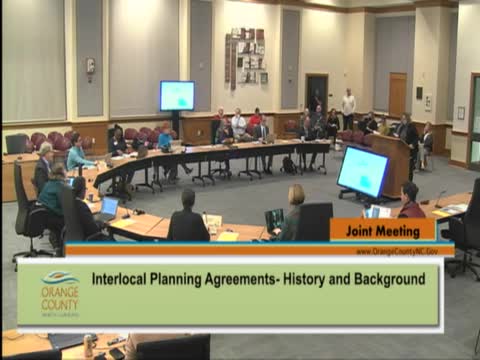
Orange County planning staff and Hillsborough planning officials on Feb. 17 reviewed a series of interlocal planning agreements that have governed land use, utilities and service coordination around the town for two decades.
Perdita Holtz, Orange County deputy director for long-range planning and administration, traced the Central Orange Coordinated Area — known as COCA — from a 2006 planning phase through an interlocal land-management agreement in 2009 and the joint land-use plan adopted in 2013 and last amended in 2020. She said COCA originally established urbanizing areas around Hillsborough and set rules for which jurisdiction’s development standards would apply to properties in the mapped areas. “Planners do like to have acronyms,” Holtz said, noting the convention in long-running planning efforts.
The pair of jurisdictions also rely on a staff-level courtesy review agreement that Holtz said is explicitly limited to coordination and does not transfer approval authority. Under the courtesy-review process, projects meeting specified thresholds — for example land-use amendments or rezonings on “5 acres” or projects proposing more than 50 dwelling units — can be routed for comment by county and town staff on topics like schools, utilities and transport; but each jurisdiction retains final permitting authority.
The five-party water-and-sewer management and boundary agreement commonly called “Wissamba” was described as the instrument that defines primary service areas, long-term interest areas and limits on water/sewer service among Orange County, the towns of Chapel Hill, Carrboro and Hillsborough and the Orange Water and Sewer Authority (OWASA). Holtz said long-term interest area designations do not automatically mean expansion is planned, and that amendments to the Wissamba map require approval of all signatories.
Holtz and other staff also reviewed the two memoranda of understanding that implement school-capacity rules (SAPFO/CAPS), which require a certificate of adequate public schools before some residential approvals. She said the certificate-of-adequate-schools step has sometimes been interpreted flexibly when districts had imminent capacity additions on the horizon and noted that courts have narrowed growth-management uses of school-capacity rules over the last 20 years. Orange County staff prepare the annual technical advisory committee report (SAPFOTAC) that summarizes capacity and recommendation updates.
Hillsborough planning director Shannon Campbell told the joint session the town’s recent comprehensive sustainability plan will prompt reexaminations of older agreements and said the town expects to seek changes or new agreements as Orange County finalizes its upcoming countywide land-use plan. She urged continued coordination so planning maps, utility service areas and permitting practices align with the town’s new conservation-and-growth framework.
County and town staff fielded questions about how changes to population projections would be handled under existing MOUs and how amendments are processed; Holtz said the county’s use of consultants to update projections is being done under consultation described in the memorandum, not as a formal amendment.
The presenters emphasized that many of the agreements — some dating to the early 2000s or earlier — worked for their time but that statutory changes (notably to annexation law) and the town’s new policy direction mean several pacts will need targeted updates.
Members of both boards and staff said they welcomed further one-on-one collaboration and suggested follow-up work sessions focused on updating particular agreements and aligning maps and utility plans with the county’s forthcoming land-use plan.