Get Full Government Meeting Transcripts, Videos, & Alerts Forever!
Get email alerts on the Parkland Dedication topic
No spam. Unsubscribe anytime.
City Planning Commission approves changes to Dallas parkland dedication ordinance following HB 15‑26
Summary
The City Planning Commission voted to update Dallas's parkland dedication rules to conform with Texas House Bill 15‑26, adopting a simplified flat-fee structure, five funding zones instead of seven, and other technical changes after staff and public discussion. Commissioners added amendments on staff overhead caps and trail‑access credits before a
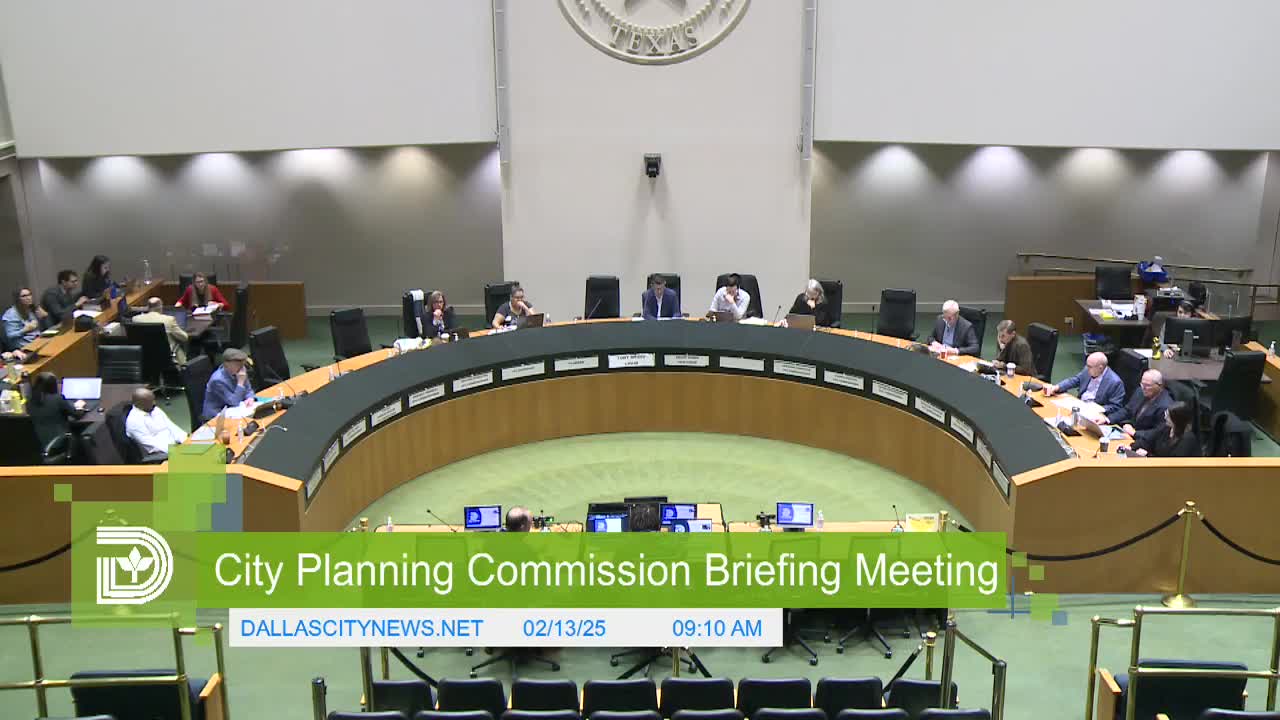
The City Planning Commission on Feb. 13 approved amendments to Dallas's parkland dedication rules, a move staff said was needed to conform the city's code to Texas House Bill 15‑26 and to simplify the prior, more complex ordinance.
The approved changes replace a previously layered formula with a simpler flat-fee approach and redraw the dedication funding zones from seven to five. Under the version sent forward by park staff and amended by the commission, fees will be capped at a flat percentage of median family income for most housing types and the city will retain the right to pursue land dedication in limited, high-need cases.
Why it matters: Parkland dedication fees are a locally controlled way to raise money for new parks and park development. The commission's vote reshapes how developers pay into the system and how the city can spend funds — a consequential change for how the city pays for future park acquisitions and improvements.
What the changes do - Fee structure: The ordinance adopts a flat-fee calculation option allowed by HB 15‑26 as staff's preferred approach. That formula sets a maximum equal to 2% of the city's five-year average median family income (MFI). Staff showed a five-year MFI of $65,400 and said, "2% of that fee is $1,308 and that's how we came up with that calculation," (Lakisha Gerter, Park Planning manager). The language adopted preserves both the flat-fee option and the statutory standard calculation so the city remains in compliance with state law. - Zones and use: The commission accepted staff's recommendation to reduce the number of parkland zones from seven to five to allow funds to accrue faster in larger zones. Staff said the update applies citywide to development applications submitted on or after Jan. 1, 2024, the date set by state law. - Treatment of affordable units: The commission kept the city's existing exemption for affordable/reserved dwelling units; the ordinance continues to exclude those units from parkland charges. - Collections and administration: Staff proposed shifting collection of the fee from the Building Department to Park & Recreation. Staff also proposed raising the cap on indirect costs from 10% to 20% to cover due diligence and oversight; commissioners amended that proposal and preserved a cap on indirect costs while directing staff to clarify how much may be used for staff overhead.
Key context cited in the meeting - Statutory drivers: City legal staff cited Texas Local Government Code section 212.203 and the new provisions in HB 15‑26 that changed how large Texas cities may calculate and collect parkland dedication (Daniel Moore, city attorney: "I would point you to Texas Local Government Code section 212.203"). - Implementation history and balance: Park staff senior managers framed the update as a chance to simplify a code that had several underused credit mechanisms, and said this version is designed to be clearer to both the development community and to residents. "This is really one of the very few intersections of the Dallas park system and the development code," Ryan O'Connor, deputy director of Dallas Park and Recreation, told commissioners.
What commissioners changed - Staff overhead cap: Commissioners amended staff's recommendation so that indirect costs remain limited and staff must return clarified language on how much may be used for overhead in a way that keeps a majority of funds dedicated to acquisition and park improvements. - Minimum land dedication: The commission also accepted the ZOAC recommendation to lower a proposed minimum parcel-size threshold for land dedication from one acre to one-half acre for targets of acquisition in the future. - Trail-access credit: Commissioner Christina Kingston offered an amendment that provides an option — under conditions spelled out by the commission — to allow a developer to meet some portion of the parkland dedication requirement by providing publicly accessible, on-site trailhead access or trail-serving amenities. The commission adopted language directing staff to return clear paths for those credits if specific public‑access conditions are recorded in a public instrument and the trail facilities meet minimum design standards.
Public comment and stakeholders - Development and real-estate groups: Jamie Jolley, president and CEO of the Real Estate Council (TREC), thanked staff and ZOAC for the simplified fee structure and the shift to a flat fee and urged caution on the city's use of land dedication authority. - Park advocates and neighbors: Supporters and park advocates framed the code update as an opportunity to accelerate park acquisition and to focus funds in zones with the greatest need.
Formal action recorded - Motion to approve the draft amendments (staff/ZOAC recommendation) carried after commissioners adopted the technical amendments described above. The motion was made by Commissioner Kouserat and seconded by Vice Chair Rubin. Outcome: approved.
What happens next The commission voted to send the amended ordinance to City Council for formal adoption. Staff will return the ordinance text with the clarified language on the indirect-cost cap and the trail‑access credit mechanics prior to council consideration.
Ending note: Commission and staff stressed that the update is intended to be compliant with state law while making the parkland dedication system easier to understand and quicker to deploy. "The intent is to simplify this so everyone can understand it," O'Connor said. The commission asked staff for a follow-up report on projected fund accrual under the new five-zone map and on the administrative steps needed to move fee collection to Park & Recreation.