Get Full Government Meeting Transcripts, Videos, & Alerts Forever!
Get email alerts on the Parking topic
No spam. Unsubscribe anytime.
Dallas planning commission advances parking-code overhaul; hearing continued to March 4
Summary
The City Planning Commission continued consideration of a broad rewrite of Dallas’s off-street parking and loading rules after a lengthy discussion of multiple amendments. Commissioners approved several targeted changes and asked staff to return a revised draft for a March 4 public hearing.
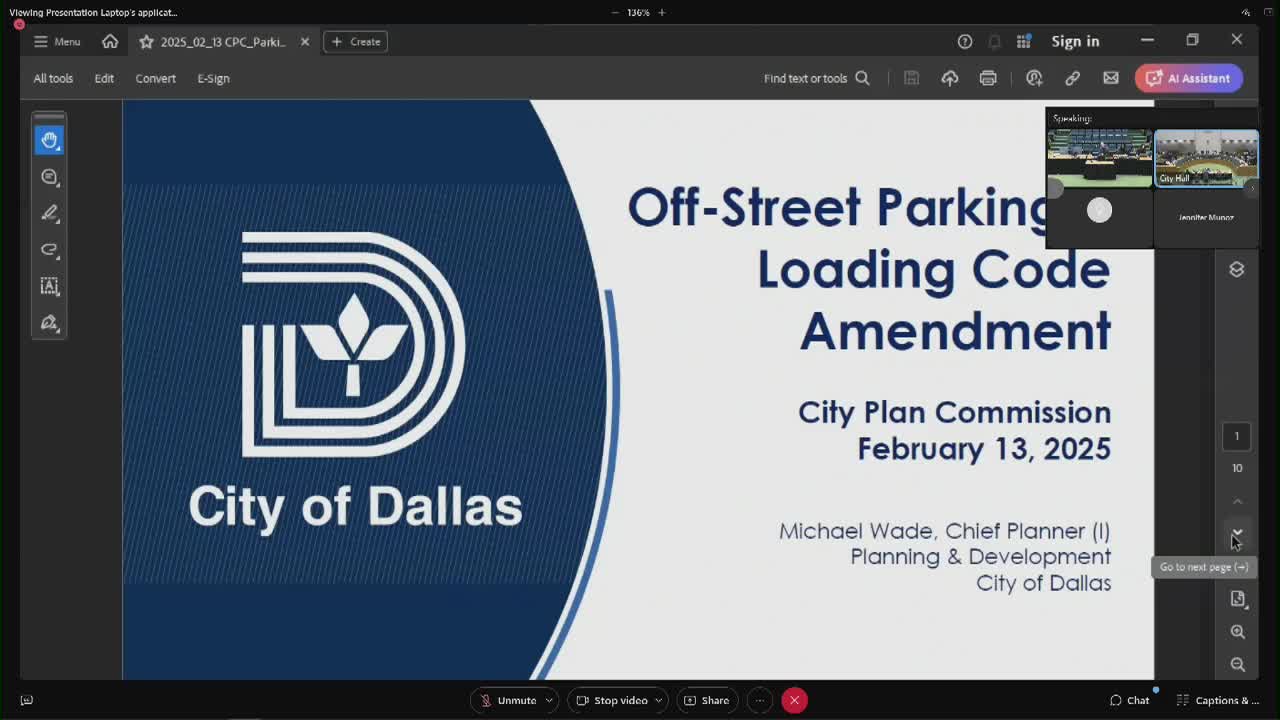
The Dallas City Planning Commission spent more than six hours on Feb. 13 debating a major rewrite of the city’s off-street parking and loading regulations — the code amendment that would eliminate many citywide minimums, add new design standards and introduce a transportation-demand-management framework. After layered amendments and votes the commission voted to hold the public hearing open and continue consideration on March 4 so staff can prepare a consolidated draft.
The parking proposal before the commission was the ZOAC and staff package known as DCA 190-002. It includes options to eliminate minimums for many land uses citywide, keep minimums for selected districts or uses to protect single-family neighborhoods, add standards for loading and short-term pick-up/drop-off, and require clearer visitor-parking accommodations at multifamily developments.
Key votes and actions - The commission approved keeping residential district (RD) and townhouse (TH) minimums in place but reduced those minimums to 1 space per dwelling unit for those districts. - Commissioners adopted a requirement that multifamily developments provide guest parking equal to 0.25 spaces per unit and that a portion of visitor/guest parking be clearly signed and accessible at driveway or pedestrian entrances (the commission specified clarity and signage to reduce spillover into neighborhoods). - The commission approved language directing larger multifamily projects to identify on-site loading and short-term pick-up/drop-off areas at the time of building permit and asked staff to require an on-site space large enough for typical delivery or moving vehicles for projects above a set threshold. - After multiple amendments and a lengthy record vote sequence, the commission voted to continue the public hearing and direct staff to return a cleaned-up draft for a specially called public hearing on March 4 at 9:00 a.m.
Discussion highlights Commissioners, staff and dozens of public speakers traded sharply differing views about how far to push the code changes. Proponents argued that parking minimums impose high costs on housing and were often unnecessary in walkable areas or near transit; opponents said blanket elimination of minimums risks spillover parking into single-family neighborhoods and could worsen safety and livability in parts of the city without rapid transit.
A recurring compromise theme during the hearing was geographic targeting — eliminating or reducing minimums in core, transit-served or mixed-use areas while maintaining some protections near single-family districts. Commissioners also debated operational fixes, such as requiring clearly signed visitor spaces and minimum on-site loading/drop-off capacity for large apartment complexes, to reduce curbside spillover and delivery-related congestion.
Public testimony About three dozen speakers addressed the commission during the hearing: developers and industry groups (the Real Estate Council and apartment-industry representatives) urged more flexibility and fewer citywide minimums; transit agency staff encouraged alignment with transit-oriented development (TOD); neighborhood residents from multiple districts urged protections for single-family areas or transit-based exceptions. Several speakers described practical problems in their neighborhoods: gated multifamily developments with visitor parking that is hard to use, deliveries that park in nearby streets, and older neighborhoods with few sidewalks or transit options.
Why the commission continued the hearing Commissioners said the change is complex and citywide, and staff should return a consolidated draft that incorporates the amendments the commission adopted during the session. The commission specifically asked staff to prepare text that shows the final set of districts, the single-family buffer language, visitor-parking signage requirements, and the loading/pickup standards so Council and the public can review a clean ordinance before a final vote.
What comes next The CPC will reconvene the item at a specially called public hearing on March 4 at 9:00 a.m. Staff will incorporate the amendments the commission adopted and return a single consolidated draft and explanatory memo recommending final text for council consideration. Commissioners asked staff for clearer figures showing how proposed changes would affect typical multifamily development costs and guest-parking calculations.