Get Full Government Meeting Transcripts, Videos, & Alerts Forever!
Get email alerts on the Traffic Safety topic
No spam. Unsubscribe anytime.
Highland council hears widespread safety concerns on Canal Boulevard; staff to collect more data
Summary
Residents urged the Highland City Council to install permanent traffic-calming measures on Canal Boulevard after years of crashes, high speeds and near-misses. Staff will collect more speed and site-distance data and return to council in April with options, while several short-term measures will be studied for earlier implementation.
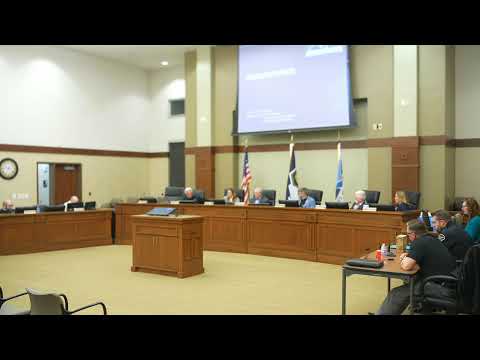
Hundreds of residents and several council members pressed Highland City Council on Tuesday for urgent action to reduce speeding and crashes on Canal Boulevard, calling for permanent physical traffic-calming measures, more enforcement and improved crossings.
Residents from neighborhoods along Canal Boulevard described repeated crashes, near-misses involving children, and regular high-speed driving at night. “There’s a concrete fence with steel barriers a hundred yards away where a car drove all the way through those, back out of those,” said Don Osler, a resident who lives near Ashby Lane, describing multiple unreported incidents. “It’s NASCAR all the time.”
The council’s traffic engineer, identified in the meeting as Chris (City Engineer), reviewed data collected during a pilot program that installed temporary speed tables and traffic counters. The data showed an average speed reduction from about 35.3 mph to about 33.0 mph while speed tables were deployed, and a drop in the share of vehicles traveling 10 mph over the limit (40+ mph) from roughly 16% to about 4.7% when the tables were in place. The 85th-percentile speeds—used by traffic engineers to measure customary driving speed—moved roughly from 39.2 mph toward the high 30s during the study period, a figure the engineer characterized as “approaching” thresholds that warrant active traffic calming.
Chris told the council the pilot program data are useful but incomplete: counters and studies focused on the central section between Alpine Highway and 6000 West and under-sampled the western segment between 6000 West and 6800 West where residents reported severe problems. He recommended additional counters and targeted site‑distance reviews on the west segment and the east segment (Alpine Highway to North County Boulevard) before selecting permanent measures. He proposed bringing the expanded data and recommendations back to the council for consideration on April 8.
Residents offered specific suggestions: permanent speed tables or raised crossings at key locations, four‑way stops at some intersections, additional illuminated crosswalks or rapid‑flashing beacons at trail crossings, camera enforcement in lower‑speed residential stretches where state law allows, and more regular police enforcement. Several residents urged restoring or replacing the temporary speed tables that had been removed for winter; others pushed for physical measures that cannot be easily bypassed.
Council members expressed a mix of urgency and caution. Several said they will support lower posted limits in specific segments if engineering and enforcement plans align, but also emphasized the need to avoid simply displacing traffic onto neighboring streets. Council members asked staff to evaluate striping and crosswalk painting that can be done quickly if weather permits, install signage marking “cross traffic does not stop” at blind intersections, and explore permanent flashing speed feedback devices. The council asked staff to provide additional speed and volume data for the western segment (6000–6800 West), run site-distance checks at blind intersections (notably near Madison), and return with modeling of how specific mitigations would affect adjacent streets.
The city engineer said the Mitchell Hollow trail crossing (west section) is scheduled for a funded crossing improvement and recommended adding rapid‑flashing beacons there. Chief of Police noted enforcement resources are spread across the city but said photo‑radar programs are allowed under state law only on roads posted at 30 mph or below and only if an officer is present when the device is operated; such programs also require an enabling ordinance.
What happens next: Council asked staff to (1) deploy additional counters and gather missing data for the stretch between 6000 West and 6800 West, (2) assess site distance at reported blind intersections and identify low‑cost pavement/striping fixes (crosswalks and “choke” striping), (3) evaluate permanent versus temporary physical calming options (speed tables sized for the posted limit, raised crossings, or four‑way stops) and their likely traffic diversion impacts, and (4) return with findings and recommended next steps at the April 8 council meeting. Staff will also explore short‑term paint/striping and signage changes that can be implemented sooner if weather and materials allow.
Why it matters: Canal Boulevard is a recently completed collector that residents say functions as a high‑volume thoroughfare through several residential neighborhoods. Community members and councilors say the combination of a collector design, road curvature, and inconsistent calming measures has produced crashes, property damage and repeated close calls involving children and pedestrians. Residents urged a mix of short‑ and long‑term solutions to prevent a serious injury or fatality.
Council members encouraged residents who want action to document recent incidents and to use the city’s traffic toolbox application for formal review requests; staff said the toolbox process remains the formal way to request mitigation and noted there is a $25 application fee for new traffic mitigation petitions.