Get Full Government Meeting Transcripts, Videos, & Alerts Forever!
Get email alerts on the Climate Resilience topic
No spam. Unsubscribe anytime.
New Rochelle releases draft climate vulnerability assessment; officials plan heat-emergency and resiliency-hub work
Summary
City consultants presented a draft Climate Vulnerability Assessment (CVA) describing rising temperatures, flooding risks and community impacts. City staff said grants were secured to develop a heat emergency plan and to design a network of ‘resiliency hubs’ and that the CVA will help target future capital and grant work.
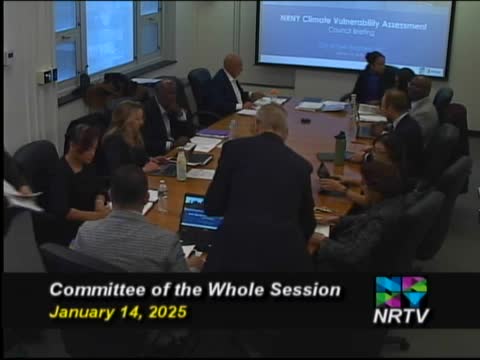
New Rochelle officials on Wednesday presented a draft Climate Vulnerability Assessment that maps rising temperatures, inland and coastal flooding risks and other climate hazards and outlines a set of recommendations — from green infrastructure and building retrofits to a network of distributed “resiliency hubs.”
The assessment was presented by Gary Sorge, vice president of Stantec Consulting Services, and reviewed by Commissioner Sarah Salgado of the Department of Development and Deputy Commissioner Seth Kaye. Sorge said the study drew on community outreach and modeling for the 2023–24 period and that about 300 residents completed the online survey used in the assessment.
The report identifies heat as a leading near-term risk. “Heat is the number 1 killer as a result of climate change,” Sorge said, citing survey results showing “76% of respondents are unable to enjoy the outdoors because of prolonged periods of heat.” The draft also reports that roughly 20% of respondents say they cannot afford utility bills in winter and that respondents reported widespread power loss and flooding during storms.
Why it matters: the CVA is intended as a planning tool to prioritize capital investment and to strengthen grant applications. Commissioner Salgado told the council the city has already secured state funding through the New York State Department of Environmental Conservation’s Climate Smart Communities program to develop a heat emergency plan and a separate grant to design and inventory potential resiliency-hub sites. Salgado said the city also plans a policy review to align the CVA with the Green New Rochelle comprehensive planning efforts.
Key findings and recommendations
- Exposure and equity: The assessment highlights that vulnerable populations tend to live in areas with higher hazard risk, including places with high impervious cover and lower tree canopy. The draft maps show heat “hot spots” concentrated in the downtown and other dense areas. The study recommends targeting outreach, cooling resources and hub sites where residents have less access to private cooling.
- Infrastructure stress and stormwater: The consultants flagged aging drainage and stormwater infrastructure and noted an ongoing City program (described in the presentation) with an estimated $350,000,000 construction program to improve hydraulics across the city’s six watersheds.
- Resiliency hubs: The CVA endorses a network of distributed resiliency hubs — trusted community facilities that could provide cooling, communication and basic services during outages or extreme events. The report recommends site inventories, upgrades (generators, communications, energy resilience), and operational agreements with nonprofit and institutional partners, including schools and community organizations. Salgado said many potential hub sites are not city-owned and will require partnership agreements.
Next steps and funding
City staff outlined a near-term work program: issue an RFP for a heat-emergency plan; inventory candidate resiliency-hub sites and scope capital improvements; and continue policy reviews to fold CVA findings into the city’s comprehensive planning. Salgado also referenced a recently adopted “direct pay” resolution the city intends to use in partnership with nonprofit and municipal partners to access federal tax-credit mechanisms that could fund capital improvements.
Council reaction
Council members broadly welcomed the CVA and emphasized implementation. Council member Sarah Kaye said the city’s preplanning positions New Rochelle well to compete for federal and state funding. Multiple councilors pressed for near-term operational actions — expanding cooling center hours, ensuring backup power for hub locations, and communicating locations and access to residents before summer heat events. Council members also asked that maps and data be provided electronically for council and public review.
What the report does not do
The CVA is an assessment, not an operational emergency response plan. Consultants and staff said tactical emergency-response planning — including evacuation routing, fire-suppression water availability and coordination with first responders — will be part of follow-up work rather than the CVA itself.
Ending note
Staff said the CVA will be used to strengthen grant applications and to guide capital planning and policy work in 2025. The city plans to return to council with a timeline for the heat-emergency plan and with a resiliency-hub inventory later this year.