Get Full Government Meeting Transcripts, Videos, & Alerts Forever!
Get email alerts on the Utilities topic
No spam. Unsubscribe anytime.
Board grants two utility waivers, orders water connection and temporary septic rule for plaza renovation
Summary
The board granted a waiver allowing a homeowner to remain on a private well (while noting distances and costs), and addressed a separate commercial-plaza permit dispute by ordering immediate connection to county water, allowing continued use of existing septic until failure or until sewer is available within the code connection distance.
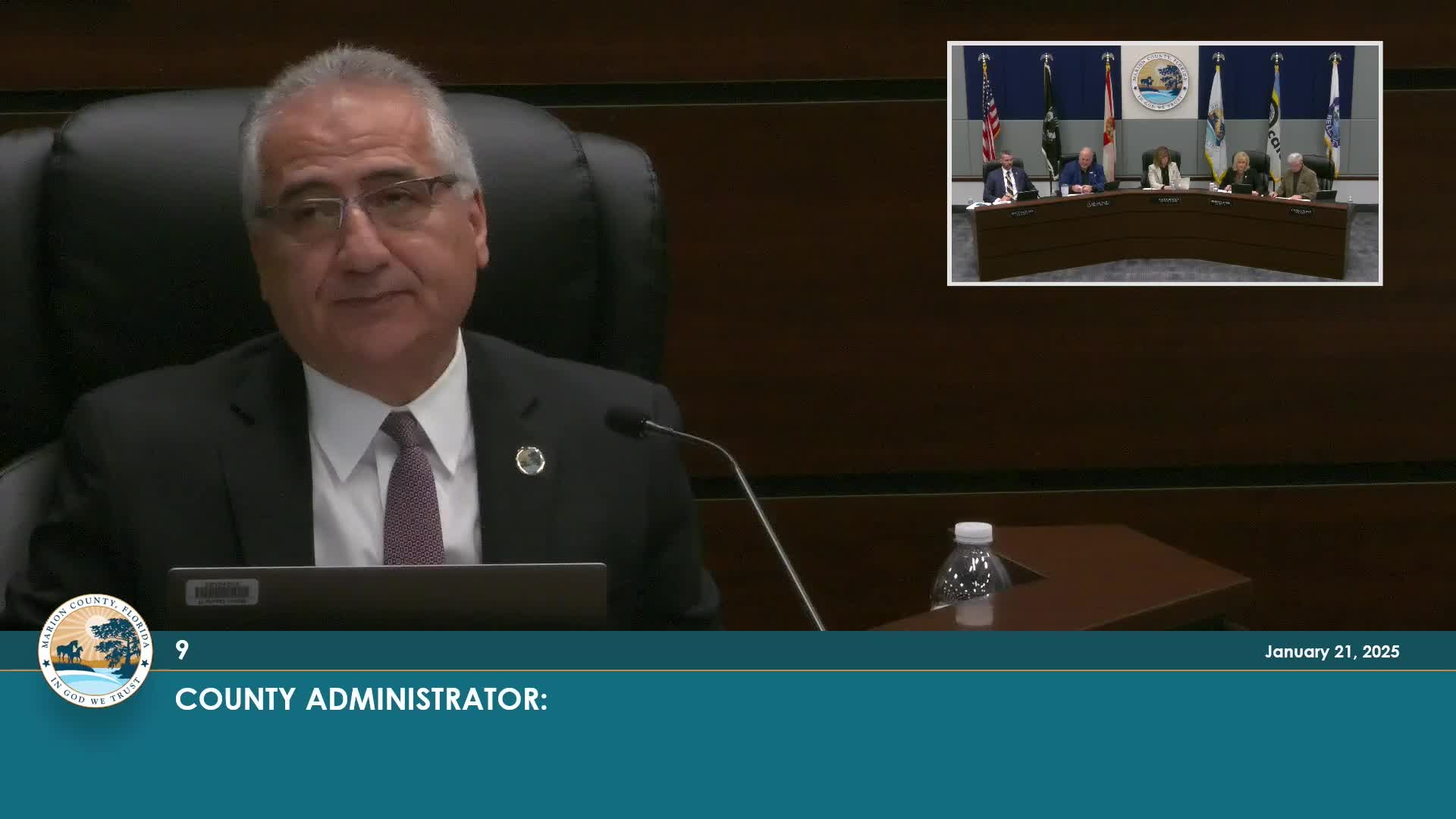
Marion County commissioners on Jan. 21 considered multiple appeals of Development Review Committee (DRC) denials and approved one waiver while imposing a staged connection requirement in another case.
Waiver for single-family lot (9.1): Marco Enderica asked the board for a waiver from the county requirement to connect to the centralized water system. Utilities staff said the county water main sits about 150 feet from the edge of his property and that a required extension would be roughly 270 feet. Enderica told the board running the extension would cost roughly $30,000 and that he prefers a private well on medical and financial grounds. After brief questioning about benefiting lots and alternative connections, Commissioner James McLean moved to grant the waiver (to overturn the DRC denial); Commissioner Stone seconded and the board voted unanimously to grant the waiver.
Plaza renovation: water & sewer (9.2 & 9.3): The board then considered a more complex case for a commercial plaza (building permit no. 202-404-3856) represented by Jimmy Gooding and engineer Jose Lopez. Staff presented cost estimates from Kimley-Horn indicating a sewer extension under U.S. 441 would cost about $109,000, water about $17,000, and design/permitting $28,000 — roughly $154,000 in total. Gooding argued the property’s change of occupancy had been previously handled in 2023 without a mandatory connection and said the new permit triggered a costly reanalysis. Staff said a modest increase in equivalent residential connections (ERCs) or flow brought the property within connection distance under current code.
After discussion about statutory and policy fairness and possible middle-ground remedies, the board adopted a compromise motion (moved by Commissioner McLean, seconded by Commissioner Alec Zalick): - The applicant must connect to county water immediately. - The applicant may remain on the existing septic system for wastewater until the septic system fails or must be replaced; upon failure or when county sewer becomes available on the applicant’s side of the road (within the code’s ERC-based connection distance), the property must connect to sewer. The motion passed unanimously.
Why it matters: Commissioners and staff recognized the financial burden of full sewer extensions across major highways but said the county’s land‑development code requires connection when flows or ERCs rise and when mains are within the code’s connection distance. Commissioners also urged staff to review code language and historic practice to improve clarity on when commercial renovations trigger mandatory connection.
Costs and context (from record): For the single‑family private‑well waiver the board noted the on‑site well option avoids an immediate $30,000 connection for the homeowner; for the plaza Kimley‑Horn estimates the sewer crossing would be the largest expense (~$109,000), with water and design raising the total to ~ $154,000. Staff recommended, and the board accepted, an approach that requires water connection now and delays sewer connection until failure or until sewer availability meets the county’s connection-distance rules.
Ending: The board voted unanimously on both matters and asked staff to provide clearer code guidance about when upgrades to existing commercial properties should trigger mandatory utility connections.