Get Full Government Meeting Transcripts, Videos, & Alerts Forever!
Get email alerts on the Housing—Taxonomy topic
No spam. Unsubscribe anytime.
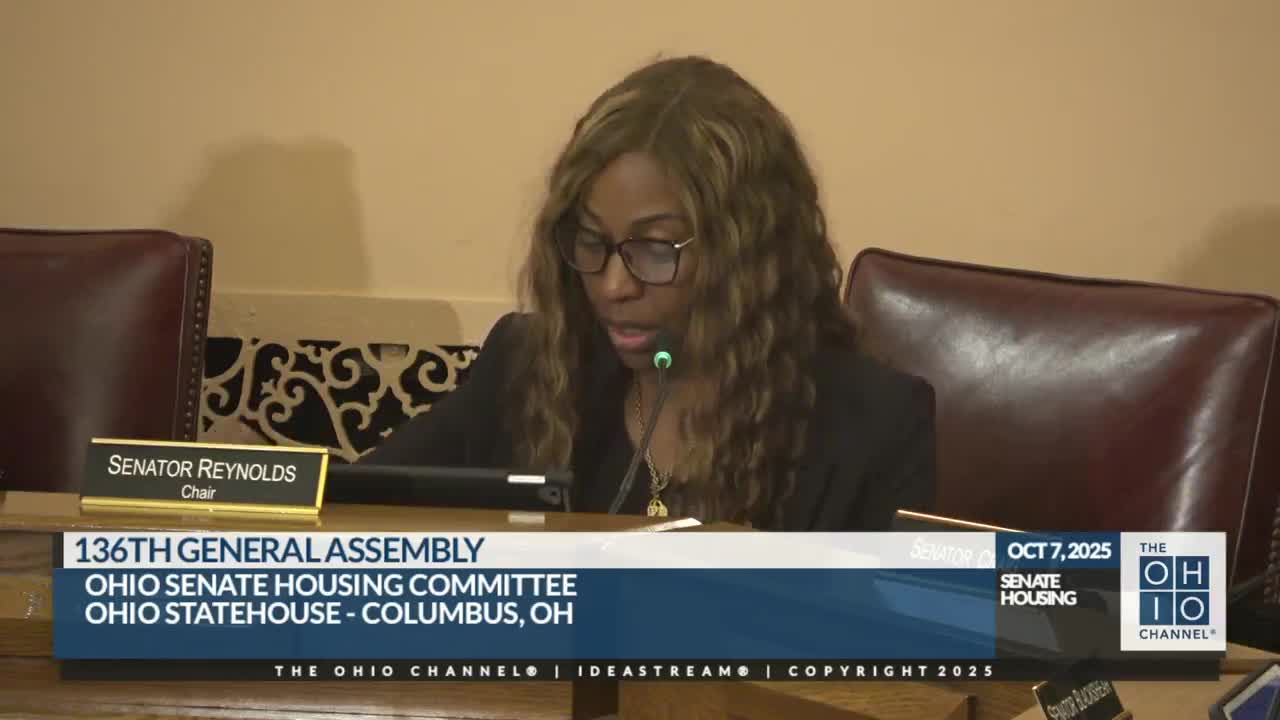
Senate committee holds first hearing on 'Promised Land Act,' a 10% tax credit to spur nonprofit housing
Summary
The Ohio Senate Housing Committee held a first formal hearing on Senate Bill 250, the Promised Land Act, which would create a 10% transferable state tax credit to support affordable housing developed by nonprofit and faith-based landowners, committee members and witnesses said during the hearing.
The Ohio Senate Housing Committee held a first formal hearing on Senate Bill 250, the Promised Land Act, which would create a 10% transferable state tax credit to support affordable housing developed by nonprofit and faith-based landowners, committee members and witnesses said during the hearing.
Neill Jurist, chief communications and government affairs officer for Community Shelter Board, testified that the credit would help nonprofits convert underused land held by churches and community organizations into deeply affordable, owner-occupied housing. “Senate Bill 250 bridges this divide by creating a 10% transferable state tax credit for eligible housing projects developed by nonprofits,” Jurist said.
The bill would limit the tax credit to single-family homeownership projects as written; witnesses said removing that restriction to allow multifamily rental projects could increase the bill’s impact in some local markets. “Currently, the bill would limit the promised land tax credit to single family home ownership development projects. We believe it would be even more impactful to remove that restriction and permit multifamily rental housing developments to qualify for the tax credits,” Gina Wilt, representative of Cohio, told the committee.
Why it matters: Advocates said the Promised Land Act targets two persistent barriers to creating affordable housing: limited financing options for mission-driven organizations, and underused land held by churches and nonprofits. Neill Jurist said Community Shelter Board (CSB), which administers about $55,000,000 annually in Franklin County to fund prevention, shelter and housing programs, views the bill as a complement to federal programs such as the Low-Income Housing Tax Credit (LIHTC) and local city and county efforts.
Key details and testimony highlights
- Credit size and structure: Witnesses described the proposal as a 10% state tax credit that would be transferable (sellable to private investors) to generate liquidity for development. Jurist described features intended to preserve affordability and ownership: occupancy requirements, ground leases, and deed restrictions.
- Target beneficiaries: Jurist said the bill aims to expand homeownership opportunities for low-income Ohioans, citing households earning less than $32,700 annually (about 30% of area median income) as a group shut out of homeownership.
- Market scope and limits: Cohio’s Gina Wilt backed the bill’s intent to unlock church land but urged the committee to allow multifamily rental projects to qualify, noting that some communities require rental stock rather than single-family ownership.
- Supporting data: Wilt cited the Ohio Office of Fiscal Analysis (OFA) fiscal year 2026 housing needs assessment in written oral testimony, saying, “More than 1,200,000 Ohioans now live in a household spending at least half of its income on housing,” and that the assessment found roughly 496,000 Ohioans are severely mortgage-burdened and more than 761,000 are severely rent-burdened.
- Relationship to existing funding: Jurist positioned the Promised Land Act as filling financing gaps and leveraging private-sector partners while preserving nonprofit mission control over land use and affordability protections.
Committee action and next steps
The hearing on Senate Bill 250 served as the committee’s first formal hearing on the measure; committee members heard proponent testimony from two in-person witnesses and were informed of written proponent testimony submitted by Tori Hollingsworth of the Ohio CDC Association and Nico Morgione of the Youngstown-Warren Regional Chamber. No committee vote or formal action on the bill occurred at the hearing; the committee adjourned following testimony.
Witnesses and attributions in this article come from on-the-record testimony to the Ohio Senate Housing Committee during the hearing.