Get Full Government Meeting Transcripts, Videos, & Alerts Forever!
Get email alerts on the Funeral Services Alkaline Hydrolysis topic
No spam. Unsubscribe anytime.
Committee unanimously recommends allowing alkaline hydrolysis at funeral homes; amendment added to include pets
Summary
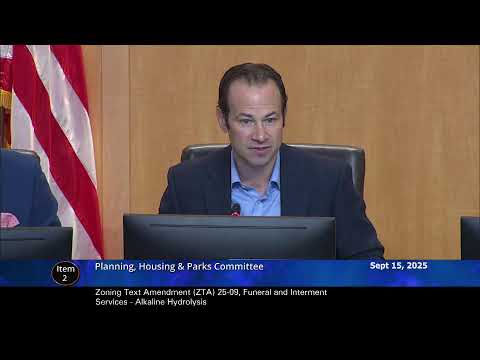
The Planning, Housing and Parks Committee unanimously recommended ZTA 25‑09 on Sept. 15 to allow alkaline hydrolysis (water cremation/aquamation) as an accessory use at funeral homes; an amendment to include pets was adopted.
The Planning, Housing and Parks Committee unanimously recommended Zoning Text Amendment 25‑09 to permit alkaline hydrolysis (water cremation, also called aquamation) as an accessory use at funeral homes. The committee vote (3‑0) sends a committee recommendation to full Council.
Committee members and staff described the change as a narrow land‑use allowance: the ZTA adds definitions for “alkaline hydrolysis” and “crematory,” allows alkaline hydrolysis as an option for crematory operations, and permits it as an accessory use to funeral homes so standalone water‑cremation facilities would not be created by the zoning change. Planning staff said licensing and performance standards would be set by state regulators under the Green Death Care Options Act and that internal building permits (plumbing, electrical) would be handled by the Department of Permitting Services (DPS).
Ms. Nadeau said all public testimony at the June 17 hearing supported the ZTA, and noted a letter from the Funeral Consumers Alliance of Maryland and Environs that described the method as cost‑effective. Planning’s climate assessment found slight positive impacts on greenhouse gas emissions and reduced land consumption compared with traditional cremation. The Office of Cemetery Oversight and the State Board of Morticians and Funeral Directors are expected to issue implementing regulations under the 2024 Green Death Care Options Act; staff checked the status and reported the state regulations were not yet posted as of the committee meeting.
Ms. Nadeau summarized how the process works: the deceased is placed in a pressurized vessel with water and an alkaline solution; the process takes about 3 to 12 hours depending on equipment and body size; chemical byproducts are treated and discharged under WSSC permitting; and remaining bone fragments are processed in a “cremulator” to produce remains similar to ashes from a traditional cremation. The ZTA uses state definitions and expressly makes alkaline hydrolysis an accessory use for an existing funeral home so that the land‑use impacts would be incidental to normal funeral operations.
Committee members asked about timing and regulatory oversight. Vice President Joanna and others asked whether state regulations or WSSC discharge permits could require follow‑up zoning changes; staff and the Executive’s representatives said the ZTA was drafted narrowly to avoid conflict with likely state rules. Earl Stoddard and Mr. Cart Hartman said the Executive Branch views the item as appropriate and recommended the committee proceed with clear operational information for the public.
An amendment introduced at the committee broadened the ZTA’s language by changing references to “human bodies” and “human remains” to broader terms such as “remains” and “decedents,” explicitly allowing animals (pet remains) to be processed. The committee approved that amendment without objection. The committee then voted 3‑0 in favor of the ZTA as amended and forwarded a unanimous committee recommendation to the full Council.
Key details: the ZTA does not change state licensing authority (state agencies will license water‑cremation facilities), WSSC must permit any discharge from the process, and internal building permits would be reviewed by DPS. Planning staff noted that Baltimore County already has at least one operating alkaline hydrolysis facility, and staff recommended continuing to monitor forthcoming state regulations and to post them in full‑council materials when available.